Final Year Project Ideas for Software Engineering Students (2026 Guide)
Explore practical software engineering project ideas with suggested features, technologies, scope and testing guidance, plus steps to prepare for your defence.

Choosing a final year project topic can be challenging, especially when you have to consider your programming skills, available resources, supervisor's expectations and the time left before submission.
Should you build an AI system, mobile application, management system or something involving cybersecurity?
The best choice is not necessarily the most complicated project. It is one that solves a clear problem, demonstrates software engineering principles and gives you enough opportunities to explain your design, implementation and testing.
In this guide, you'll discover 21 practical final year project ideas for software engineering students in 2026, including suggested features, technologies, project scope and ways to evaluate your work.
These ideas are relevant to university and polytechnic students in Nigeria, Ghana, Kenya and other African countries.
Quick Summary: What Makes a Good Software Engineering Project?
A strong software engineering final year project should demonstrate how you:
- Identify a real or realistic problem.
- Gather and document system requirements.
- Design the system architecture and database.
- Implement a working solution.
- Test the system against its requirements.
- Explain its limitations and possible improvements.
- Document the development process clearly.
You don't need to build the biggest application or use the latest technology.
For example, a properly designed Student Clearance Management System with working authentication, approval workflows and meaningful tests can be a more suitable academic project than a complex AI application you cannot adequately evaluate.
💡 Quick Tip: Before choosing a topic, ask yourself: Can I build, run, test and explain this project before my deadline? If the answer is uncertain, consider reducing the scope.
Always discuss your proposed topic with your supervisor. Approval and assessment depend on your department's requirements.
What Makes a Good Software Engineering Final Year Project?
Software engineering is more than writing code or designing attractive interfaces.
A good project should demonstrate an understanding of the Software Development Life Cycle (SDLC), including requirements analysis, system design, implementation, testing and maintenance considerations.
Your project should answer six important questions:
- What problem are you solving? Identify the users and explain their difficulties.
- What should the system do? Define functional and non-functional requirements.
- How will the system work? Explain the architecture, components, database and major workflows.
- How did you implement it? Describe the technologies and development decisions.
- Does it work correctly? Present meaningful tests and observed results.
- What are its limitations? Explain what remains incomplete or requires further investigation.
Depending on the project, you may use UML diagrams, use-case diagrams, entity-relationship diagrams, flowcharts or other appropriate design techniques.
You should also consider usability, security, maintainability and performance where relevant.
For example, claiming that an application is secure simply because it has a login page is insufficient. You should be able to explain and test the permissions and protections you implemented.
21 Software Engineering Final Year Project Ideas for 2026
The following ideas are grouped into six categories. The suggested scope is a starting point, not a fixed departmental requirement.
AI and Intelligent Systems Project Ideas
Artificial intelligence projects are useful when there is a clearly defined problem, suitable data and a credible method of evaluating the system.
1. Student Academic Performance Prediction System
Project idea: Design and implement a system that uses historical academic data to predict a defined student performance outcome.
The application could help academic advisers identify students who may benefit from additional support.
Suggested features:
- Student academic data import.
- Data preparation and validation.
- Machine learning model training.
- Performance prediction.
- Prediction results dashboard.
- Model evaluation reports.
Suggested technologies: Python, Scikit-learn, Pandas, Flask and SQLite.
How to evaluate: Compare predictions against a simple baseline using data that was not used for training. Report appropriate evaluation metrics and model limitations.
Scope advice: Use appropriately authorised or public data. Avoid presenting predictions as reliable grounds for consequential academic decisions.
2. Intelligent Course Recommendation System
Project idea: Develop a system that recommends suitable courses or electives based on students' interests, prerequisites and academic programme requirements.
Suggested features:
- Student profile management.
- Course catalogue.
- Prerequisite checking.
- Recommendation engine.
- Explanations for recommended courses.
Suggested technologies: Python, Flask, SQLite or MySQL.
How to evaluate: Test whether recommended courses satisfy prerequisite rules and whether the explanations match the recommendation logic.
Scope advice: A rule-based recommendation system may be sufficient. Machine learning is not compulsory unless you have relevant data and a clear reason to use it.
3. AI-Based Resume Screening Prototype
Project idea: Build a prototype that compares submitted CVs against specified job requirements.
Suggested features:
- CV upload and text extraction.
- Job description input.
- Skills identification.
- Requirements matching.
- Explanation of matching results.
Suggested technologies: Python, Flask, natural language processing libraries and SQLite.
How to evaluate: Compare extracted skills and matching outcomes against manually checked examples.
Scope advice: Use fictional or appropriately authorised CVs. Treat the application as a research prototype and discuss possible errors and bias rather than using it to make real hiring decisions.
4. Departmental Information Chatbot
Project idea: Create a chatbot that answers common student questions using a defined collection of departmental information.
For example, it could answer questions about registration procedures, course requirements and departmental guidelines.
Suggested features:
- Question-and-answer interface.
- Approved departmental knowledge base.
- Source references.
- Responses for unsupported questions.
- Frequently asked questions management.
Suggested technologies: Python, Flask, a search or retrieval system, and SQLite.
How to evaluate: Prepare a question set and check response correctness, supporting sources and how the chatbot handles unknown questions.
Scope advice: Start with one department and a small set of verified documents. Explain whether internet access or external AI services are required.
Web and Mobile Application Project Ideas
Web and mobile applications are popular software engineering projects because they allow students to demonstrate database design, authentication, business logic and user interaction.
5. Online Final Year Project Management System
Project idea: Develop a web application that helps students and supervisors manage final year projects.
Suggested features:
- Student and supervisor accounts.
- Project topic submission.
- Supervisor assignment.
- Feedback and revision tracking.
- Project progress dashboard.
- Submission history.
Suggested technologies: PHP, Laravel, MySQL or JavaScript-based web frameworks.
How to evaluate: Test role permissions, topic submission workflows, revision history and feedback tracking.
Scope advice: Begin with project submissions and supervisor feedback. Advanced plagiarism detection can be treated as a separate feature or future integration.
6. E-Learning Management System With Progress Tracking
Project idea: Build an online learning platform for students and lecturers.
Suggested features:
- Student registration.
- Course enrolment.
- Learning material uploads.
- Online quizzes.
- Assignment submission.
- Student progress reports.
Suggested technologies: PHP, MySQL, JavaScript or a suitable web framework.
How to evaluate: Verify access restrictions, quiz score calculations, submission records and course completion tracking.
Scope advice: Limit the initial system to a few courses. Extensive video streaming and advanced learning analytics can be future extensions.
7. QR-Based Student Attendance Management System
Project idea: Design a system that records attendance using QR codes generated for authorised class sessions.
Suggested features:
- Student registration.
- Course management.
- QR code generation.
- Attendance recording.
- Duplicate submission prevention.
- Attendance reports.
Suggested technologies: Python, Flask, PHP, MySQL and a QR code library.
How to evaluate: Test expired codes, repeated submissions, invalid enrolment and attendance report accuracy.
Scope advice: Explain that scanning a QR code does not necessarily prove that a student stayed in the classroom for the entire session.
8. Multi-Vendor E-Commerce Platform
Project idea: Develop a marketplace where multiple sellers can list products and buyers can place orders.
Suggested features:
- Buyer and seller accounts.
- Product listings.
- Product search.
- Shopping cart.
- Order management.
- Seller dashboard.
Suggested technologies: PHP, MySQL, Laravel or React with Node.js.
How to evaluate: Verify that sellers cannot modify other sellers' products or orders. Test stock updates, cancellations and order status changes.
Scope advice: Use simulated payments or an appropriate payment provider test environment. A single-vendor system may be more manageable if your deadline is short.
Enterprise and Automation Project Ideas
These projects focus on improving administrative processes and managing organisational information.
They are useful for demonstrating workflows, database relationships, reporting and access control.
9. Clinic Appointment Management System
Project idea: Develop a system that manages appointments between patients and healthcare practitioners.
Suggested features:
- Patient registration.
- Practitioner profiles.
- Appointment scheduling.
- Cancellation and rescheduling.
- Appointment history.
- Administrative dashboard.
Suggested technologies: PHP, MySQL, Python or Flask.
How to evaluate: Test conflicting appointments, invalid dates, appointment cancellation and user access permissions.
Scope advice: Focus on appointments rather than implementing an entire hospital management system. Use fictional patient data for demonstrations.
10. Payroll and Staff Management System
Project idea: Design an application that manages employee records and calculates salaries using defined payroll rules.
Suggested features:
- Employee registration.
- Salary components.
- Configurable deductions.
- Payroll processing.
- Payslip generation.
- Monthly payroll reports.
Suggested technologies: PHP, MySQL, Python or SQLite.
How to evaluate: Compare calculations against manually verified examples and test whether duplicate payroll processing is prevented.
Scope advice: Clearly state the payroll rules implemented. Do not claim compliance with current tax or employment regulations without verifying the applicable requirements.
11. Inventory Management System With Demand Forecasting
Project idea: Develop an inventory system that records stock movements and optionally estimates future product demand.
Suggested features:
- Product management.
- Purchases and sales recording.
- Stock adjustment.
- Low-stock notifications.
- Inventory reports.
- Optional demand forecasting.
Suggested technologies: Python, Flask, MySQL, Pandas or Scikit-learn.
How to evaluate: Check stock balances against known transactions and test whether invalid stock movements are handled correctly.
For the forecasting feature, compare predictions against a simple baseline using historical data kept separate from model training.
Scope advice: Make inventory management the core project. Forecasting can be an additional module.
12. Automated Examination Result Processing System
Project idea: Build a system that calculates, stores and reports students' examination results according to a defined grading scheme.
Suggested features:
- Student management.
- Course registration.
- Score entry.
- Automatic grade calculation.
- Result approval.
- Printable result reports.
Suggested technologies: PHP, MySQL, Python or Flask.
How to evaluate: Test grade boundaries, missing scores, duplicate results and permissions for modifying approved results.
Scope advice: Document the grading scheme used and confirm that it matches your institution's requirements.
Cybersecurity and Verification Project Ideas
Cybersecurity projects should demonstrate a specific security property in a controlled and authorised environment.
13. Secure File Storage System With Encryption
Project idea: Develop an application that stores files in encrypted form and restricts access to authorised users.
Suggested features:
- User authentication.
- File uploads.
- File encryption.
- Authorised downloads.
- File management.
- Activity history.
Suggested technologies: Python, Flask, SQLite and established cryptography libraries.
How to evaluate: Test file access permissions, file recovery, invalid files and altered file handling.
Scope advice: Explain how encryption keys are managed. Encryption alone does not guarantee that the complete application is secure.
14. Blockchain-Based Certificate Verification System
Project idea: Explore the use of blockchain or a distributed ledger to verify academic certificate records.
Suggested features:
- Authorised certificate issuer accounts.
- Certificate registration.
- Certificate identifiers or document fingerprints.
- Certificate verification.
- Certificate revocation records.
Suggested technologies: A suitable blockchain development framework, JavaScript and a supporting database.
How to evaluate: Test modified documents, unknown issuers and revoked certificates.
Scope advice: Compare the blockchain approach with a conventional database. Explain what additional value the distributed ledger provides and what it cannot verify.
15. Multi-Factor Authentication System
Project idea: Build an application that requires more than one authentication factor before granting access.
Suggested features:
- Account registration.
- Password authentication.
- Second-factor verification.
- Authentication recovery.
- Login activity records.
Suggested technologies: Python, Flask, PHP or a suitable authentication library.
How to evaluate: Test invalid or expired verification codes, repeated use of codes and recovery procedures.
Scope advice: Focus on one second-factor method. Biometric systems introduce additional hardware and data protection requirements.
Internet of Things and Smart Systems Project Ideas
These topics combine software development with sensors, measurement devices or other hardware components.
A simulated prototype can be useful, but your report should distinguish simulated behaviour from real hardware testing.
16. Smart Energy Monitoring System
Project idea: Create a dashboard that records and displays electricity consumption information from a suitable measurement setup.
Suggested features:
- Measurement collection.
- Timestamped readings.
- Usage charts.
- Consumption summaries.
- Threshold notifications.
Suggested technologies: Python, Flask, SQLite and suitable measurement hardware.
How to evaluate: Compare readings with a reference measurement and document accuracy limitations.
Scope advice: Agree on a safe hardware approach with your supervisor before purchasing or integrating electrical components.
17. Smart Parking Management System
Project idea: Develop a system that displays available and occupied parking spaces.
Suggested features:
- Parking space management.
- Occupancy monitoring.
- Availability dashboard.
- Occupancy history.
- Administrative reports.
Suggested technologies: Python, Flask, SQLite and appropriate sensors or a simulator.
How to evaluate: Test occupancy changes, delayed updates and inaccurate readings.
Scope advice: Begin with a small number of parking spaces. Payment systems, reservations and number plate recognition can be treated as future extensions.
18. IoT-Based Environmental Monitoring System
Project idea: Develop a system that collects and displays environmental measurements such as temperature or humidity.
Suggested features:
- Sensor readings.
- Data storage.
- Live or periodically updated dashboard.
- Historical charts.
- Threshold alerts.
Suggested technologies: Python, Flask, SQLite and suitable environmental sensors.
How to evaluate: Investigate measurement accuracy, missing readings and device disconnections.
Scope advice: Clearly distinguish between live readings, manually imported data and simulated measurements.
Beginner-Friendly Software Engineering Project Ideas
If you're working with a limited budget or a short timeline, a smaller system with clear requirements may be more practical.
These three ideas focus on workflows that can be implemented and tested without requiring AI models or specialised hardware.
19. Student Clearance Management System
Project idea: Design and implement a web application that manages student clearance requests across different administrative units.
Suggested features:
- Student registration.
- Clearance application.
- Departmental approval workflow.
- Clearance status tracking.
- Administrative dashboard.
- Clearance slip generation.
Suggested technologies: PHP, MySQL, Python or Flask.
How to evaluate: Verify that staff can process only the requests assigned to their unit and that clearance slips cannot be generated until the required approvals are complete.
Scope advice: Start with a few designated units, such as the library and department office.
20. Car Wash Management System
Project idea: Develop an application that helps a car wash business manage customers, bookings and daily activities.
Suggested features:
- Customer registration.
- Service catalogue.
- Booking management.
- Job status tracking.
- Payment records.
- Daily sales reports.
Suggested technologies: PHP, MySQL, Python or Flask.
How to evaluate: Test booking validation, job status changes and the accuracy of recorded transaction totals.
Scope advice: Begin with booking and service tracking before adding more advanced features.
21. Examination Malpractice Incident Reporting System
Project idea: Build a system for documenting and reviewing reported examination incidents.
Suggested features:
- Incident reporting.
- Authorised staff accounts.
- Review and decision workflow.
- Status tracking.
- Audit history.
- Administrative reports.
Suggested technologies: PHP, MySQL, Python or Flask.
How to evaluate: Test access permissions, required incident information and whether review decisions are recorded accurately.
Scope advice: Use fictional incident records for demonstrations and ensure the system does not automatically treat an unreviewed allegation as a confirmed finding.
Which Software Engineering Project Should You Choose?
Different projects require different levels of programming experience, available data, hardware and testing.
The following table provides a general comparison. Actual difficulty depends on your project's scope.
| Project idea | Estimated difficulty | Main focus |
|---|---|---|
| Car Wash Management System | Beginner | Booking and records |
| Student Clearance System | Beginner to Intermediate | Workflows and permissions |
| QR Attendance System | Intermediate | Validation and reporting |
| Inventory Management System | Intermediate | Database and transactions |
| Course Recommendation System | Intermediate | Recommendation rules |
| E-Learning Management System | Intermediate | User roles and progress |
| Academic Performance Prediction | Intermediate to Advanced | Machine learning evaluation |
| Smart Energy Monitoring | Intermediate to Advanced | Hardware and data collection |
If you're still learning web development, consider a project involving a small database and clearly defined user roles.
If you have experience with Python and data analysis, a prediction or recommendation system may be suitable.
If you enjoy hardware and software integration, an environmental or energy monitoring system may be worth exploring.
The most suitable project is one you can complete and evaluate within your available resources.
For more ideas, browse 227+ Software Engineering Final Year Project Topics in Nigeria.
How to Choose the Right Final Year Project Topic
Before submitting a topic for approval, consider the following factors.
1. Choose a Problem You Understand
Start by identifying a problem affecting students, lecturers, businesses or other potential users.
For example, if students complete clearance forms manually, investigate how a digital workflow could reduce unnecessary repetition and make application status easier to track.
2. Consider Your Programming Skills
Choose a project that builds on what you already understand while allowing you to learn manageable new concepts.
A student familiar with PHP and MySQL may find a database-backed management system more practical than a machine learning project requiring extensive data preparation.
3. Check Data and Resource Availability
Some projects require historical data, sensors, hardware, external APIs or paid services.
Confirm access to these resources before committing.
4. Define a Manageable Scope
You do not need every feature in the first version.
For example, an Online Examination System could begin with student authentication, question management, exam sessions and automatic scoring.
Advanced monitoring and analytics could be considered later.
5. Plan How You Will Test the System
Before implementation, identify how you'll demonstrate that important requirements work.
For example, in an Inventory Management System, you should be able to test stock additions, sales, adjustments and report calculations.
6. Discuss the Topic With Your Supervisor
Your supervisor may recommend changes to the title, methodology, scope or evaluation approach.
For more guidance, read How to Choose a Computer Science Project Topic in Nigeria.
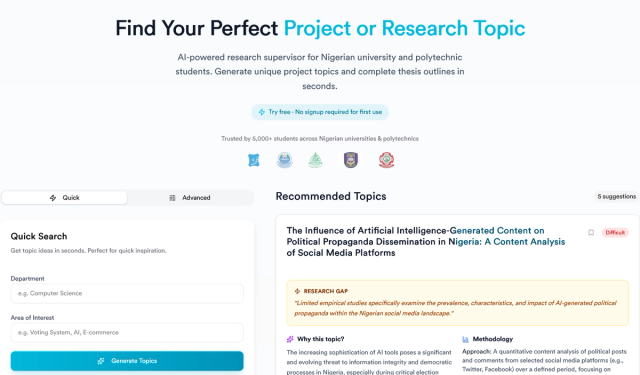
You can also use the MonoEd Project Topic Generator to explore additional ideas before discussing them with your supervisor.
Turn Your Approved Topic Into a Development Plan
Once your project topic is accepted, avoid jumping straight into coding.
Start by outlining the problem, users, requirements and technical decisions.
Your development plan should cover:
- Users and permissions: Who will use the application and what can each user do?
- Functional requirements: What activities must the system support?
- System workflows: What steps will users follow to complete important tasks?
- Database design: Which tables or collections and relationships are required?
- System architecture: How will the interface, application logic and data storage communicate?
- Testing: How will you check each important requirement?
- Project limitations: What features or conditions are excluded?
Use version control to record changes, and maintain a list of implementation decisions, tests and known issues.
If your report states that you used Agile, Waterfall or another development approach, explain how that approach was actually applied.
Simply naming a methodology is not enough.
Best Programming Languages and Technologies for Software Engineering Projects
You don't need to use every popular framework in your final year project.
Choose technologies that suit your system and that you can install, maintain and explain.
| Technology | Suitable project types |
|---|---|
| Python + Flask + SQLite | Small management systems, dashboards and Python-based applications |
| PHP + MySQL | Clearance, attendance, inventory and booking systems |
| React + Node.js | Interactive web applications with separate frontend and backend components |
| Java + Spring Boot | Structured backend and enterprise applications |
| Flutter | Mobile applications |
| Scikit-learn | Machine learning prototypes |
| Git + GitHub | Version control and project history |
For a typical database-backed project, Python with Flask or PHP with MySQL may provide a manageable starting point.
Before choosing a stack, check your department's technology requirements and consider whether the project must run without internet access.
Avoid introducing unnecessary tools, frameworks or external services that make installation and evaluation more difficult.
Need Help Building Your Final Year Project System?
Have an approved Software Engineering or Computer Science project topic but need help turning it into a working application?
MonoEd Project Source Code helps students explore software builds based on their project topics.
Instead of searching through unrelated source code downloads, you can enter your topic and review a proposed system plan before deciding whether to proceed.
How it works
- Enter your project topic: Provide your topic, department and institution.
- Review the proposed plan: See the intended features and scope before payment.
- Proceed with the build: The platform supports selected Python and PHP software projects.
- Study the generated materials: Use the source code and supporting documentation to understand, run and evaluate the application.
The project package includes:
- Source code.
- Setup instructions.
- A guide explaining the system.
- Screenshots.
- Project-specific defence questions.
The platform is particularly relevant to database-backed software projects such as management, booking, attendance and administrative systems.
Important: Not every idea in this article is suitable for automatic software generation. Hardware-based IoT projects, specialised cybersecurity systems and some advanced AI applications may need additional development or tools.
Follow your institution's rules on external assistance and AI use. Review the generated work, test the application and ensure you understand the implementation you present.
Take a look at MonoEd Project Source Code
How to Write Your Software Engineering Final Year Project Report
Your report should describe the system you actually designed, implemented and evaluated.
Although chapter arrangements vary by institution, many software engineering reports include the following sections.
Chapter One: Introduction
Explain the background, problem statement, aim, objectives, significance and scope of the project.
Chapter Two: Literature Review
Review related studies, existing systems and relevant technologies.
Identify the problem your proposed system addresses and explain its relationship to previous work.
Chapter Three: System Analysis, Design and Methodology
Describe the development approach, requirements, architecture, database design, diagrams and major system processes.
Your design should correspond to the application you intend to build.
Read How to Write Chapter Three: Methodology.
Chapter Four: Implementation, Results and Testing
Explain the implementation and present evidence of the system's behaviour.
Depending on your project, this may include screenshots, test cases, evaluation metrics, observed results and known limitations.
Chapter Five: Conclusion and Recommendations
Summarise what was achieved, relate the outcomes to your objectives and explain the limitations and possible future improvements.
Need Help With Your Report?
The MonoEd FYP Report Generator can help you organise and draft your project chapters.
Ensure the report accurately describes your own requirements, development process, implementation, tests and findings.
Do not include fictional tests, unsupported results or descriptions of features that do not exist in your application.
Common Software Engineering Final Year Project Defence Questions
Preparing for your defence involves more than memorising definitions.
You should understand the decisions behind your project and be ready to demonstrate the system.
1. Why did you choose this project?
Explain the specific problem, the intended users and why the proposed solution was worth investigating.
2. What software development methodology did you use?
Describe the development process you followed, including requirements gathering, system design, implementation, testing and revisions.
3. Why did you choose your programming language and database?
Connect your choices to project requirements, your available resources and relevant trade-offs.
4. How does your system work?
Explain the major components and demonstrate a complete workflow from user input to the expected result.
5. How did you test your application?
Present test cases and explain what the observed outcomes show about your system's requirements.
6. How does your system prevent unauthorised access?
Explain the authentication and permission mechanisms implemented and demonstrate a relevant test.
7. How is your project different from existing systems?
Identify its specific use case, workflow, design decisions or evaluated contribution.
Avoid claiming that no similar software exists without supporting evidence.
8. What are the limitations of your project?
Discuss features, conditions or requirements that remain incomplete or unverified.
9. What improvements would you recommend?
Suggest realistic extensions based on the limitations identified during implementation and evaluation.
For additional preparation, read Final Year Project Defence Questions and Answers.
Frequently Asked Questions (FAQs)
What are the best final year project ideas for software engineering students?
Suitable options include Student Clearance Management Systems, QR-Based Attendance Systems, Inventory Management Systems, E-Learning Platforms, Course Recommendation Systems and Examination Result Processing Systems.
The best option depends on your programming skills, available resources, timeframe and departmental requirements.
What is the easiest software engineering final year project for a beginner?
A focused booking, library, inventory or student clearance system may be manageable for a beginner familiar with basic programming and databases.
However, even a small project requires appropriate requirements analysis, design, implementation and testing.
Does my software engineering final year project need artificial intelligence?
No. Artificial intelligence is not compulsory unless your department or approved project requires it.
A well-implemented database-backed application can demonstrate important software engineering principles.
Can I use Python for my final year project?
Yes, subject to your department's requirements. Python can be used for web applications, data processing, machine learning and automation.
Frameworks such as Flask can support small web-based projects.
Can software engineering students build mobile applications?
Yes. Mobile projects can demonstrate software design, data management, user interaction and application testing.
Ensure you can develop and test the application on suitable devices.
Can I use an existing project idea?
Yes, provided your institution permits it and you can demonstrate an appropriate contribution.
You could adapt a system to a new context, improve a workflow or evaluate a different technical approach.
Can I use AI tools or existing source code for my final year project?
This depends on your institution's academic integrity rules and applicable software licences.
Where assistance is permitted, disclose it as required, verify the implementation and accurately explain your own contribution.
Does a more complex project guarantee a higher grade?
No. Grades depend on departmental assessment criteria and the quality of the work.
A more complex system also creates additional design, implementation and testing requirements.
What should I prioritise before my final year project defence?
Prioritise a working core system, evidence from meaningful testing, documentation that matches your implementation and a demonstration you can explain confidently.
Conclusion
Your software engineering final year project is an opportunity to apply what you've learned about requirements analysis, system design, programming, testing and problem-solving.
Whether you choose an attendance system, inventory application, AI prototype or another project idea, focus on building something practical and understandable.
A manageable project with clear requirements, working features and credible evaluation is often a better choice than an ambitious application you cannot complete.
If you're still deciding, explore the Software Engineering Project Topics Directory for additional ideas.
Once your topic is approved, you can also explore MonoEd Project Source Code for supported Python and PHP software projects.
Choose carefully, document your decisions, test your implementation and prepare to explain the work you actually completed.
About the Author
Mohammad-Jamiu B. Balogun, GMNSE
Founder & Product Architect, MonoEd Africa
Mohammad-Jamiu is a First-Class Telecommunications Engineer and Best Graduating Student of Bayero University, Kano (Class of 2024), and the founder of MonoEd Africa. An AI engineer and product architect, he designs and builds MonoEd's guided workflows for SIWES logbooks and reports, final year projects and academic tools such as the GPA calculator, helping students produce better work and build the skills the AI era demands. MonoEd's tools have reached more than 20,000 students across Nigeria.