One-Way ANOVA: When to Use It and How to Interpret SPSS Output (Project Guide)
When to use one-way ANOVA in your project, how to run it in SPSS, how to read the F, Sig. and post hoc tables, and how to report the result in Chapter Four.

When your hypothesis compares more than two groups, a t-test is no longer enough. One-way ANOVA (analysis of variance) handles it in one test and then tells you, through post hoc tests, exactly where the differences are.
When to use one-way ANOVA
| Use ANOVA | Use something else |
|---|---|
| Comparing 3 or more groups on one score (e.g. levels of study, faculties, age groups) | Only two groups: use a t-test |
| Outcome is a continuous or scale score | Both variables categorical: use chi-square |
Example hypothesis: There is no significant difference in the use of e-library resources among 200, 300 and 400 level students.
Assumptions (in plain language)
- The outcome is a continuous or scale score.
- Groups are independent.
- Scores in each group are roughly normal, or groups are reasonably large.
- Group variances are similar (checked with Levene's test).
How to run it in SPSS
- Analyze → Compare Means → One-Way ANOVA.
- Put your score in Dependent List and the group variable in Factor.
- Click Options: tick Descriptive, Homogeneity of variance test and Welch.
- Click Post Hoc: tick Tukey (and Games-Howell in case variances are unequal).
- Click OK.
How to read the output (example)
Descriptives:
- N
- 50
- Mean
- 2.61
- Std. Deviation
- 0.59
- N
- 50
- Mean
- 2.83
- Std. Deviation
- 0.55
- N
- 50
- Mean
- 2.98
- Std. Deviation
- 0.53
| Level | N | Mean | Std. Deviation |
|---|---|---|---|
| 200 level | 50 | 2.61 | 0.59 |
| 300 level | 50 | 2.83 | 0.55 |
| 400 level | 50 | 2.98 | 0.53 |
Test of Homogeneity of Variances: Levene's Sig. = .412. Above .05, so variances are similar and the standard ANOVA is fine.
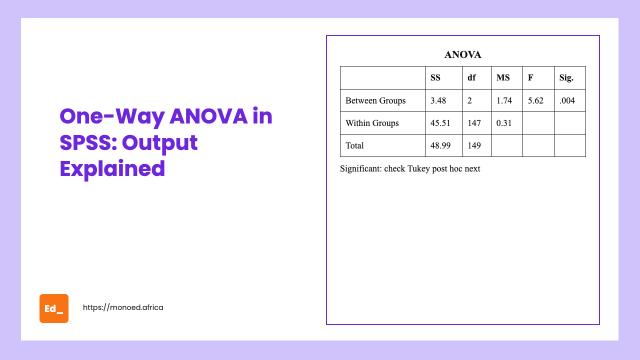
ANOVA:
- Sum of Squares
- 3.48
- df
- 2
- Mean Square
- 1.74
- F
- 5.62
- Sig.
- .004
- Sum of Squares
- 45.51
- df
- 147
- Mean Square
- 0.31
- F
- Sig.
- Sum of Squares
- 48.99
- df
- 149
- Mean Square
- F
- Sig.
Read the Between Groups row: F(2, 147) = 5.62, p = .004. Since p < .05, at least one group mean differs.
Post Hoc (Tukey HSD): shows each pair. Suppose 200 vs 400 level has Sig. = .003, while the other pairs are above .05. Then the significant difference is between 200 and 400 level students.
The figures above are an example for illustration.
If Levene's test is significant (Sig. ≤ .05), report the Welch test from the Robust Tests table instead of the standard F, and use Games-Howell for post hoc comparisons.
How to report it in Chapter Four
A one-way ANOVA showed a significant difference in e-library use across levels of study, F(2, 147) = 5.62, p = .004. Tukey post hoc tests showed that 400 level students (M = 2.98, SD = 0.53) used e-library resources significantly more than 200 level students (M = 2.61, SD = 0.59), p = .003. There was no significant difference between the other pairs. The null hypothesis is therefore rejected.
Common mistakes
- Running three separate t-tests instead of ANOVA. This increases the chance of a false significant result.
- Reporting a significant F without saying which groups differ.
- Ignoring Levene's test.
- Reading the Within Groups row for F.
New to this? Start with hypothesis testing and p-values explained and how to analyse questionnaire data in SPSS.
Frequently Asked Questions
When should I use one-way ANOVA?
When you compare the means of three or more independent groups on one continuous or scale score.
What does a significant ANOVA mean?
At least one group mean is different. Use post hoc tests to find which ones.
What is a post hoc test?
A follow-up test, such as Tukey HSD, that compares each pair of groups after a significant ANOVA.
How do I report ANOVA in APA style?
F(between df, within df) = value, p = value. For example, F(2, 147) = 5.62, p = .004.
What if Levene's test is significant?
Report Welch's ANOVA and use Games-Howell post hoc tests.
About the Author
Mohammad-Jamiu B. Balogun, GMNSE
Founder & Product Architect, MonoEd Africa
Mohammad-Jamiu is a First-Class Telecommunications Engineer and Best Graduating Student of Bayero University, Kano (Class of 2024), and the founder of MonoEd Africa. An AI engineer and product architect, he designs and builds MonoEd's guided workflows for SIWES logbooks and reports, final year projects and academic tools such as the GPA calculator, helping students produce better work and build the skills the AI era demands. MonoEd's tools have reached more than 20,000 students across Nigeria.