How to Write Chapter One of a Final Year Project in Nigeria (Complete Student Guide)
Learn how to write Chapter One of a final year project in Nigeria. This guide explains background of the study, problem statement, objectives, research questions, hypotheses, significance, scope, limitations and definition of terms with Nigerian based examples.

Chapter One is the foundation of every final year project in Nigerian universities and polytechnics. It introduces the topic, explains the problem, and sets the direction for the entire research. A strong Chapter One increases your supervisor’s confidence and makes your entire report easier to develop.
This guide explains each section of Chapter One in a simple, practical, and Nigerian focused way, with examples and formatting tips you can apply immediately.
Standard Structure of Chapter One in Nigerian Projects
Chapter One is usually arranged in the order below:
- Background of the Study
- Statement of the Problem
- Objectives of the Study
- Research Questions
- Research Hypotheses (if applicable)
- Significance of the Study
- Scope of the Study
- Limitations of the Study
- Definition of Terms
- Organisation of the Study
Each section has a specific role. Let’s go through them properly.
1. Background of the Study
This section explains the context behind your research. Start from the general topic area then narrow it down to the specific issue your project will address.
A strong background should:
- provide history and current information
- reference previous authors
- explain the gap or challenge in Nigeria
- show why the topic is important
Example guide for writing a good background
Start broad
→ Move into trends or problems
→ Narrow down to your specific research gap
→ End with why the study is needed
If your topic is about fintech adoption in Nigeria, your background may start with the global rise of digital payments, then Nigerian trends, then specific issues like trust, regulation, or consumer behaviour.
2. Statement of the Problem
This is the most important section in Chapter One. It explains the exact problem your study wants to solve.
A good problem statement:
- is clear and direct
- points out what is wrong or unknown
- shows the consequences of the problem
- identifies the gap your study will address
Avoid vague or general statements. Be specific and relate the problem to Nigerian reality.
Simple format to follow
Despite the growth of X, problem Y still occurs.
This has resulted in Z.
Existing studies have not fully addressed A, B, or C.
This study therefore seeks to examine…
3. Objectives of the Study
This section explains what the project aims to achieve.
There are two types:
General Objective
A broad aim that usually restates the project topic.
Specific Objectives
These break the main goal into measurable tasks.
Start each one with action words such as:
- to examine
- to determine
- to assess
- to evaluate
- to investigate
Your specific objectives must align directly with your problem statement.
4. Research Questions
These are the questions your study will answer. They must match your specific objectives.
If one objective is “to determine the factors influencing X”, the research question becomes “What are the factors influencing X?”
Use question words like:
- What
- How
- To what extent
Avoid yes or no questions.
5. Research Hypotheses (if applicable)
This applies mostly to quantitative research.
You often write:
- Null Hypothesis (H0)
- Alternate Hypothesis (H1)
Example:
H0: There is no significant relationship between mobile banking usage and customer satisfaction in Lagos State.
H1: There is a significant relationship…
If you are in Management, Social Sciences, Agriculture or Pure Sciences, your supervisor may require hypotheses.
For qualitative projects, research questions are usually enough.
6. Significance of the Study
This section explains who benefits from your research and how.
Examples of groups to mention:
- students and researchers
- organisations
- policymakers
- industry practitioners
- community members
You can also mention contribution to:
- knowledge
- practice
- policy
- future research
Keep it clear and practical.
7. Scope of the Study
Scope defines what your research will cover.
Mention:
- geographical scope
- time frame
- variables or concepts
- population of study
- specific boundaries you set
Scope tells the reader what is included and what is excluded.
8. Limitations of the Study
No research is perfect. This section explains challenges you faced or expect to face, such as:
- time constraints
- limited access to data
- financial restrictions
- small sample size
- respondent availability
Do not exaggerate. Keep it realistic and honest.
9. Definition of Terms
Write simple meaning for all key terms in your study.
Define them based on how you use them in your research.
One to two lines per term is enough.
Example:
Digital Banking: All banking activities carried out through electronic channels such as mobile apps and web platforms.
10. Organisation of the Study
Briefly explain how your entire project is arranged.
Example format:
Chapter One presents the introduction of the study.
Chapter Two reviews related literature and theoretical frameworks.
Chapter Three explains the research methodology.
Chapter Four presents results and analysis.
Chapter Five provides conclusion and recommendations.
One paragraph is enough for this section.
Short Example of a Well Structured Chapter One Outline
If your topic is “Impact of Social Media Marketing on Customer Engagement among Fashion Businesses in Abuja”, your Chapter One outline may look like this:
1.1 Background of the Study
1.2 Statement of the Problem
1.3 Objective of the Study
- 1.3.1 General Objective
- 1.3.2 Specific Objectives
1.4 Research Questions
1.5 Research Hypotheses
1.6 Significance of the Study
1.7 Scope of the Study
1.8 Limitations of the Study
1.9 Definition of Terms
1.10 Organisation of the Study
Tips for Writing a Strong Chapter One
- follow your school or department’s specific format
- make sure every section aligns with the others
- keep your writing clear and concise
- revise your objectives and questions until they match perfectly
- avoid plagiarism by citing properly and paraphrasing in your own voice
- use approved referencing styles like APA, Harvard or MLA
Tools That Can Help You Write a Better Chapter One
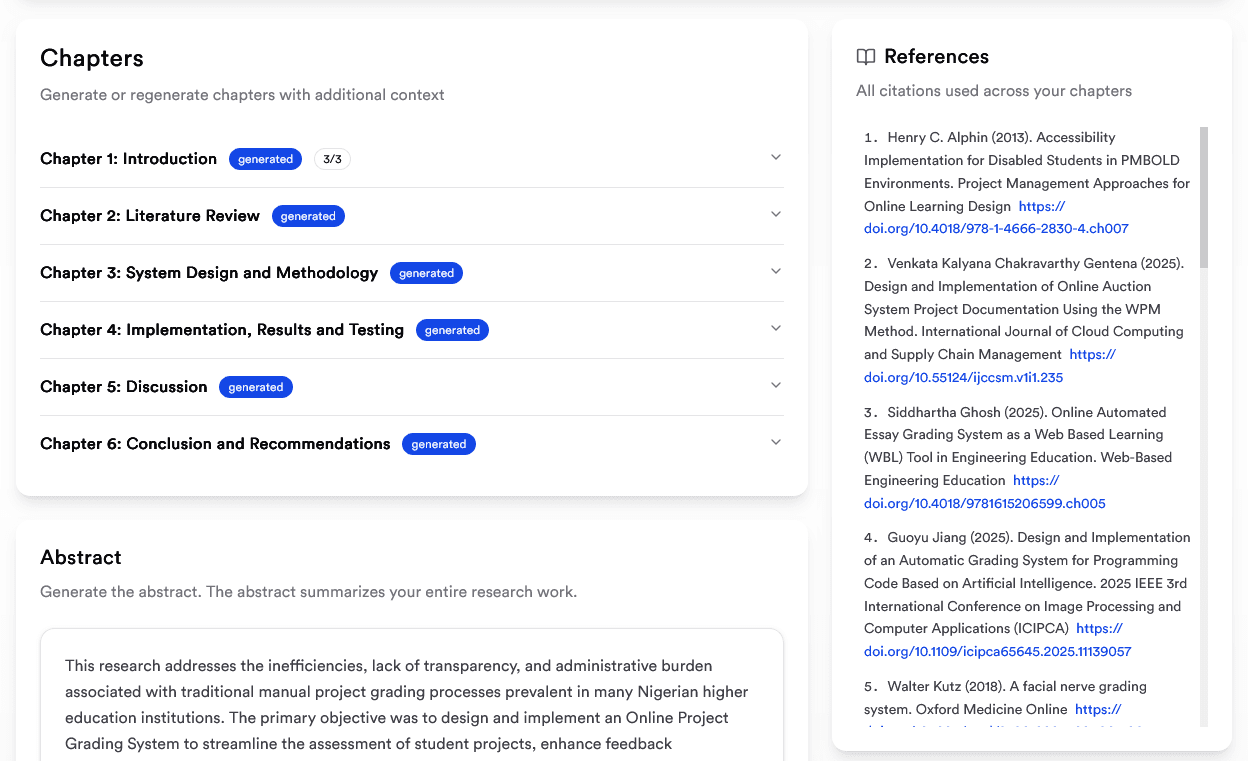
To save time and avoid formatting stress, you can use MonoEd tools designed for Nigerian students:
FYP Report Generator
Creates clean Chapter One content, APA citations, objectives, questions, and even hypotheses based on your topic.
https://fyp.monoed.africa
Project Topic Generator
Provides supervisor ready project topics and chapter outlines across all Nigerian departments.
https://topics.monoed.africa
These tools reduce writing time and give you a strong structure you can refine with your supervisor.
Conclusion
Chapter One is the backbone of your final year project. When written properly, it guides your entire research and convinces your supervisor that your study is clear, relevant, and achievable.
By following the standard structure explained in this guide and using the tools provided, you can complete a high quality Chapter One in a short time and move confidently to Chapter Two.