How to Write Your Final Year Project in Nigeria: Complete Step-by-Step Guide
Learn how to write a Nigerian final year project with our step-by-step guide. Covers topic selection, research, chapter structure, writing tips, and AI tools to generate topics, outlines, and citations.

Writing a Final Year Project (FYP) in Nigeria can feel overwhelming, but with the right plan, you can handle it confidently. Whether you’re a polytechnic (ND/HND) or university (BSc) student, this guide simplifies the entire process, from choosing a solid project topic to submitting a professionally structured report.
You’ll learn how to select a strong, researchable topic, structure each chapter correctly, and use proven strategies to produce high-quality academic work. The guide also includes field-specific chapter formats (for Science, Engineering, Social Sciences, Management, and IT), as well as modern tools that help you generate project topics, outline chapters, and even draft sections faster.
📙 Final Year Project Tools 🔥
FYP Report Generator — Generate full project chapters and citations.
https://fyp.monoed.africa
Project Topic Generator — Get supervisor-ready project topics instantly.
https://topics.monoed.africa
Step 1: Choosing the Right Topic
Your topic sets the tone for the entire project. A good topic should:
- Align with your field of study and personal interests
- Identify a research gap
- Be feasible within your timeframe and resources
💡 Pro Tip: If you’re stuck on what to research, use the Project Topic Generator by MonoEd Africa. This AI tool helps Nigerian students:
- Generate unique project topics tailored to your department
- Choose topics with different difficulty levels (Easy, Moderate, Hard)
- Factor in constraints like budget, data access, or lab facilities
- Generate complete thesis outlines with chapter breakdowns
How to Use the Tool:
- Enter your Department (e.g., Computer Science, Accounting)
- Enter your Area of Interest (e.g., AI, E-commerce)
- Choose constraints that match your situation
- Select difficulty level
- Click “Generate Topics” and bookmark your favorites
- Generate a full outline including objectives, research questions, methodology, and expected analysis
💡 Tip: Be specific with inputs for the most tailored suggestions.
Step 2: Conducting Research
After choosing a topic, gather research materials:
- Review academic journals, books, and theses to identify what has already been done
- Highlight research gaps to justify your project
- Take notes and organize sources for easy referencing
Pro Tip: Use online libraries and resources such as Google Scholar, Free-Ebooks.net, The Free Library, Wikibooks, and university repositories.
Step 3: Structuring Your Project
A well-structured FYP ensures clarity and professionalism. Here’s the standard Nigerian FYP structure:
Preliminary Pages
- Title Page
- Declaration
- Acknowledgement
- Dedication
- Abstract
- Table of Contents
- List of Figures/Tables
- Abbreviations
Chapter 1: Introduction
- Background of the Study
- Problem Statement
- Research Questions or Hypotheses
- Aims & Objectives
- Significance of the Study
- Scope and Limitations
- Definitions of Terms
- Chapter Outline
Chapter 2: Literature Review
- Theoretical Framework
- Review of Related Studies
- Identify Research Gaps
Chapter 3: Research Methodology
- Research Design
- Population & Sample
- Data Collection Tools
- Data Analysis Techniques
Chapter 4: Results/Analysis
- Present findings using tables, charts, or graphs
- Analyze data according to your research questions
Chapter 5: Discussion
- Interpret results in context
- Compare with existing literature
Chapter 6: Conclusion & Recommendations
- Summarize findings
- Suggest practical recommendations
- Highlight limitations and areas for future research
References & Appendices
- Include all cited sources
- Add supplementary materials if needed
Step 4: Chapter Structure by Field Category
Different fields have slightly different requirements for chapters. Here’s a breakdown:
STEM / Engineering / Computing
- Chapter 1: Introduction
- Chapter 2: Literature Review
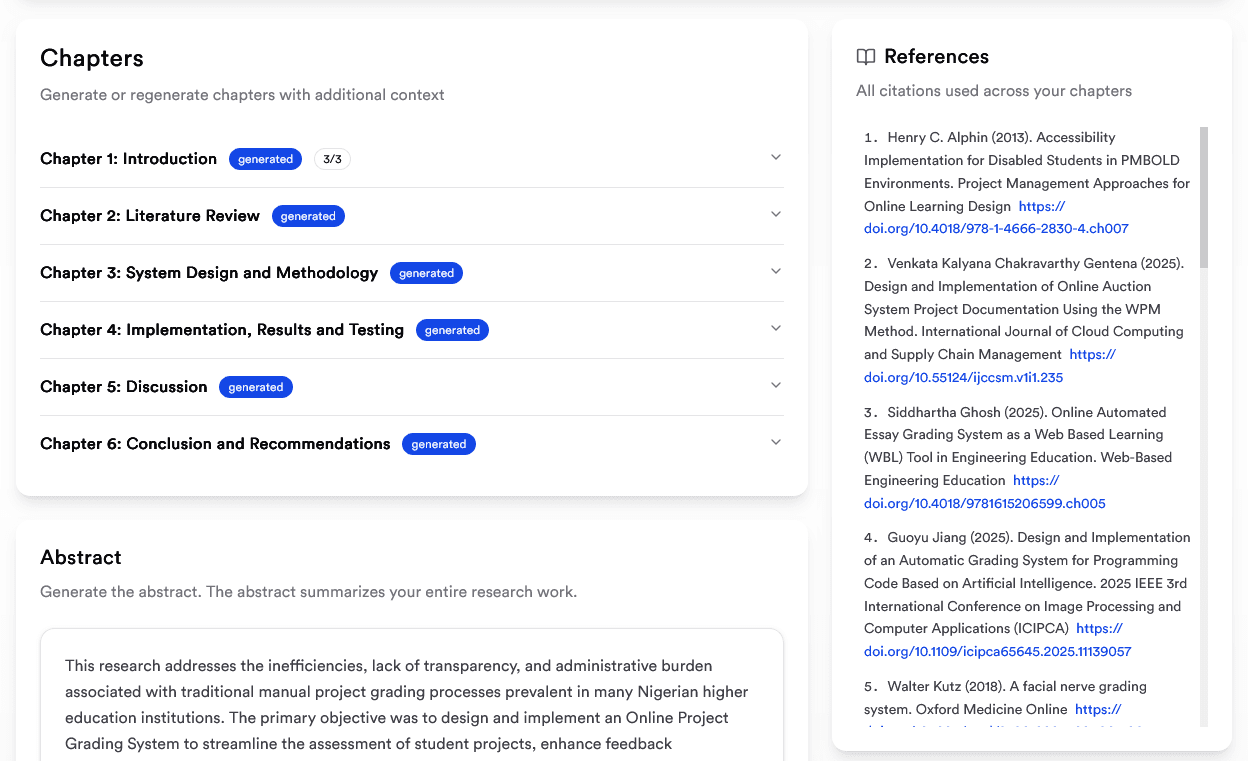
- Chapter 3: System Design and Methodology
- Chapter 4: Implementation, Results and Testing
- Chapter 5: Discussion
- Chapter 6: Conclusion and Recommendations
Social Sciences / Management
- Chapter 1: Introduction
- Chapter 2: Literature Review
- Chapter 3: Research Methodology
- Chapter 4: Data Presentation, Analysis and Results
- Chapter 5: Discussion
- Chapter 6: Conclusion and Recommendations
Pure Sciences / Life Sciences
- Chapter 1: Introduction
- Chapter 2: Literature Review
- Chapter 3: Materials and Methods
- Chapter 4: Results (and Discussion for Pure Sciences)
- Chapter 5: Discussion
- Chapter 6: Conclusion and Recommendations
Arts / Humanities / Law
- Chapter 1: Introduction
- Chapter 2: Literature Review
- Chapter 3: Research Methodology
- Chapter 4: Analysis and Findings
- Chapter 5: Discussion
- Chapter 6: Conclusion and Recommendations
Step 5: Writing Your Project
- Draft sequentially: start with Introduction, Literature Review, then Methodology
- Be original: avoid plagiarism, cite sources correctly (APA, MLA, etc.)
- Use clear, professional English
- Incorporate visuals: tables, charts, and diagrams improve readability
💡 Pro Tip: To save time, you can use the Final Year Project Report Generator by MonoEd Africa to generate full chapters with structured APA citations. Just enter your project details once, and it produces a ready-to-edit Word document from Introduction to Conclusion.
Step 6: Reviewing & Editing
- Proofread for grammar, spelling, and clarity
- Check formatting guidelines from your university
- Ensure all references are complete and accurate
- Have your supervisor review drafts
Step 7: Submission & Presentation
- Compile final document with all chapters and appendices
- Include any diagrams, screenshots, or supplementary materials
- Submit according to university deadlines
- Prepare for oral defense if required
Tips for Success
- Start early and work consistently
- Stay organized: maintain notes, references, and raw data
- Consult your supervisor regularly
- Use AI tools to speed up repetitive tasks like topic generation, chapter outlines, and citations
Related Resources:
FAQs
Q: Can I reuse previous project topics from other students?
A: No, it’s important to create original work. You can get inspiration but always identify a unique research gap.
Q: How long should each chapter be?
A: It varies by department, but generally: Introduction (5–10 pages), Literature Review (10–20 pages), Methodology (5–10 pages), Results & Analysis (10–20 pages), Discussion (5–10 pages), Conclusion & Recommendations (3–5 pages).
Q: Are AI tools acceptable for Nigerian FYPs?
A: Yes, as long as you validate all content and properly cite sources. Tools like MonoEd’s FYP Generator streamline writing, but your original analysis is essential.
Q: Can I use the Project Topic Generator if I have no ideas?
A: Absolutely. It’s designed for students who need inspiration, and it also produces full chapter outlines to guide your research.
Final Thoughts
Writing a final year project in Nigeria doesn’t have to be stressful. By choosing the right topic, conducting thorough research, following a structured chapter plan, and leveraging AI tools, you can produce a polished, professional FYP efficiently.
💡 Use the Project Topic Generator to find the perfect topic, and the Final Year Project Report Generator to create chapters and citations.
With proper planning, your project can be completed in weeks rather than months.