Recommendation Letter for a Student: Samples for Masters, Scholarships and Jobs (2027)
How to ask a lecturer for a recommendation letter, what a strong letter includes, and three samples (masters, scholarship, job) you can share with your referee.

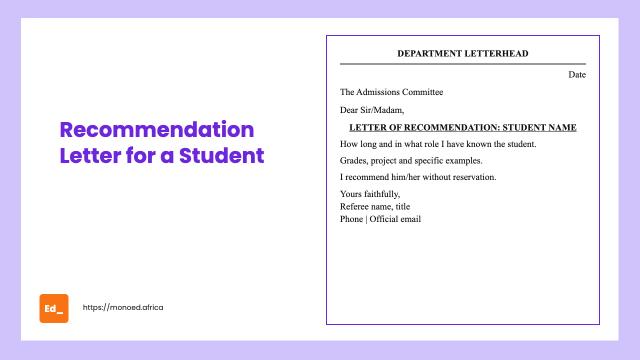
Most masters programmes, scholarships and many graduate jobs ask for two or three recommendation letters (also called reference letters). In Nigeria, students often have to ask a busy lecturer and even draft the letter themselves for the lecturer to edit and sign.
This guide shows you how to ask, what a strong letter includes, and three samples.
Who should write your letter?
| Application | Best referees |
|---|---|
| Masters or PhD | Your project supervisor, lecturers who taught you core courses, your HOD |
| Scholarship | A lecturer who knows your grades and a leader who knows your character |
| Graduate job | Your SIWES or NYSC supervisor, a lecturer, an internship manager |
Choose people who actually know your work. A short, specific letter from your supervisor beats a vague one from a professor who cannot remember you.
How to ask (and make it easy to say yes)
- Ask early. Give at least two to three weeks.
- Ask in person or by a polite email. Remind them how they know you.
- Send a short pack: your CV, transcript or result summary, the programme or job description, the deadline, and how to submit.
- Offer a draft if they ask for one. Many Nigerian lecturers will ask you to prepare a draft. Write it honestly; they will edit and sign it.
- Follow up politely a week before the deadline, and thank them afterwards.
What a strong recommendation letter includes
- Official letterhead, date and the recipient (or "To Whom It May Concern").
- How long the referee has known you and in what capacity.
- Specific evidence: your grades or position in class, your project, a task you handled well.
- Personal qualities with examples: reliability, leadership, curiosity.
- A clear recommendation, for example "I recommend her without reservation".
- The referee's name, title, department, phone and official email.
Sample 1: For a masters application (from a project supervisor)
Department of Microbiology
University of Nigeria, Nsukka
10th February, 2027
The Admissions Committee
School of Postgraduate Studies
Dear Sir/Madam,
LETTER OF RECOMMENDATION: CHIOMA EZE
I am pleased to recommend Miss Chioma Eze for admission into your M.Sc. Microbiology programme. I taught her two 400 level courses and supervised her final year project between 2025 and 2026.
Chioma graduated with a First Class, placing among the top five students in a class of 120. Her project on antibiotic resistance in bacteria from hospital wastewater was one of the strongest in the department. She designed the sampling plan herself, worked carefully in the laboratory and presented her results clearly at the departmental seminar.
She is hardworking, honest and asks thoughtful questions. I am confident she will do excellent postgraduate work, and I recommend her without reservation.
Yours faithfully,
(Signature)
Dr. Emeka Nwosu
Senior Lecturer, Department of Microbiology
0803 000 0000 | [email protected]
Sample 2: For a scholarship (from a lecturer)
To Whom It May Concern,
I write in support of Mr. Ibrahim Sani's application for the XYZ Foundation Undergraduate Scholarship. I have taught Ibrahim in three courses in the Department of Electrical Engineering, Bayero University Kano, since 2024.
Ibrahim has a CGPA of 4.62 out of 5.00 and consistently ranks among the best in his class. Beyond grades, he leads a peer tutorial group for 200 level students every week, which shows his willingness to help others. He comes from a modest background and has combined his studies with part-time work without his performance dropping.
I strongly recommend him for this scholarship.
Yours faithfully,
Engr. Dr. Halima Musa
Department of Electrical Engineering, Bayero University Kano
For scholarship options, see undergraduate scholarships in Nigeria and fully funded scholarships for international students.
Sample 3: For a job (from a SIWES or NYSC supervisor)
To Whom It May Concern,
Mr. David Okon worked under my supervision as a corps member in the IT department of ABC Hospital, Uyo, from March 2026 to February 2027.
David maintained our 45 computers and network, set up a simple patient record backup system, and trained nurses on basic computer use. He was punctual, careful with confidential records and quick to learn.
I recommend him for any IT support or junior systems role.
Yours faithfully,
Mrs. Grace Etim
Head, IT Unit, ABC Hospital, Uyo
Tips if you are asked to draft your own letter
- Write in the referee's voice and only include true details.
- Use specific examples and numbers, not general praise.
- Keep it to one page.
- Leave space for the referee's own edits and signature.
Make your record easy to recommend
Referees write stronger letters when you give them something concrete to point to: a good CGPA, a solid final year project or a published paper. Track your grades with our free CGPA calculator, and if you are heading for a masters, read how to turn your final year project into a research paper. A publication is one of the strongest things a supervisor can mention.
For your application documents, see how to write an academic CV for scholarships.
Frequently Asked Questions
Who can write a recommendation letter for a student?
A lecturer, project supervisor, HOD, SIWES supervisor, NYSC employer or anyone who has supervised your work and knows you well.
How long should a recommendation letter be?
About one page, with three or four paragraphs.
Can I write my own recommendation letter?
Some referees ask you to prepare a draft. Write it honestly in their voice; they should edit it, sign it and submit it.
Is a reference letter the same as a recommendation letter?
In Nigeria, the terms are used for the same thing. Some employers use "reference" for a shorter confirmation of your role and conduct.
How early should I ask my lecturer?
At least two to three weeks before the deadline.
About the Author
Mohammad-Jamiu B. Balogun, GMNSE
Founder & Product Architect, MonoEd Africa
Mohammad-Jamiu is a First-Class Telecommunications Engineer and Best Graduating Student of Bayero University, Kano (Class of 2024), and the founder of MonoEd Africa. An AI engineer and product architect, he designs and builds MonoEd's guided workflows for SIWES logbooks and reports, final year projects and academic tools such as the GPA calculator, helping students produce better work and build the skills the AI era demands. MonoEd's tools have reached more than 20,000 students across Nigeria.