How to Choose a Computer Science Project Topic in Nigeria (2026 Student Guide)
Learn how to choose a Computer Science project topic in Nigeria, compare feasible ideas, define your scope and prepare a clear proposal for your supervisor.

Quick Summary
To choose a Computer Science project topic, start with a specific problem, identify the people affected and define a solution you can build and evaluate.
Before submitting a topic, check that:
- It meets your department’s requirements.
- You understand the problem and intended users.
- The scope fits your skills, budget and deadline.
- You can obtain the necessary data, equipment or permissions.
- You can test the result and explain your decisions during defence.
Prepare a shortlist for your supervisor. Once a topic is approved, turn it into a plan covering users, features, screens, data and testing.
Why Your Project Topic Matters
Your topic influences the software you build, the research you conduct, the resources you need and the questions you will answer during your defence.
A title can sound impressive while hiding an unrealistic workload. “AI-Powered University Management System,” for example, leaves many questions unanswered:
- Which university process will it improve?
- Who will use it?
- What exactly will the AI do?
- Where will the data come from?
- How will you evaluate whether it works?
A focused topic makes these questions easier to answer. It also gives your supervisor something concrete to assess.
1. Check Your Department’s Requirements
Before searching for ideas, read your project handbook or ask your project coordinator what is expected.
Confirm:
- Whether the project must include working software.
- Whether research, experimental, security or hardware projects are accepted.
- Any required programming language or technology.
- The expected proposal and report format.
- Whether a case study is required.
- The rules for existing code, external assistance and AI use.
- The submission and demonstration deadlines.
Computer Science projects do not all follow the same approach. A database application, machine learning experiment and networking study may need different methods and evidence.
Choose a topic that fits the requirements applying to your own project.
2. Start With a Problem You Can Investigate
Look for a process that causes a specific difficulty.
Examples include:
- Hostel staff cannot easily track vacant rooms.
- Students carry clearance forms between several offices.
- A department records attendance on paper.
- A small business struggles to reconcile bookings and daily records.
- Library staff cannot quickly identify overdue loans.
- Students cannot track the progress of submitted complaints.
Then ask:
- Who experiences the problem?
- How is the task handled now?
- What goes wrong?
- What would a useful improvement look like?
- How could you check whether your solution addresses the problem?
Avoid assuming that a problem exists simply because an organisation uses paper. Investigate the actual process through permitted observation, interviews or available records.
For more ideas, browse the Computer Science project topics library.
3. Match the Topic to Your Skills
List what you can already do and what you would need to learn.
For a web application, this might include:
- Building forms and pages.
- Writing database queries.
- Managing user accounts.
- Validating inputs.
- Implementing permissions.
- Testing application behaviour.
Your project can introduce new skills, but allow time to learn and apply them.
If you already understand PHP and MySQL, a focused management system may be more achievable than learning mobile development and machine learning at the same time.
If you know Python, you might consider a Flask application, dashboard or prediction project. A prediction topic also requires suitable data and an evaluation method.
Choose technology because it serves the project and you can explain it.
4. Turn a Broad Idea Into a Manageable Topic
A broad idea becomes more practical when you define the users, activities and boundaries.
Example: Hospital System
Broad idea: Hospital Management System.
Focused topic: Design and Implementation of an Appointment Booking System for a School Clinic.
Possible scope:
- Patient registration.
- Appointment requests.
- Staff approval.
- Appointment schedules.
- Booking history.
Medical diagnosis, pharmacy stock, laboratory results and payroll can remain outside the scope.
Example: Student Clearance
Broad idea: University Administration System.
Focused topic: Design and Implementation of a Student Clearance Management System.
Possible scope:
- Student clearance applications.
- Review by designated units.
- Approval or rejection with comments.
- Progress tracking.
- Release of a clearance slip after the required approvals.
Example: Attendance
Broad idea: Smart School System.
Focused topic: Design and Implementation of a Class Attendance Management System.
Possible scope:
- Course and student records.
- Attendance sessions.
- Attendance marking.
- Percentage calculations.
- Reports.
QR codes can be an extension if you have time to implement and test the rules around their use.
The title should match the work. Do not add “AI,” “blockchain” or “IoT” unless that technology has a defined role in the project.
5. Check Data and Access Before Committing
Some topics become difficult because the necessary information is unavailable.
Before choosing, identify:
- The data you need.
- Who owns or controls it.
- Whether you have permission to use it.
- How long access may take.
- What you will do if access is refused.
Student, medical and financial records may contain sensitive information. Do not assume that an organisation will share them.
For a software demonstration, clearly labelled fictional records can help you test application behaviour. They do not prove that the system has been evaluated in a real organisation.
For machine learning, check that you have a suitable dataset, permission to use it, relevant labels and a realistic evaluation plan. Avoid claiming that sample data represents real local conditions without evidence.
6. Estimate the Full Cost
Consider more than the cost of writing code.
Your project may require:
- Internet and downloads.
- Hosting or a domain.
- Paid APIs or software.
- Data collection.
- Sensors and other components.
- Transport to a case-study organisation.
- Printing and binding.
- Repairs or replacement equipment.
Also check what your laptop can run.
A project that depends on paid services, powerful hardware or continuous internet access needs a plan for those dependencies. Test installation and demonstration conditions early.
7. Decide How You Will Evaluate the Result
A useful topic should lead to something you can examine and explain.
For a hostel allocation system, you could test whether:
- Students can submit valid applications.
- Staff can allocate available rooms.
- Full rooms reject additional allocations.
- A student cannot receive two active allocations.
- Cancellation updates availability.
- Unauthorised users cannot change allocations.
For a prediction project, evaluation might involve performance on appropriately separated test data and comparison with a simple baseline.
Choose evaluation methods that match your objectives. Do not promise improvements in speed, accuracy or efficiency unless you have a way to measure them.
8. Compare Your Shortlist
Use the same questions for each idea:
- Can I explain the problem clearly?
- Can I identify the intended users?
- Can I obtain the information or equipment needed?
- Can I build the essential features before the deadline?
- Can I test the result?
- Can I explain the main technical decisions?
- Does it meet my department’s requirements?
- Is there a realistic backup if a dependency fails?
Treat an unknown answer as something to investigate before committing.
For a practical comparison:
- Library loan system: Check access to the borrowing process and define loan rules.
- Attendance system: Decide how attendance is recorded and how duplicate entries are prevented.
- Student clearance system: Define the approval sequence and who can make each decision.
- Prediction system: Confirm the dataset, target variable and evaluation method.
- Hardware system: Confirm component availability, cost and how you will test the physical device.
9. Prepare a Clear Topic Proposal
Follow your department’s submission format. If you are preparing an initial discussion note, include:
Proposed Topic
State a specific title.
Problem
Explain what happens now, who is affected and the difficulty you want to address.
Aim
Describe the overall purpose of the project.
Objectives
List actions you can complete and evaluate.
For an attendance system, these might be:
- Analyse the current attendance-recording process.
- Design the application and database.
- Implement attendance recording and reporting.
- Test the main features against defined requirements.
Proposed Approach
Summarise the intended tools, data sources and development or research method.
Scope and Limitations
State what the project will cover and what it will leave out.
Resources and Evaluation
Explain what you need and how you will check the result.
A clear proposal helps your supervisor assess feasibility. It does not guarantee approval.
See How to Write a Final Year Project Proposal in Nigeria.
Should You Include a Case Study?
Follow your department’s guidance.
A case study is useful when you will investigate a particular organisation or process. Confirm access before naming an organisation in the title.
For example:
Without a named case study:
Design and Implementation of a Student Attendance Management System.
With a case study:
Design and Implementation of a Student Attendance Management System: A Case Study of [Approved Institution].
Changing an organisation’s name alone does not establish a meaningful contribution. Explain the requirements, implementation or evaluation specific to your project.
After Approval: Turn the Topic Into a Build Plan
Approval gives you a direction. Your next task is to define what you will actually produce.
For a software project, write down:
- Users: Who signs in, and what can each person do?
- Features: What actions must the system support?
- Screens: Which pages are needed?
- Data: Which records, fields and relationships are required?
- Rules: What must the system allow or prevent?
- Tests: How will you verify the important behaviour?
- Documentation: Which diagrams, screenshots and results will explain the work?
Build an early version of the main workflow. This can reveal problems while there is still time to adjust the scope.
For implementation ideas, see 35 Web Development Project Topics for Computer Science Students.
Need Help Building Your Approved System?
MonoEd Project Source Code builds systems around students’ topics, with software options in Python or PHP.
You review the proposed plan before payment. The package includes source code, setup instructions, screenshots, a guide explaining the system and defence questions based on the build.
You can explore a Student Clearance Management System example to see how a topic becomes users, features, screens and database records.
Check that your scope is supported and follow your department’s rules on assistance and disclosure. You remain responsible for running, checking and understanding the work.
For the written report, MonoEd FYP Report Generator can support drafting. Ensure that the chapters describe the system and evidence you actually have.
Common Mistakes to Avoid
Choosing a Title Because It Sounds Impressive
Ask what the project will do and how you will evaluate it. A title alone does not establish technical depth.
Adding Too Many Features
Complete and test the essential workflow before considering extensions.
Assuming Data Will Be Available
Confirm access early. Have an approved alternative if access is uncertain.
Copying a Project Without Understanding It
Check licences and attribution requirements when using existing code. Understand its behaviour and explain your contribution.
Treating AI Output as Verified Work
Check generated code, references, explanations and results. Never report tests or research activities that did not happen.
Leaving Documentation Until the End
Keep notes on design decisions, database changes, tests and limitations as you work. This makes the report more accurate and defence preparation easier.
Frequently Asked Questions (FAQs)
How many topics should I submit to my supervisor?
Follow your department’s instructions. If no number is specified, a shortlist of three to five well-explained ideas can provide useful options for discussion.
Can two students have similar project topics?
That depends on departmental rules. Where similar topics are allowed, clarify the differences in requirements, implementation, context or evaluation.
Must every Computer Science project title start with “Design and Implementation”?
No. The title should reflect the work and follow your department’s requirements. A software development project, algorithm comparison and experimental study may need different wording.
Should I choose a web application or a mobile application?
Choose according to the problem, intended users, requirements and your available skills. Consider installation, testing and demonstration needs before deciding.
Should I choose an AI project?
Choose one when AI serves a clear purpose and you can obtain suitable data or services, implement the approach and evaluate its limitations.
Can I choose a topic before knowing how to code it?
You can learn during the project, but investigate the technical requirements first. Try a small prototype and allow time for learning, testing and corrections.
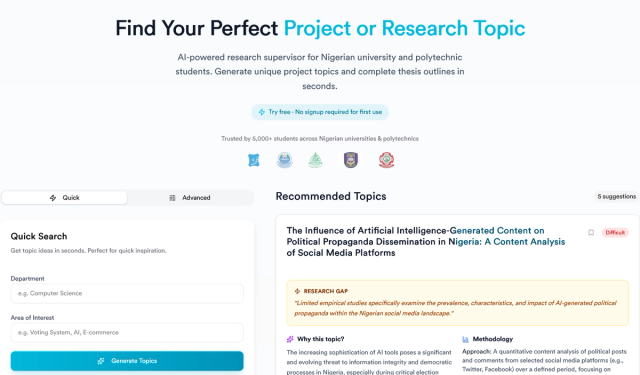
Can a topic generator help?
A project topic suggestion tool can help you explore directions. Check each suggestion for feasibility and discuss it with your supervisor.
What should I do immediately after my topic is approved?
Confirm the objectives and scope, record the requirements, plan your evidence and evaluation, and begin an early prototype. Keep the software, report and diagrams consistent as the project develops.
About the Author
Mohammad-Jamiu B. Balogun, GMNSE
AI Security Researcher · Founder, MonoEd Africa
Mohammad-Jamiu is a First-Class Telecommunications Engineer and Best Graduating Student, BUK '24, and an AI security researcher. He founded MonoEd Africa to give Nigerian students AI-powered academic tools — from SIWES logbooks to final year projects. His work has reached over 10,000 students across Nigeria.