How to Fill Your SIWES Logbook as a Biochemistry Student in Nigeria (With Week 1 and Week 2 Examples)
Learn how to fill your SIWES logbook as a Biochemistry student with clear daily and weekly examples. Includes practical lab tasks, sample entries, and AI tools to simplify your logbook writing.
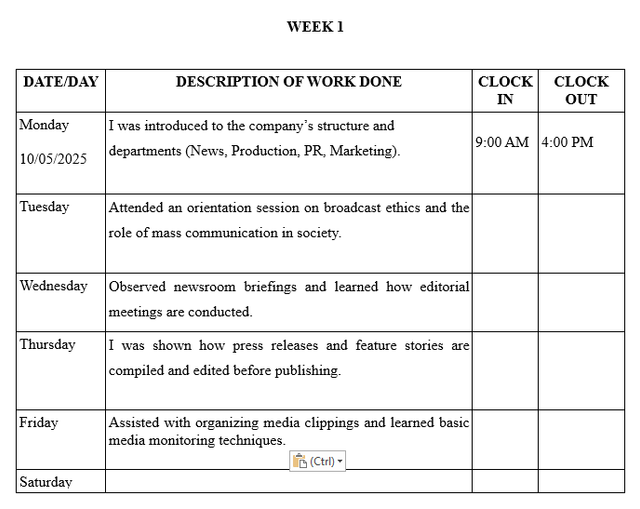
Filling your SIWES logbook as a Biochemistry student can be confusing if you are not sure what to write each day. Your logbook is an official record of what you learned and practiced during your industrial training. A neatly written and well detailed logbook improves your final score and demonstrates your professionalism.
This guide explains what to write, how to write it, and includes real examples for your first two weeks.
What to Fill in the Front Pages
Before writing your daily entries, complete all the introductory sections.
Student Information
Include your name, matric number, department, institution, level, and session.
Organization Information
Write the name of your lab or company, the address, supervising biochemist or scientist, phone number, and email.
Training Duration
Record your start and end dates clearly.
Supervisor Signatures
Your industry and school supervisors will sign during their scheduled visits or at the end of each week.
What Your Biochemistry Logbook Should Contain
Every daily entry should cover the following:
- Day and date
- Tasks you observed or performed
- Equipment and materials used
- Reagents or chemicals involved
- Techniques applied
- What you learned
- Signature space for your supervisor at the end of the week
Avoid vague statements like "did some laboratory work". Instead, be clear and specific, for example:
- Prepared buffer solutions used for enzyme activity tests
- Performed protein estimation using the Biuret method
- Assisted in sample centrifugation and pellet separation
- Observed glucose determination using a colorimetric method
Tips for Writing a Good SIWES Logbook
Here are practices that match school expectations across Nigeria:
1. Write in past tense
Examples:
- “I observed…”
- “I assisted in…”
- “I participated in…”
- "Today, I learned ..."
2. Be specific about laboratory tests
Biochemistry labs run many analytical procedures, so mention them.
For example:
- Protein estimation
- Glucose determination
- Lipid profile
- Enzyme assays
- DNA extraction
- Spectrophotometric analysis
- pH measurement
- Titration procedures
3. Mention instruments and equipment
Examples include:
- Spectrophotometer
- pH meter
- Centrifuge
- Water bath
- Hot plate
- Analytical balance
- Micropipettes
- Vortex mixer
4. Mention reagents and chemicals where applicable
Examples:
- Buffer solutions
- Biuret reagent
- Benedict reagent
- Sulphuric acid
- Sodium hydroxide
- Glucose standard
- Acetic acid
- Distilled water
5. Keep a jotter
Write rough notes daily, then transfer the clean version into the logbook neatly.
6. Get weekly signatures
Your supervisor should sign on Fridays or the last day of the week.
7. Add drawings when relevant
Biochemistry students can draw:
Structure of amino acids
Layout of a spectrophotometer
Enzyme substrate reaction diagram
Calibration curve sketch
Caption your drawings clearly, for example:
“Absorbance against concentration calibration curve for glucose determination.”
Sample SIWES Logbook Entries for Biochemistry Students
These examples assume you were posted to a biochemical analysis laboratory, research lab, food production company, or diagnostic facility.
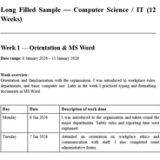
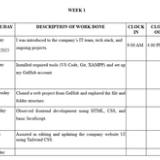
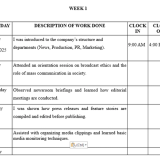
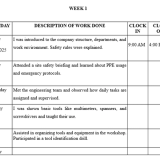
Week 1: Orientation and Introduction to Basic Laboratory Techniques
| Day | Activities |
|---|---|
| Monday | Reported to the laboratory and received an introduction to staff and departments. Observed general safety rules, proper dressing, and handling of chemicals. Learned about quality control and standard operating procedures. |
| Tuesday | Observed preparation of simple buffer solutions. I learned the importance of correct pH adjustment using a pH meter. Assisted in washing and organizing glassware. |
| Wednesday | Participated in weighing chemicals using the analytical balance. Observed correct calibration and handling. Assisted in labelling reagent bottles and storing chemicals. |
| Thursday | I observed the use of the centrifuge for sample separation. Learned about centrifuge speed, time settings, and balancing of tubes. |
| Friday | Assisted in general laboratory cleaning. Reviewed safety sheets for chemicals like acids, bases, and buffer salts. A senior technologist explained the purpose of MSDS sheets. |
Week 2: Analytical Skills and Basic Biochemical Tests
| Day | Activities |
|---|---|
| Monday | I observed glucose analysis using a colorimetric method. Used pipettes, cuvettes, and the spectrophotometer. Assisted in setting absorbance wavelength. |
| Tuesday | Prepared a standard glucose solution and helped in plotting a calibration curve. Learned the importance of dilution accuracy. |
| Wednesday | Participated in protein estimation using the Biuret method. Assisted in mixing reagents and measuring absorbance. Observed colour change from blue to violet. |
| Thursday | Observed lipid extraction from food samples. Watched the use of solvents and the drying process in a water bath. |
| Friday | I assisted in measuring enzyme activity using an indicator solution. Helped in recording results and cleaning cuvettes after analysis. |
Common Biochemistry Procedures You Can Mention
| Technique | Description |
|---|---|
| Colorimetry | Measuring concentration based on absorbance |
| Protein Estimation | Using Biuret, Lowry, or Bradford methods |
| Glucose Analysis | Using Benedict or enzymatic kits |
| Lipid Extraction | Using solvents like ether or chloroform |
| DNA Extraction | Using simple salt or detergent methods |
| Titration | Determination of acidity or alkalinity |
| Buffer Preparation | Adjusting pH with acid or base |
| Centrifugation | Separating mixtures into layers |
Quick Writing Formula for Each Day
Here is an easy structure you can follow:
1. Start with what you observed
2. State what you assisted in or performed
3. Mention materials or equipment used
4. State what you learned
Example:
“I observed protein analysis using the Biuret test. I assisted in preparing reagent mixtures and used pipettes, test tubes, and the spectrophotometer. I learned how absorbance relates to protein concentration.”
Want to Write Faster? Automate Your Daily Entries
Do not spend hours writing twenty four weeks of entries manually. Use the free tool made for Nigerian students.
📘 SIWES Logbook Generator – Instantly create weekly logbook entries.
📑 SIWES Report Draft Generator – Generate a full SIWES report draft in minutes.
🎓 Trusted by 1,000+ Nigerian students.
👉 Try them now and save hours of work.
About the Author
Mohammad-Jamiu B. Balogun, GMNSE
AI Security Researcher · Founder, MonoEd Africa
Mohammad-Jamiu is a First-Class Telecommunications Engineer and Best Graduating Student (BUK), and an AI security researcher. He founded MonoEd Africa to give Nigerian students AI-powered academic tools — from SIWES logbooks to final year projects. His work has reached over 10,000 students across Nigeria.