Complete Guide to SIWES Defence Questions and How to Answer Them
Get the most common SIWES defence questions and sample answers. Learn how SIWES is graded, how to prepare, and how to score high in your defence in any Nigerian university or polytechnic.

The SIWES defence is one of the most important stages of your industrial training. It determines a large part of your final grade and it is where you prove that you truly learned something during your training period.
Many students fear the defence because they are not sure what the panel will ask. The good news is that SIWES defence questions are usually predictable. When you understand the common questions and how to answer them correctly, scoring high becomes much easier.
This guide explains how SIWES defence works in Nigerian universities and polytechnics. It also includes sample questions and answers that apply to all fields including engineering, science, medical laboratory, hospitality, business administration, environmental courses, and more.
⚡ SIWES Tools for Students 🔥
Stop struggling with your SIWES documents — use our free AI-powered generators:
📘 SIWES Logbook Generator – Instantly create weekly logbook entries.
📑 SIWES Report Draft Generator – Generate a full SIWES report draft in minutes.
🎓 Trusted by 1,000+ Nigerian students. | Try them now and save hours of work!
What Is SIWES Defence
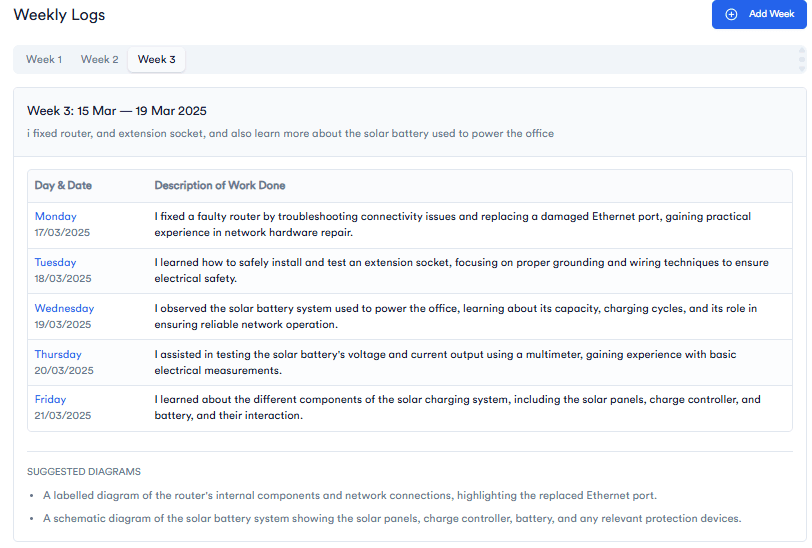
The SIWES defence is a short oral presentation where you explain your training experience to a panel of lecturers or departmental supervisors. During the session, you defend your logbook, your report, and the tasks you carried out during the training.
Most schools use the defence to confirm:
- if you truly attended your SIWES placement
- if you understand the tasks you recorded
- if your logbook and report were written by you
- if you gained practical skills related to your course
The defence usually lasts between 5 and 20 minutes depending on the school.
How SIWES Is Graded in Most Nigerian Schools
While the exact grading varies slightly, most universities and polytechnics use a similar pattern.
Typical SIWES Grading Format
| Component | Typical Percentage | Primary Focus |
|---|---|---|
| Logbook | 30 to 40 percent | Weekly entries, supervisor stamps, signatures |
| SIWES Report | 30 to 40 percent | Structure, technical accuracy, depth of content |
| Defence | 20 to 40 percent | Confidence, clarity, technical knowledge, Q and A performance |
If your logbook and report are good, the defence becomes easier. A strong defence can also boost your final grade significantly.
How to Prepare for Your SIWES Defence
- Read your logbook thoroughly
Be ready to explain every procedure, machine, task, or activity mentioned. - Know the company background
Be able to describe what the company does, its departments, location, and your unit of attachment. - Understand the tasks you performed
Be prepared to explain why a task was done, how it is done, tools used, safety measures, and what you learned. - Prepare a short summary of your training
Include introduction, duration, department, weekly tasks, skills gained, challenges, and recommendations. - Dress neatly
Simple corporate wear is best. - Answer confidently
Speak clearly, stay relaxed, and avoid rushing.
Most Common SIWES Defence Questions and Sample Answers
Below are the questions the panel asks most frequently. Customize the sample answers to match your experience.
Questions on Introduction and Placement
| Question | Sample Answer |
|---|---|
| Introduce yourself and tell us about your SIWES placement | My name is [Name]. I completed my SIWES training at [Company Name] in [City]. I worked in the [Department] for [Duration] where I gained practical experience in [Two or Three Key Tasks]. |
| Why did you choose this company for SIWES | I chose the company because it offers practical exposure related to my course. The department I worked in handles activities that match the skills I wanted to develop. |
| How did your SIWES relate to your course of study | The training helped me connect classroom theory with practical applications. For example, concepts from [Course Name] were applied when carrying out [Task]. |
Questions on Work Done and Technical Skills
| Question | Sample Answer |
|---|---|
| What are the major duties you performed | My responsibilities included [Task 1], assisting with [Task 2], observing [Procedure], and developing competence in [Skill or Machine]. |
| Explain one major task you performed and the steps involved | One major task I performed was [Task]. The steps included preparing the materials, setting up equipment, following the procedure, monitoring the outcome, and documenting results. I also observed all safety rules and used PPE. |
| What equipment or tools did you use | I used equipment such as [Tool 1], [Tool 2], and [Tool 3]. Each tool helped me carry out specific tasks under supervision. |
| What new skills did you gain | I gained practical skills such as [Skill 1], [Skill 2], and [Skill 3]. I also learned teamwork, safety compliance, and how to use field equipment. |
| Mention safety rules you followed | I used PPE, followed standard operating procedures, avoided unauthorized machine operation, maintained cleanliness, and reported hazards. |
Questions on Challenges and Conclusion
| Question | Sample Answer |
|---|---|
| What challenges did you face | I faced challenges such as limited equipment access, high workload, and learning new procedures. I overcame them by asking questions and seeking guidance. |
| What recommendations do you have for the company | I recommend better equipment maintenance, more training materials for interns, and improved workspace. |
| Was your SIWES training successful | Yes. I gained technical knowledge, confidence, and better understanding of industry practices. |
| How did you prepare your SIWES report | I followed the official departmental format and included introduction, company overview, weekly activities, tools used, results, challenges, and conclusion. I attached my signed logbook and supervisor evaluation. |
| Do you have any questions for the panel | A simple and effective question is: Are there recommended certifications that can help me advance in this field |
How to Present During Your SIWES Defence
- Stand upright
- Maintain steady eye contact
- Avoid reading directly from your report
- Speak in clear and simple sentences
- Do not argue or interrupt the panel
- Stay calm even if corrected
- Keep your hands relaxed
Common Mistakes to Avoid
- Not reading logbook or report
- Giving short one word answers
- Dressing carelessly
- Rushing or panicking
- Describing tasks you do not understand
- Contradicting your logbook entries
Conclusion
The SIWES defence becomes easy when you understand what the panel expects. Read your logbook, understand your tasks, prepare your answers, dress professionally, and stay confident. With good preparation, you can score high and finish your SIWES successfully.