Free AI Detectors Compared: GPTZero, ZeroGPT, QuillBot, Scribbr and Copyleaks (2026 Guide for Students)
GPTZero, ZeroGPT, QuillBot, Scribbr and Copyleaks compared for students: free limits, what each shows, how accurate they are, and how to use them on your project.

If you have used ChatGPT anywhere in your project, or you are simply worried that your own writing sounds "too formal", you have probably thought about running it through an AI detector first. There are many free ones, and they often give very different results for the same text.
This guide compares the five free AI detectors students use most, explains what their scores mean, and shows how to use them without panicking. Details were checked on each tool's website on 15 November 2026. Free limits change often, so confirm on the site before you rely on them.
How AI Detectors Work (and Why They Disagree)
AI detectors do not find your text somewhere on the internet. They look at patterns in the writing itself, such as how predictable each word is and how much your sentences vary, and then estimate how likely it is that a person or an AI wrote it.
That has two consequences:
- Different detectors give different results. Each one is trained on different data and uses different thresholds.
- Human writing can be flagged. Formal, repetitive or template-like writing looks predictable, and predictable text looks like AI to a detector. A 2023 Stanford study of seven AI detectors found that they flagged more than half of essays by non-native English speakers as AI-generated.
So treat any AI score as a hint, not proof.
The 5 Free AI Detectors at a Glance
| Detector | Free use (checked 15 Nov 2026) | What you get | Good to know |
|---|---|---|---|
| GPTZero | Up to 10,000 characters per scan on the homepage | Overall verdict plus highlighted sentences | One of the best-known detectors; markets itself to teachers and schools |
| ZeroGPT | Up to 15,000 characters per scan | Percentage of AI text plus highlighted sentences | Simple, no account needed |
| QuillBot | Reported at 1,200 words per scan, 6 scans a day | AI, AI-refined and human categories | Same company also makes the QuillBot paraphraser |
| Scribbr | Free detector on Scribbr's site | Percentage likely AI | Scribbr's free detector runs on QuillBot's detector |
| Copyleaks | Up to 25,000 characters without logging in | Verdict plus explanations of why text was flagged | Also sells plagiarism checking to schools |
GPTZero
GPTZero is one of the earliest and best-known AI detectors. The free version on its homepage accepts up to 10,000 characters (roughly 1,500 words) per scan and highlights sentences it thinks are AI-written. It advertises very high accuracy, but that is the company's own claim.
Best for: checking a section of a chapter and seeing which sentences stand out.
ZeroGPT
ZeroGPT is free, needs no account, and accepts up to 15,000 characters per scan. It shows a single percentage ("Your text is AI/GPT generated" or "Your text is human written") and highlights suspect sentences.
Best for: a quick yes-or-no check on a few pages.
QuillBot AI Detector
QuillBot's detector sorts text into AI-generated, AI-refined (AI text that was edited or paraphrased) and human-written. Reviews in 2026 report a free limit of 1,200 words per scan and 6 scans a day. QuillBot also makes a popular paraphraser, and Turnitin specifically says its own detector looks for text changed with paraphrasing tools such as QuillBot.
Best for: seeing whether edited or paraphrased text still looks AI-written.
Scribbr AI Detector
Scribbr is known for citation and proofreading guides. Its free AI detector is QuillBot's detector embedded on Scribbr's website, so expect results similar to QuillBot's. Running the same text through both will not give you a truly independent second opinion.
Best for: students who already use Scribbr's citation tools.
Copyleaks AI Detector
Copyleaks allows up to 25,000 characters without logging in, the highest free limit of the five, and explains why text was flagged. Copyleaks itself warns that writing edited with tools like Grammarly, which use generative AI for some features, can be flagged as AI.
Best for: longer sections and understanding why a passage was flagged.
What We Found When We Tested
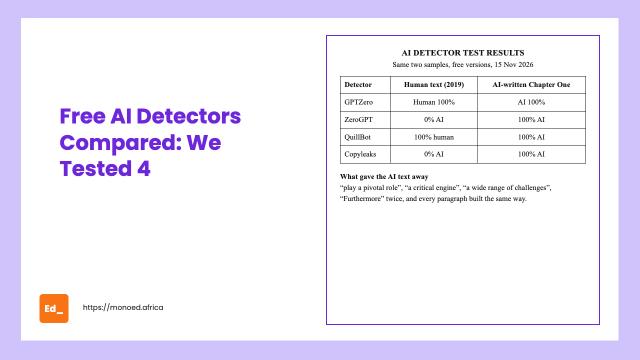
On 15 November 2026 we ran the same two samples through GPTZero, ZeroGPT, QuillBot and Copyleaks, using each tool's free version:
- A human text of about 380 words on agriculture in Nigeria, taken from a 2019 version of a Wikipedia article, written years before ChatGPT existed.
- An AI text of about 320 words: a typical "background to the study" on SMEs in Nigeria, written by an AI model in the style of a Chapter One.
| Sample | GPTZero | ZeroGPT | QuillBot | Copyleaks |
|---|---|---|---|---|
| Human text (2019) | Human 100% | 0% AI | 100% human | 0% AI |
| AI-written Chapter One background | AI 100% | 100% AI | 100% AI-generated | 100% AI, 26 "AI phrases" |
All four got both samples right, and Scribbr runs on QuillBot's detector, so it would very likely agree. Copyleaks also listed 26 "AI phrases" in the AI sample: phrases that appear far more often in AI-written text than in human writing.
These were clear-cut samples: one fully human, one fully AI. Real projects are usually a mix of your own writing, edited text and quoted sources, and that is where detectors disagree and make mistakes.
Notice what made the AI sample so easy to spot: phrases like "play a pivotal role", "a critical engine", "a wide range of challenges", "Furthermore" twice, and every paragraph built the same way. This is exactly how many copied or AI-written Chapter One backgrounds sound, and it is what detectors and supervisors notice first.
Are Free AI Detectors the Same as Turnitin?
No. Most Nigerian schools that check for AI use Turnitin's AI detector, and Turnitin works differently:
- It only scores full sentences in paragraphs, skipping tables, lists and references.
- It hides scores between 1% and 19% (shown as *%) because they are less reliable.
- Students cannot see their Turnitin AI score; only lecturers can.
A free detector can show you which sentences sound generic, but it cannot tell you your Turnitin AI score. Read our full guide on how Turnitin's AI detector works.
How to Use a Free AI Detector on Your Project
- Check one section at a time. Most free limits are a few thousand words, and results are easier to act on per section.
- Read the highlighted sentences, not just the score. The score tells you little; the highlights show what to fix.
- Rewrite, don't spin. Running text through a paraphraser to "beat" a detector can make it worse. Turnitin looks for paraphrased AI text, and supervisors notice strange wording.
- Add your own details. Your study location, sample, dates and what you actually found are the fastest way to make writing sound like you.
- Keep your drafts. If your work is ever questioned, version history and notes show how you wrote it.
A Free Detector That Also Checks for Plagiarism
Most AI detectors only answer one question: does this sound like AI? Your supervisor will also ask whether any of it was copied.
MonoEd's Plagiarism and AI Checker does both in one check. It shows every sentence in your chapter that appears on public web pages or in published research, with a link to the source, and points out lines that may look AI-written with the reason (for example, "every sentence here is about the same length"). You can then rewrite flagged lines in your own words and put the fixed version straight back into your chapter. Your first 1,500 words are free.
Like the other tools here, it is not Turnitin, so your school's result can still differ.
Frequently Asked Questions
Which free AI detector is the most accurate?
No free detector is accurate all the time, and accuracy claims usually come from the companies themselves. GPTZero, Copyleaks and QuillBot are the most widely used. Running the same section through two detectors that use different technology gives a better picture than relying on one.
Is GPTZero better than ZeroGPT?
They are different tools from different companies, despite the similar names. GPTZero highlights sentences and is widely used by teachers; ZeroGPT is simpler and accepts longer text for free. In our test, both (along with QuillBot and Copyleaks) correctly identified a fully human sample and a fully AI sample.
Is Scribbr's AI detector the same as QuillBot's?
Scribbr's free AI detector runs on QuillBot's detector inside Scribbr's website, so the results are usually similar.
Can AI detectors detect QuillBot paraphrasing?
Some can. QuillBot's own detector has an "AI-refined" category for edited AI text, and Turnitin says its English detector looks for AI text changed with paraphrasing tools such as QuillBot.
Why does my own writing show as AI?
Formal, repetitive or template-style writing looks predictable to detectors. Mix short and long sentences, cut filler phrases, and add specific details from your own study.
Will a free AI detector tell me my Turnitin AI score?
No. Each detector uses its own model. A free detector can point out sentences that sound generic, but your school's Turnitin result can be different.
About the Author
Mohammad-Jamiu B. Balogun, GMNSE
Founder & Product Architect, MonoEd Africa
Mohammad-Jamiu is a First-Class Telecommunications Engineer and Best Graduating Student of Bayero University, Kano (Class of 2024), and the founder of MonoEd Africa. An AI engineer and product architect, he designs and builds MonoEd's guided workflows for SIWES logbooks and reports, final year projects and academic tools such as the GPA calculator, helping students produce better work and build the skills the AI era demands. MonoEd's tools have reached more than 20,000 students across Nigeria.