Turnitin AI Detection Explained: How the AI Score Works and What Nigerian Students Should Know
How Turnitin's AI detector works, what the AI percentage and asterisk mean, why your own writing can be flagged, and what to do if your project is flagged.

Many Nigerian students now hear two numbers about their project: the Turnitin similarity score and the Turnitin AI score. They are not the same thing, and mixing them up causes a lot of unnecessary panic.
This guide explains how Turnitin's AI detector works, what each score means, why human writing sometimes gets flagged, and what to do if it happens to you. It is based on Turnitin's own guides for lecturers, checked on 15 November 2026.
What Is the Turnitin AI Detector?
The Turnitin AI detector is a feature inside Turnitin that estimates how much of a document was likely written by a generative AI tool, such as ChatGPT, Gemini or other chatbots. It also looks for AI text that was passed through word spinners, paraphrasing tools such as QuillBot, and so-called bypasser tools.
The result is the AI writing percentage, shown in a separate AI Writing Report.
Two things to know from the start:
- It is separate from the similarity score. The similarity score shows text that matches other sources (plagiarism). The AI percentage estimates AI writing. Turnitin says the two are completely independent and do not affect each other.
- Your school must switch it on. AI detection is a feature institutions choose to license and enable, so not every Nigerian school that uses Turnitin also checks for AI.
For the similarity score, see our guide on what Turnitin similarity percentage is acceptable for a Nigerian project.
How Turnitin Detects AI Writing
According to Turnitin's guides:
- It only reads prose. Turnitin removes headings, lists, bullet points, tables, references, formulas and code. Only full sentences in paragraphs are scored.
- It scores every sentence. Each sentence gets a score between 0 and 1, judged in the context of the sentences around it. Sentences above a set threshold are labelled AI; the rest are labelled human.
- It calculates a percentage. The AI score is the percentage of scored sentences labelled AI.
- It checks for paraphrased AI text. In English, the report separates text that was likely AI-generated from AI text that was likely changed with a paraphraser or bypasser tool.
Requirements for an AI score
Turnitin only produces an AI score when the document:
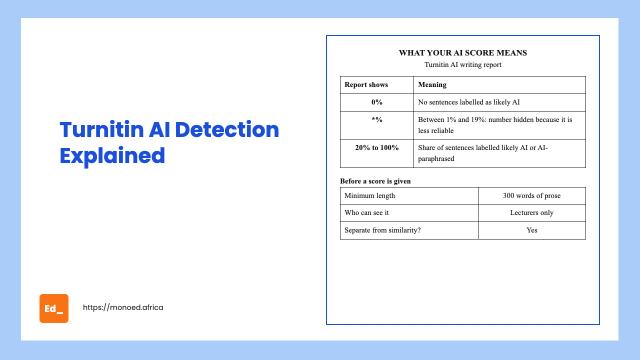
- Has at least 300 words of prose in long-form writing
- Has no more than 30,000 words
- Is a .docx, .pdf, .txt or .rtf file under 100 MB
- Is in a supported language, including English
Because tables and lists are skipped, your AI percentage can look very different from what you expect. A Chapter Four that is mostly tables, for example, has fewer sentences for Turnitin to score.
What Your Turnitin AI Score Means
| What the report shows | What it means |
|---|---|
| 0% | No scored sentences were labelled as likely AI. |
| *% (asterisk) | Something between 1% and 19% was detected. Turnitin hides the number and the highlights because scores in this range have more false positives. |
| 20% to 100% | That share of the scored sentences was labelled as likely AI, or AI then paraphrased. Highlights show which sentences. |
Turnitin also explains that it prefers to miss some AI text rather than wrongly flag human writing. In its own example, a document reported as 50% AI could contain as much as 65% AI writing.
What AI percentage is acceptable?
There is no official "safe" AI percentage, and no national rule in Nigeria. Each school or department decides how it uses the AI score, and many treat it as a starting point for a conversation, not a verdict. Ask your supervisor or project coordinator whether your department checks for AI and how it reads the result.
Can Students See Their Turnitin AI Score?
No. Turnitin's guides say the AI writing indicator and report are not visible to students. Only lecturers see it, although a lecturer can download the AI report as a PDF and share it with you.
This means you usually will not know your AI score before you submit. The best protection is to write in your own voice from the start and keep evidence of how you wrote your project.
How Accurate Is Turnitin's AI Detector?
Turnitin says it aims to keep false positives (human writing wrongly flagged as AI) under 1% for documents with more than 20% AI writing, and that it tests every update on over 700,000 academic papers written before ChatGPT existed. That still means roughly one in every 100 fully human documents could be flagged.
Turnitin is also clear about the limits. Its guide for lecturers says the model may misidentify human, AI and AI-paraphrased text, so it should not be used as the sole basis for adverse action against a student.
Outside Turnitin, researchers have raised concerns about AI detectors in general. A 2023 Stanford study of seven AI detectors found that they flagged more than half of essays written by non-native English speakers as AI-generated. Some universities, such as Vanderbilt in the United States, have switched Turnitin's AI detector off for this reason.
Why Your Own Writing Can Be Flagged as AI
Turnitin's guides name the kinds of human writing that are more likely to be flagged:
- Writing with little variation in structure. Every sentence the same length and shape.
- Text that repeats itself. The same idea restated in slightly different words.
- Text paraphrased without new ideas. Sentences reworded from a source without adding your own thinking.
- Short documents. With only a few hundred words, the prediction is close to "all or nothing", so a mix of your own and AI-assisted text can be flagged as fully AI.
Many Nigerian projects fall into these patterns by accident. Formal academic English, template-style background sections and stiff phrases ("In today's contemporary society", "It is pertinent to note") make writing sound uniform and generic.
How to make your writing sound like you
- Mix short and long sentences, the way you would naturally explain something.
- Use specific details from your study: your actual location, sample size, dates, the company or community you studied, what you observed.
- Cut filler phrases that add nothing.
- Explain ideas in your own words instead of rewording a source sentence by sentence.
- Write your own interpretation in Chapter Four and Chapter Five. Detectors and supervisors both notice when results are described in a generic way.
How to Protect Yourself Before You Submit
- Keep your drafts. Save each version of each chapter with a date, or write in Google Docs or Word online, which keep version history. This is the strongest evidence that you wrote your work.
- Keep your notes and sources. Reading notes, questionnaires, field notes and data files show your process.
- Know your own project. If you can explain every part of it in your own words, a high AI score is much easier to challenge.
- Use AI tools openly and carefully. If your department allows AI for brainstorming, outlining or checking grammar, use it for that and write the chapters yourself. Our guide on using ChatGPT for research without getting flagged by Turnitin shows where the line is.
- Check your chapter first. Find lines that may sound AI-written and rewrite them in your own words before your department checks.
What to Do If Your Project Is Flagged for AI
- Stay calm and ask to see the report. Your lecturer can download it and share it with you. Find out which sentences were highlighted and what percentage was shown.
- Explain your process. Show your drafts, version history, notes, data and sources.
- Offer to talk through your work. Being able to explain your methodology and findings clearly is strong evidence that the work is yours.
- Point to Turnitin's own guidance, politely. Turnitin says the AI score should not be the only basis for action, and that scores can be wrong.
- Fix the flagged parts if asked. Rewrite them in your own voice, with your own examples and data.
Check for AI-Sounding Lines Before You Submit
MonoEd's Plagiarism and AI Checker points out parts of your chapter that may look AI-written, explains what stands out (for example, every sentence being the same length), and helps you rewrite those lines in your own words. It also shows every sentence that appears on public web pages or in published research, with a link to the source.
It is not Turnitin and does not give a Turnitin score. Use it to find and fix the lines most likely to raise questions before your department sees your work.
Frequently Asked Questions
What is the Turnitin AI detector?
It is a Turnitin feature that estimates how much of a document was likely written by AI, or written by AI and then changed with a paraphrasing or bypasser tool. It gives an AI writing percentage that is separate from the similarity score.
Can Turnitin detect ChatGPT?
Turnitin's detector is designed to identify text from large language models, which includes ChatGPT. It is not perfect: it can miss some AI text and can wrongly flag some human writing.
Can Turnitin detect QuillBot?
Turnitin says its English AI detector looks for AI text that was further modified by paraphrasing tools and word spinners, and names QuillBot as an example. This is reported separately in the AI Writing Report.
What does the asterisk (*%) mean on Turnitin's AI score?
It means Turnitin detected something between 1% and 19%. Scores in that range have more false positives, so Turnitin hides the number and the highlights.
Can I see my own Turnitin AI score?
No. The AI report is visible only to lecturers. A lecturer can download it as a PDF and share it with you.
Does the Turnitin AI score affect my similarity score?
No. Turnitin says the two scores are completely independent.
Why does Turnitin not give an AI score for my document?
Your document may have fewer than 300 words of prose, be in an unsupported format, or your school may not have AI detection switched on.
Can Turnitin's AI detector be wrong?
Yes. Turnitin says false positives are possible and that the score should not be the only basis for action against a student. Keep your drafts and notes so you can show how you wrote your work.
About the Author
Mohammad-Jamiu B. Balogun, GMNSE
Founder & Product Architect, MonoEd Africa
Mohammad-Jamiu is a First-Class Telecommunications Engineer and Best Graduating Student of Bayero University, Kano (Class of 2024), and the founder of MonoEd Africa. An AI engineer and product architect, he designs and builds MonoEd's guided workflows for SIWES logbooks and reports, final year projects and academic tools such as the GPA calculator, helping students produce better work and build the skills the AI era demands. MonoEd's tools have reached more than 20,000 students across Nigeria.