What Is EagleScan? Nigeria's Plagiarism Checker Explained for Students
EagleScan is the plagiarism checker built for Nigerian universities. What it checks, how it differs from Turnitin, what your score means, and how to prepare.

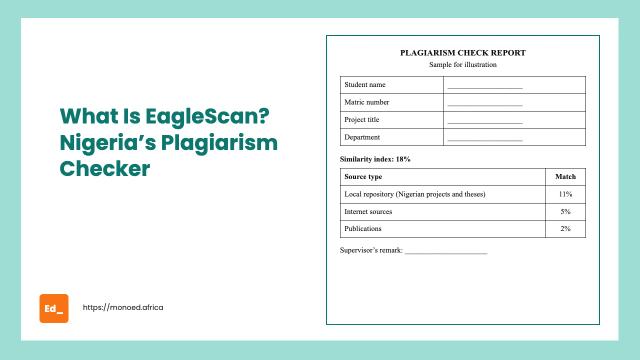
If your supervisor or project coordinator has said your project "will go through EagleScan", you are not alone in asking what that means. EagleScan is a plagiarism checker made in Nigeria for Nigerian schools, and more departments now use it for final year projects, seminars and theses.
This guide explains what EagleScan is, what it checks, how it differs from Turnitin, and how to get your project ready before you submit. It uses EagleScan's official website (eaglescan.ng), checked on 15 November 2026, and reporting by University World News from June 2022.
What Is EagleScan?
EagleScan is a plagiarism detection platform that was an idea of the Committee of Vice-Chancellors of Nigerian Universities (CVCNU), the body of vice-chancellors of federal, state and private universities. A team of developers from Nigerian universities built it, including Al-Hikmah University, the University of Jos, the University of Ilorin, Delta State University, Benue State University and Covenant University. The project also had support from the NUC, TETFund, the Federal Ministry of Education and JAMB.
The software was ready in April 2021 and officially launched in Abuja on 27 April 2022.
EagleScan is not only for universities. Its price list also covers polytechnics, colleges of education, individuals and other organisations.
Why Nigeria Built Its Own Plagiarism Checker
Nigerian universities used Turnitin under a special licence in the mid-2000s. According to the CVCNU's secretary-general, it did not solve the problem, because most Nigerian students were not copying from foreign sources. They were copying from each other: one school's students copied projects from another school, and those projects sat in departmental libraries that no global database could see.
EagleScan was built to close that gap. Its core idea is a local repository: a growing collection of Nigerian projects, theses and dissertations that your work is compared against, alongside global sources.
This matters for you. A project copied from a senior, a past project in your department library or a project material website is exactly what EagleScan was designed to catch.
What EagleScan Checks
EagleScan lists these features:
- Plagiarism checker: compares your document with its local and global sources.
- Similarity index: your result as a percentage of text that matches other sources.
- Local repository: stored Nigerian projects and theses that new work is checked against.
- Document comparison: compares two documents directly.
- Title verification: checks whether a project title or scope has been used before.
- Abstract validation, peer review and a grammar checker.
In June 2022, University World News reported that EagleScan had indexed over 790,000 documents and was used by more than 230 institutions, 57 of them higher institutions, with over 4,200 subscribers. These are 2022 figures, and the repository depends on schools digitising their old projects, so coverage differs from school to school.
What about AI detection? EagleScan describes its platform as built with artificial intelligence and machine learning. We could not find any public information that it scores how "AI-written" a project sounds, so do not assume it does or does not. Ask your department if it matters to them.
EagleScan vs Turnitin
| EagleScan | Turnitin | |
|---|---|---|
| Made by | Nigerian universities (CVCNU) | Turnitin, LLC (United States) |
| Main strength | Local repository of Nigerian projects and theses | Huge global database of web pages, journals and student papers |
| Best at catching | Copying from past Nigerian projects | Copying from international sources and papers in its database |
| Result | Similarity percentage | Similarity percentage |
| Price shown publicly | Yes, on eaglescan.ng | No, sold to institutions |
The same chapter can get a different score on each tool, because each one compares your work with different sources. That is why a low score on one checker does not promise a low score on another.
What Is an Acceptable EagleScan Score?
There is no national EagleScan percentage. Each school, faculty or department sets its own limit, and some exclude references, quotes and small matches before they read the score. Many Nigerian departments use limits somewhere between 15% and 30% for undergraduate projects, but the only number that counts is the one your department gives you.
Ask your supervisor or project coordinator:
- Which tool will check my project: EagleScan, Turnitin or both?
- What is the maximum similarity allowed?
- Are references and quotations excluded from the score?
- Do I submit it myself, or does the department submit it for me?
For how similarity scores work in more detail, see our guide on what Turnitin percentage is acceptable for a Nigerian project. The same thinking applies to EagleScan.
How Much Does EagleScan Cost?
EagleScan's website lists these yearly prices (checked 15 November 2026):
- Nigerian universities, polytechnics and colleges of education: ₦1,150 per year
- Individuals and other organisations: ₦1,250 per year
- Subscribers outside Nigeria: $3 per year
In most schools the department or school runs the check, so you may never pay or log in yourself. Confirm with your department before you register.
One caution before uploading your own project: some plagiarism checkers keep uploaded documents in their database. If that happens, your final submission can match your own earlier upload and your score goes up. We could not confirm how EagleScan handles individual uploads, so ask your department or EagleScan support first.
How to Prepare Your Project for EagleScan
Because EagleScan is built to find copying from Nigerian projects, the safest approach is to write your own work from the start and check it as you go.
1. Do not reuse a senior's project or a project material website
These are the sources EagleScan's local repository is designed to catch. Changing the case study, the year or the name of the school does not make a copied project original.
2. Rewrite your Chapter One background and Chapter Two definitions
Background sections and definitions are where most copying happens, because they are often pasted "for now" and never rewritten. Explain each idea in your own words and cite where it came from.
3. Cite everything that is not yours
Definitions, theories, statistics, tables and figures from other works all need a citation. Put exact words in quotation marks and keep quotes short.
4. Check each chapter before you submit
Find copied sentences early, while there is still time to fix them. Our guide on how to avoid plagiarism in your final year project shows how to paraphrase properly and how to reduce a high score.
Check Your Chapter Before Your Department Does
MonoEd's Plagiarism and AI Checker shows every sentence in your chapter that appears on public web pages or in published research, with a link to the source, and points out lines that may look AI-written. You get suggested rewrites in your own words, then put the fixed version back into your chapter.
It is not EagleScan and cannot see the projects stored in EagleScan's repository, so your school's score can still be different. Use it to find and fix copied sentences from the web before you submit.
Frequently Asked Questions
Is EagleScan the same as Turnitin?
No. Both give a similarity percentage, but EagleScan was made by Nigerian universities and compares your work with a local repository of Nigerian projects and theses. Turnitin is an American tool with a large global database.
Who owns EagleScan?
EagleScan was an initiative of the Committee of Vice-Chancellors of Nigerian Universities (CVCNU) and was built by developers from Nigerian universities, with support from bodies including the NUC and TETFund.
Does EagleScan detect AI-written work?
We could not find public information that EagleScan gives an AI-writing score. Ask your department whether they check for AI and with which tool.
Can EagleScan detect paraphrasing?
EagleScan's developers said in 2022 that they were building AI into the platform to recognise paraphrased and translated work. Swapping a few words for synonyms is still easy for most checkers to spot, so rebuild each sentence from your own understanding instead.
What percentage is acceptable on EagleScan?
There is no national figure. Your department sets the limit. Many Nigerian departments use limits between 15% and 30% for undergraduate projects.
Can I check my project on EagleScan myself?
EagleScan sells individual subscriptions on its website. Before you upload your final work, ask whether uploaded documents are saved to the repository, because that could make your official submission match your own earlier upload.
Does EagleScan check past projects from my school?
It checks projects that have been added to its repository. How many past projects your school has added depends on how far your school has gone in digitising them.
About the Author
Mohammad-Jamiu B. Balogun, GMNSE
Founder & Product Architect, MonoEd Africa
Mohammad-Jamiu is a First-Class Telecommunications Engineer and Best Graduating Student of Bayero University, Kano (Class of 2024), and the founder of MonoEd Africa. An AI engineer and product architect, he designs and builds MonoEd's guided workflows for SIWES logbooks and reports, final year projects and academic tools such as the GPA calculator, helping students produce better work and build the skills the AI era demands. MonoEd's tools have reached more than 20,000 students across Nigeria.