Why Your IELTS Writing Score Is Stuck at Band 6.5: What to Check Before Writing Another Essay
Stuck at IELTS Writing Band 6.5? Learn how to review task response, paragraph development, vocabulary, and grammar to choose your next practice steps.

You write another IELTS essay.
You check the result.
Band 6.5 again.
It can be frustrating, especially when you are practising regularly and need Band 7 for your application.
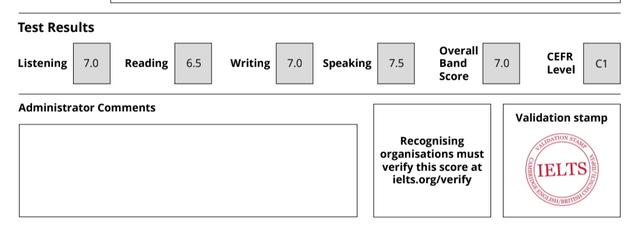
During my preparation, I often received mock scores around 6.0 and 6.5. My eventual Writing score was 7.0, and my overall result was also 7.0.
That experience does not mean everyone will improve in the same way.
However, it taught me to look beyond the number.
If your Writing score keeps returning to the same level, the useful question is:
“What weakness keeps appearing in my work?”
This article focuses on Task 2 and how to investigate that question before writing another essay.
Quick Summary: What to Check First
If your Writing results are not changing:
- Identify where the scores come from.
- Look at feedback for each marking criterion.
- Check whether you answer every instruction.
- Examine how fully you explain your main points.
- Review paragraph organisation and connections.
- Identify recurring vocabulary and grammar errors.
- Revise an existing response before starting another.
- Test what you learned on a fresh question.
These are areas to investigate, not a diagnosis based on your score alone.
Different candidates can receive the same band for different reasons.
1. Check What the Score Actually Represents
Before deciding that you are stuck at 6.5, identify the source of that number.
Is it:
- An official IELTS Writing result?
- A teacher’s assessment of a Task 2 essay?
- An AI-generated estimate?
- Your own judgement?
These are different kinds of evidence.
Also distinguish between an assessment of one Task 2 essay and your complete IELTS Writing result.
Look for repeated weaknesses in the feedback, rather than assuming every score is directly comparable.
If different tools give very different results, avoid choosing whichever score feels most encouraging. Return to the actual comments and, where possible, ask a qualified teacher to explain the assessment.
2. Review Each Marking Criterion Separately
Task 2 is assessed through Task Response, Coherence and Cohesion, Lexical Resource, and Grammatical Range and Accuracy.
The official IELTS Writing band descriptors describe performance across these areas.
Use them to organise your review.
| Area | A useful review question |
|---|---|
| Task Response | Have I answered the question and developed my points? |
| Coherence and Cohesion | Can the reader follow the argument easily? |
| Lexical Resource | Am I choosing words accurately and appropriately? |
| Grammatical Range and Accuracy | Can I use different sentence structures with control? |
Do not assume that vocabulary is the problem simply because you want a higher score.
Your next improvement might involve answering an overlooked instruction or explaining an example more clearly.
3. Check Whether You Answered Every Part of the Question
An essay can contain reasonable English while leaving part of the task unanswered.
Consider this illustrative question:
Some people believe governments should make public transport free. Discuss the advantages and disadvantages of this policy and give your own opinion.
A response that only explains the benefits would leave important instructions unaddressed.
Before reviewing your essay, write down the task requirements:
- Explain advantages.
- Explain disadvantages.
- Give an opinion.
Then identify where your response addresses each one.
This simple comparison can reveal a problem that proofreading alone will not fix.
4. Look for Ideas That Are Repeated Instead of Developed
Read this example:
Public transport is important because it has many benefits. It is useful for people and helps society. Therefore, governments should improve it.
The paragraph expresses support, but the explanation remains vague.
What benefit does the writer mean?
Who experiences it?
How does it happen?
A more developed version could be:
Reliable public transport can make employment more accessible to people who cannot afford a car. A bus route connecting residential areas with business districts allows these residents to reach workplaces that would otherwise be difficult to access. This gives them more practical options when looking for work.
The revision develops one specific point.
Try asking “why?” or “how?” after each main claim in your own essay. If the next sentence does not answer either question, the explanation may need work.
5. Check Whether Your Examples Support Your Argument
An example should help explain the point you are making.
Suppose your paragraph argues that online learning reduces the cost of education.
An example about watching entertaining videos would not clearly support that claim.
An example about avoiding relocation or daily travel would connect more directly.
After each example, ask:
“What does this demonstrate?”
If the answer is different from your paragraph’s main point, revise the example or reconsider the argument.
Avoid adding invented research findings or unsupported percentages to make a paragraph appear convincing. Explain a relevant situation clearly.
6. Review Connections Between Sentences
A paragraph can contain useful ideas but still be difficult to follow.
Read it without paying attention to linking words.
Can you identify how each sentence follows from the previous one?
For example:
Many employees prefer flexible hours. However, they can start work earlier.
“However” suggests a contrast, but the second sentence does not establish a clear opposing idea.
You could write:
Flexible hours allow some employees to start work earlier and finish in time to collect their children from school.
The relationship is now clearer without needing an extra linking phrase.
Check that words such as “therefore,” “however,” and “for example” match the relationship you intend.
7. Stop Replacing Words Without Checking Meaning
Vocabulary practice is useful, but automatic synonym replacement can create unnatural sentences.
For example, “a big problem” might become “a significant problem.”
However, a more useful revision might explain the problem itself:
Long commuting times leave some employees with little opportunity to rest between working days.
That sentence tells the reader more.
When reviewing vocabulary, check:
- Is the meaning accurate?
- Does the word fit naturally with the surrounding words?
- Is the sentence unnecessarily vague?
- Can I express the point more precisely?
Keep a simple word when it does the job well.
8. Find the Grammar Errors That Keep Returning
One isolated mistake may be easy to correct.
A repeated pattern needs deliberate practice.
For example:
Many student prefer studying online.
These course are convenient.
Both suggest difficulty with plural noun forms.
Record the pattern, correct the sentences, and practise applying the correction to new examples.
Do not respond to grammar feedback by removing every complex sentence. Work toward using a range of structures accurately, beginning with sentences whose meaning you can control.
9. Change What Happens Between Essays
If every session follows this pattern—
Write → receive score → start another essay
—you may be missing the stage where learning happens.
Try:
Write → review → revise → explain the changes → attempt a fresh question
Keep the original and revised versions.
Write a short note:
“My first paragraph repeated the claim. I added an explanation of how the benefit occurs.”
That note gives you something specific to apply next time.
💡 You may like to read: How to Score Band 7+ in IELTS Writing
Get Feedback You Can Turn Into an Action
Since taking IELTS, I’ve built MyBandPrep to help candidates practise Task 2 writing and identify sentences to improve.
You can review an estimated band score across the four criteria, revise your response, and check it again.
Find areas to improve in your IELTS Task 2 essay
The scores are AI-generated practice estimates, not official IELTS results. Evaluate the suggestions carefully and use teacher feedback where you need further clarification.
A Focused Practice Plan to Try
For your next few writing sessions:
- Select an essay with feedback.
- Identify one recurring weakness.
- Revise the relevant paragraph.
- Explain why the revision helps.
- Plan a fresh question.
- Write a new response independently.
- Check whether the same weakness appears.
If the problem continues, make the exercise smaller.
For example, practise developing individual main points before attempting another complete timed essay.
Conclusion
A repeated score tells you to investigate.
It does not tell you which skill to practise.
Look closely at the question, your explanations, your organisation, and the language patterns in your work.
Choose a specific weakness, practise addressing it, and check whether the change carries over to a fresh response.
That gives your next writing session a clearer purpose.
FAQs
Why do I keep getting Band 6.5 in IELTS Writing?
There is no single explanation. Different combinations of strengths and weaknesses can produce the same result. Review feedback across the four criteria and look for recurring problems.
Is vocabulary always the reason I cannot reach Band 7?
No. Vocabulary is one assessment area. Task coverage, idea development, organisation, and grammar also need attention. Use feedback to identify your priorities.
Should I write an essay every day?
Choose a routine that includes review and revision. If daily essays leave no time to understand mistakes, fewer complete essays with more focused practice may be more useful.
Can an AI checker tell me exactly what my official score will be?
No. Treat an AI-generated score as a practice estimate. Use the comments to investigate your work rather than treating the number as a guaranteed result.
How long does it take to improve from Band 6.5 to Band 7?
There is no dependable timeline for every candidate. It depends on the weaknesses involved, the feedback available, and how consistently you can apply what you learn.
Should I get help from a teacher?
Consider qualified feedback if you cannot understand repeated problems, receive conflicting assessments, or remain below your required score. A focused review may help you decide what to practise next.
About the Author
Mohammad-Jamiu B. Balogun, GMNSE
AI Security Researcher · Founder, MonoEd Africa
Mohammad-Jamiu is a First-Class Telecommunications Engineer and Best Graduating Student, BUK '24, and an AI security researcher. He founded MonoEd Africa to give Nigerian students AI-powered academic tools — from SIWES logbooks to final year projects. His work has reached over 10,000 students across Nigeria.