40 Microbiology Seminar Topics for Nigerian Students (2026)
40 microbiology seminar topics for Nigerian students, from antimicrobial resistance and food safety to environmental and industrial microbiology.

A microbiology seminar is your chance to explain a topic you find interesting without the stress of lab work. You read recent studies, organise what they found, and present it clearly. The best topics connect microbiology to a real problem people care about: infections, food safety, pollution or new technology.
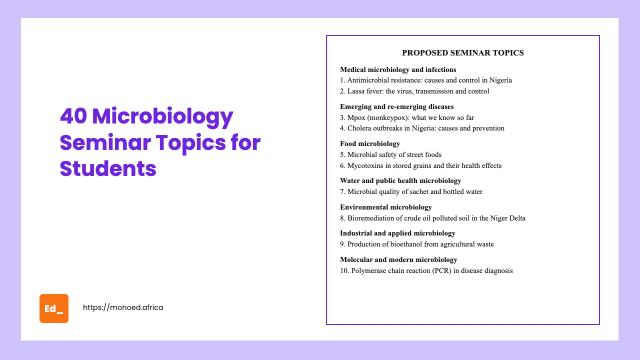
Here are 40 seminar topics grouped by area.
Treat these as ideas to discuss with your seminar coordinator. Your department has the final say.
What makes a good microbiology seminar topic
- Current. New outbreaks, resistance trends, new technologies or recent research.
- Well covered. At least 15 to 20 recent journal articles or reports.
- Focused. One organism, one disease, one process or one application.
- Relevant to Nigeria. Panels like topics that link global research to local problems.
40 microbiology seminar topics
Medical microbiology and infections
- Antimicrobial resistance: causes and control in Nigeria
- Lassa fever: the virus, transmission and control
- Methicillin-resistant Staphylococcus aureus (MRSA) in hospitals
- Typhoid fever: diagnosis challenges and drug resistance
- Tuberculosis and the rise of multidrug-resistant strains
- Hospital-acquired infections and their prevention
- Helicobacter pylori and stomach diseases
- Urinary tract infections in women
Emerging and re-emerging diseases
- Mpox (monkeypox): what we know so far
- Cholera outbreaks in Nigeria: causes and prevention
- Zoonotic diseases and the One Health approach
- Diphtheria re-emergence and vaccination gaps
- Viral haemorrhagic fevers in West Africa
Food microbiology
- Microbial safety of street foods
- Mycotoxins in stored grains and their health effects
- Probiotics and human health
- Microbiology of traditional fermented foods
- Food preservation methods and microbial control
- Foodborne pathogens: Salmonella, Listeria and E. coli
Water and public health microbiology
- Microbial quality of sachet and bottled water
- Water-borne diseases and safe water in rural Nigeria
- Hand hygiene and the spread of infections
- Microbial contamination of currency notes
Environmental microbiology
- Bioremediation of crude oil polluted soil in the Niger Delta
- Microbial degradation of plastics
- Role of microorganisms in waste management
- Biofilms: formation, problems and control
- Microorganisms and climate change
Industrial and applied microbiology
- Production of bioethanol from agricultural waste
- Microbial enzymes and their industrial uses
- Single cell protein as a future food source
- Biofertilizers and sustainable agriculture
- Microbial production of antibiotics
Molecular and modern microbiology
- Polymerase chain reaction (PCR) in disease diagnosis
- CRISPR and its applications in microbiology
- Bacteriophage therapy as an alternative to antibiotics
- The human microbiome and health
- Genome sequencing in outbreak investigation
Immunology and vaccines
- Malaria vaccines: progress and prospects
- Vaccine hesitancy and its effect on disease control
How to prepare your microbiology seminar
Narrow the topic. "Antimicrobial resistance" is wide. "Antimicrobial resistance in Staphylococcus aureus in Nigerian hospitals" gives you a clear focus.
Use recent sources. Look for journal articles from the last ten years, reports from the WHO and the Nigeria Centre for Disease Control (NCDC), and reviews in microbiology journals. See how to find papers for a literature review.
Structure it simply. Introduction, the organism or process, current evidence, the situation in Nigeria, control or applications, then conclusion and recommendations.
Write it yourself. Seminar papers are mostly literature, so copied text is easy to spot. Read how to avoid plagiarism, and use your department's seminar report format.
For project ideas, see microbiology project topics, and for more departments see seminar topics for students.
Frequently Asked Questions
What are good microbiology seminar topics?
Antimicrobial resistance, Lassa fever, food safety, bioremediation, probiotics and phage therapy are current and well researched.
Do I need lab work for a microbiology seminar?
No. A seminar reviews published research. Lab work is for your final year project.
How many references should a seminar paper have?
Usually 15 to 30, mostly recent journal articles and reports. Check your department's guidelines.
Where can I find sources?
Google Scholar, PubMed, African Journals Online, WHO and NCDC reports, and your university library's e-resources.
How long is a microbiology seminar presentation?
Usually 15 to 20 minutes, followed by questions.
About the Author
Mohammad-Jamiu B. Balogun, GMNSE
Founder & Product Architect, MonoEd Africa
Mohammad-Jamiu is a First-Class Telecommunications Engineer and Best Graduating Student of Bayero University, Kano (Class of 2024), and the founder of MonoEd Africa. An AI engineer and product architect, he designs and builds MonoEd's guided workflows for SIWES logbooks and reports, final year projects and academic tools such as the GPA calculator, helping students produce better work and build the skills the AI era demands. MonoEd's tools have reached more than 20,000 students across Nigeria.