35 Microbiology Final Year Project Topics and Ideas for Nigerian Students
35 microbiology project topics for Nigerian students, from water and food quality to antibiotic resistance, with tips on lab access and choosing a topic.

A microbiology project lives or dies in the lab. The topic can be great on paper, but if your department has no media for the organism, or the autoclave is booked by twenty other students, you will struggle. So before you fall in love with a topic, ask two questions: where will I get my samples, and can our lab handle the tests?
The good news is that some of the most approvable topics use samples you can buy or collect anywhere: sachet water, street food, soil, hospital surfaces.
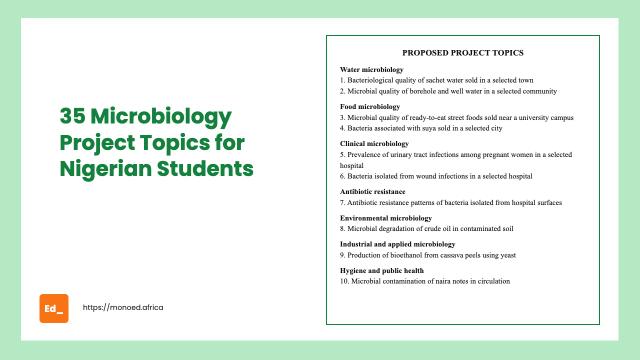
Here are 35 ideas by area.
Treat these as a starting point for a talk with your supervisor, and confirm lab access before you commit.
What makes a good microbiology topic
- Local, easy samples. Water, food, soil, surfaces or clinical samples you are allowed to collect.
- Standard methods. Isolation, identification, counts and sensitivity tests your lab can run.
- A clear comparison. Between sites, brands, seasons or treatments.
- A public health angle. Panels like topics that matter to people's health.
35 microbiology project topics
Water microbiology
- Bacteriological quality of sachet water sold in a selected town
- Microbial quality of borehole and well water in a selected community
- Comparison of the microbial quality of bottled and sachet water brands
- Presence of coliforms in water stored in household containers
- Effect of storage time on the microbial quality of sachet water
Food microbiology
- Microbial quality of ready-to-eat street foods sold near a university campus
- Bacteria associated with suya sold in a selected city
- Microbial load of locally fermented foods such as ogi, fura or ugba
- Fungi associated with the spoilage of tomatoes in local markets
- Microbial quality of zobo and kunu drinks sold by vendors
- Isolation of Staphylococcus aureus from meat pies and snacks
- Microbial contamination of raw milk and wara
Clinical microbiology
- Prevalence of urinary tract infections among pregnant women in a selected hospital
- Bacteria isolated from wound infections in a selected hospital
- Prevalence of Helicobacter pylori among patients with stomach complaints
- Prevalence of malaria parasites among students in a university clinic
- Candida species isolated from high vaginal swabs
Antibiotic resistance
- Antibiotic resistance patterns of bacteria isolated from hospital surfaces
- Bacteria on mobile phones of healthcare workers and their sensitivity to antibiotics
- Antibiotic sensitivity of Escherichia coli isolated from poultry droppings
- Contamination of door handles and toilets in student hostels
- Antimicrobial activity of plant extracts against common pathogens
Environmental microbiology
- Microbial degradation of crude oil in contaminated soil
- Bacteria and fungi associated with refuse dumpsites
- Microbial quality of air in hospital wards
- Biodegradation of plastic waste by soil microorganisms
- Heavy metal tolerant bacteria from industrial effluents
Industrial and applied microbiology
- Production of bioethanol from cassava peels using yeast
- Isolation of amylase-producing bacteria from soil
- Production of single cell protein from agricultural waste
- Use of lactic acid bacteria as starter cultures for fermented foods
- Production of vinegar from local fruits
Hygiene and public health
- Microbial contamination of naira notes in circulation
- Effectiveness of hand sanitisers sold in local markets
- Bacterial contamination of cosmetics and creams sold in open markets
Choosing a microbiology topic you can finish
Talk to your lab technologist early. They know which media are in stock and which tests are realistic this semester.
Plan your sampling. Decide how many samples, from where, and on which days. Ten to thirty samples is common for undergraduate projects.
Get permission for clinical samples. Hospital samples need approval from the hospital and often an ethics committee. If time is short, choose food, water or environmental samples instead.
Budget for consumables. Media, antibiotic discs and reagents cost money. Price them before you settle on a topic.
More help: how to choose a final year project topic.
Writing your microbiology project
Chapter Three should describe sample collection, media preparation, isolation, identification and any sensitivity testing in enough detail that someone could repeat it. Chapter Four presents counts, identified organisms and resistance patterns in tables, with your interpretation.
Your SIWES lab experience is a good source of practical topics. See the microbiology SIWES report guide.
Frequently Asked Questions
What are easy microbiology project topics?
Water and food quality topics, such as sachet water or street food, are easy to sample and use standard methods most department labs can run.
Do I need ethical approval?
For clinical samples from patients, usually yes. Food, water and environmental samples normally do not need ethics approval, but check with your department.
How many samples do I need?
Ten to thirty is common for undergraduate projects, depending on your topic and lab capacity. Agree the number with your supervisor.
What is a good antibiotic resistance topic?
Testing bacteria from hospital surfaces, mobile phones of health workers or poultry droppings against common antibiotics is practical and relevant.
How many chapters does a microbiology project have?
Most use five: introduction, literature review, materials and methods, results, and discussion with conclusion. Check your department's format.
About the Author
Mohammad-Jamiu B. Balogun, GMNSE
Founder & Product Architect, MonoEd Africa
Mohammad-Jamiu is a First-Class Telecommunications Engineer and Best Graduating Student of Bayero University, Kano (Class of 2024), and the founder of MonoEd Africa. An AI engineer and product architect, he designs and builds MonoEd's guided workflows for SIWES logbooks and reports, final year projects and academic tools such as the GPA calculator, helping students produce better work and build the skills the AI era demands. MonoEd's tools have reached more than 20,000 students across Nigeria.