30 Community Health Project Topics and Ideas for Nigerian Students
30 community health project topics for Nigerian students, from primary health care and immunisation to sanitation and disease prevention, with tips on choosing one.

Community health is about keeping people healthy where they live: clean water, immunisation, malaria prevention, good nutrition and primary health care that people actually use. If you are a Community Health Extension Worker (CHEW) student, a public health student or studying community health in a college of health technology, your project should reflect that focus on the community.
Most projects take one community or local government and measure knowledge, practices or use of a health service. Your field posting is often the best source of a topic.
Here are 30 ideas grouped by area.
Treat these as a starting point for a talk with your supervisor. Get permission from community leaders or the health facility before collecting data.
What makes a good community health topic
- One community or local government. A real place you can visit.
- One health issue. Malaria, immunisation, sanitation, nutrition, hypertension or a specific service.
- One thing to measure. Knowledge, attitude, practice or use of a service.
- Simple data collection. A short questionnaire or observation checklist.
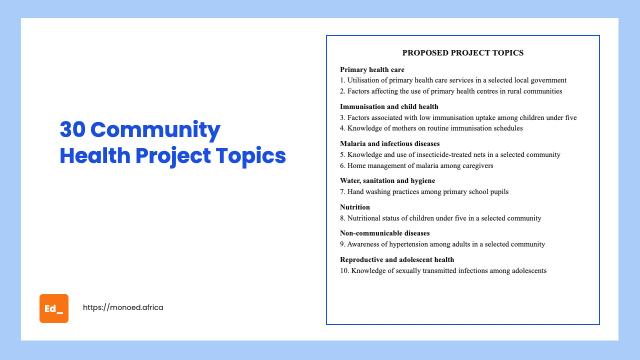
30 community health project topics
Primary health care
- Utilisation of primary health care services in a selected local government
- Factors affecting the use of primary health centres in rural communities
- Community participation in primary health care
- Client satisfaction with services in a selected primary health centre
Immunisation and child health
- Factors associated with low immunisation uptake among children under five
- Knowledge of mothers on routine immunisation schedules
- Management of childhood diarrhoea by mothers in a selected community
- Growth monitoring practices in primary health centres
Malaria and infectious diseases
- Knowledge and use of insecticide-treated nets in a selected community
- Home management of malaria among caregivers
- Knowledge and prevention of Lassa fever in a selected community
- Awareness of tuberculosis symptoms and treatment
- Knowledge and prevention of cholera in a riverine community
Water, sanitation and hygiene
- Hand washing practices among primary school pupils
- Sources of drinking water and water treatment practices in households
- Waste disposal practices in a selected community
- Open defecation and access to toilets in rural communities
Nutrition
- Nutritional status of children under five in a selected community
- Feeding practices of mothers of infants
- Knowledge of balanced diet among secondary school students
Non-communicable diseases
- Awareness of hypertension among adults in a selected community
- Knowledge of diabetes risk factors among adults
- Use of tobacco and alcohol among young people in a selected area
Reproductive and adolescent health
- Knowledge of sexually transmitted infections among adolescents
- Use of family planning services in a selected community
- Menstrual hygiene practices among adolescent girls
Health education and services
- Role of community health extension workers in health promotion
- Effectiveness of health education on hygiene practices among pupils
- Use of traditional medicine in a selected community
- Health insurance awareness among artisans and traders
Choosing a community health topic you can finish
Use your field posting. Problems you saw during community posting are easier to justify and research.
Get community entry right. Visit the community head, health facility in charge or local government health department before you start. A letter from your department helps.
Keep the questionnaire short. Many respondents may not read English well. Use simple questions and get help with translation into the local language if needed.
Consider observation. For hygiene and sanitation topics, an observation checklist can be more accurate than asking people what they do.
More help: how to choose a final year project topic and how to calculate sample size.
Writing your community health project
Most projects use five chapters. Chapter Two often uses the Health Belief Model or the PRECEDE-PROCEED model. Chapter Three describes the community, sampling method, instrument and ethical considerations. Chapter Four presents results in frequency tables with interpretation.
For related topics, see public health project topics and nursing project topics.
Frequently Asked Questions
What are good community health project topics?
Topics on primary health care use, immunisation uptake, malaria prevention, hand washing and waste disposal are practical and researchable.
Which theory can I use?
The Health Belief Model, the PRECEDE-PROCEED model and the Theory of Planned Behaviour are common in community health projects.
Do I need ethical approval?
Many schools require it, especially when you collect data from people in a community. Ask your department and get permission from community leaders.
How many respondents do I need?
Many projects use 100 to 200 respondents, depending on the community size. Use a sample size formula and agree with your supervisor.
How many chapters does the project have?
Most use five. Check your school's format.
About the Author
Mohammad-Jamiu B. Balogun, GMNSE
Founder & Product Architect, MonoEd Africa
Mohammad-Jamiu is a First-Class Telecommunications Engineer and Best Graduating Student of Bayero University, Kano (Class of 2024), and the founder of MonoEd Africa. An AI engineer and product architect, he designs and builds MonoEd's guided workflows for SIWES logbooks and reports, final year projects and academic tools such as the GPA calculator, helping students produce better work and build the skills the AI era demands. MonoEd's tools have reached more than 20,000 students across Nigeria.