35 Economics Project Topics and Ideas for Nigerian Students
35 economics project topics for Nigerian students, from inflation and exchange rates to agriculture and remittances, with tips on data sources and methods.

Economics projects have one big advantage: most of the data is free. The Central Bank of Nigeria statistical bulletin, the National Bureau of Statistics and the World Bank publish decades of figures on GDP, inflation, interest rates, exchange rates, oil revenue and more. If you can find two or three series that run for 25 to 35 years, you have a project.
The usual structure is simple: one dependent variable (like GDP growth or manufacturing output), a few explanatory variables, and a regression model. What separates a good project from an average one is how well you explain the results.
Here are 35 ideas grouped by area.
Treat these as a starting point for a talk with your supervisor, and check the data exists for your period before you commit.
What makes a good economics topic
- A clear relationship. The effect of X on Y in Nigeria.
- Data that exists. At least 25 years of annual data, or enough quarterly data, from a reliable source.
- A method you can explain. OLS regression, ARDL, cointegration or VAR, depending on your data.
- A current issue. Inflation, the naira, fuel subsidy removal, debt and unemployment are all live debates.
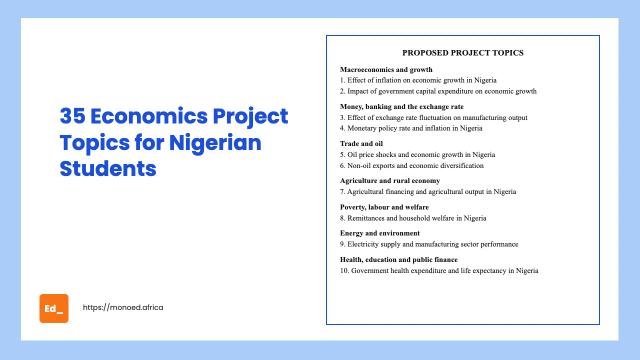
35 economics project topics
Macroeconomics and growth
- Effect of inflation on economic growth in Nigeria
- Impact of government capital expenditure on economic growth
- Public debt and economic growth in Nigeria
- Effect of unemployment on economic growth
- Fiscal policy and macroeconomic stability in Nigeria
Money, banking and the exchange rate
- Effect of exchange rate fluctuation on manufacturing output
- Monetary policy rate and inflation in Nigeria
- Effect of money supply on inflation
- Interest rate and private sector investment
- Financial inclusion and economic growth in Nigeria
- Effect of the naira redesign on cash circulation and small businesses
Trade and oil
- Oil price shocks and economic growth in Nigeria
- Non-oil exports and economic diversification
- Trade openness and economic growth
- Effect of import substitution on local manufacturing
- Foreign direct investment and economic growth in Nigeria
Agriculture and rural economy
- Agricultural financing and agricultural output in Nigeria
- Effect of the Anchor Borrowers' Programme on rice production
- Insecurity and agricultural output in North Central Nigeria
- Rural infrastructure and farmers' income in a selected state
Poverty, labour and welfare
- Remittances and household welfare in Nigeria
- Determinants of poverty in rural households in a selected state
- Youth unemployment and crime in Nigeria
- Effect of minimum wage increases on employment
- Human capital development and economic growth
Energy and environment
- Electricity supply and manufacturing sector performance
- Effect of fuel subsidy removal on transport costs and inflation
- Renewable energy consumption and economic growth
- Climate change and agricultural productivity in Nigeria
Health, education and public finance
- Government health expenditure and life expectancy in Nigeria
- Education expenditure and economic growth
- Tax revenue and economic growth in Nigeria
- Corruption and economic development
Digital and emerging economy
- Mobile money and financial inclusion in rural Nigeria
- Effect of digital payments on small business growth
Choosing an economics topic you can finish
Download the data first. Before you submit a topic, open the CBN statistical bulletin or the World Bank database and confirm that every variable you need covers your period. Gaps in the data are the most common reason economics projects stall.
Keep the model small. One dependent variable and three or four explanatory variables are enough. More variables mean more to explain at your defence.
Learn your software early. EViews, Stata, R or Gretl are common for time series work. SPSS can handle simple regression. See SPSS vs Excel vs Python.
Know your tests. Time series projects usually need unit root tests (such as ADF) and often cointegration tests. Panels will ask why you used them.
More help: how to choose a final year project topic and research objectives, questions and hypotheses.
Writing your economics project
Chapter Two should cover the concepts, the economic theory behind your relationship (for example Keynesian theory, the quantity theory of money or endogenous growth theory) and recent empirical studies. Chapter Three specifies your model, data sources and estimation technique. Chapter Four presents your tests and regression results with interpretation.
- Chapter One
- Chapter Two: literature review
- Chapter Three: methodology
- Chapter Four: results
- Chapter Five
Frequently Asked Questions
What are good economics project topics?
Topics on inflation and growth, exchange rates and manufacturing, public debt, oil prices and remittances are popular because the data is free and the issues are current.
Where can I get data for an economics project?
The Central Bank of Nigeria statistical bulletin, the National Bureau of Statistics, the World Bank World Development Indicators and the IMF publish free data on most Nigerian variables.
How many years of data do I need?
Around 25 to 35 years of annual data is common for time series projects. Check with your supervisor.
Which software should I use?
EViews is common in Nigerian economics departments. Stata, R and Gretl also work. Use what your department supports and you can explain.
Do I need to do unit root tests?
For time series data, usually yes. They check whether your variables are stationary, which affects which model you should use.
About the Author
Mohammad-Jamiu B. Balogun, GMNSE
Founder & Product Architect, MonoEd Africa
Mohammad-Jamiu is a First-Class Telecommunications Engineer and Best Graduating Student of Bayero University, Kano (Class of 2024), and the founder of MonoEd Africa. An AI engineer and product architect, he designs and builds MonoEd's guided workflows for SIWES logbooks and reports, final year projects and academic tools such as the GPA calculator, helping students produce better work and build the skills the AI era demands. MonoEd's tools have reached more than 20,000 students across Nigeria.