SIWES vs SWEP: What Is the Difference?
SWEP and SIWES are both practical training, but they are not the same. See who runs each one, when you do it, where it happens and how it is graded.

Quick summary:
SWEP (Students Work Experience Programme) is practical training your own school runs, usually in its workshops, labs or farms, in an early year of your course. SIWES (Students Industrial Work Experience Scheme) comes later and happens outside school, in a real company or organisation, with the Industrial Training Fund (ITF) involved. SWEP prepares you; SIWES puts you in industry.
If you study engineering, agriculture or some science courses, you may hear about SWEP before you hear about SIWES. Students often think they are the same thing. They are related, but different.
What is SWEP?
SWEP stands for Students Work Experience Programme. It is practical training organised by your university, usually for students in their early years, often during a long vacation.
It normally takes place inside the school, in places like:
- engineering workshops (fitting, welding, carpentry, electrical)
- the university farm (for agriculture)
- laboratories
The aim is to give you basic hands-on skills before you go out to industry. Your school sets the timetable, the tasks and how it is assessed. Not every course or school runs SWEP, so check your department.
What is SIWES?
SIWES stands for Students Industrial Work Experience Scheme. It was set up in 1973 and is managed by the Industrial Training Fund (ITF) together with universities, polytechnics and colleges. See the history of SIWES.
You do SIWES outside your school, in a company, government agency, hospital, media house or other organisation that takes you. You keep a logbook, fill ITF forms, and write a report at the end. See SIWES forms explained.
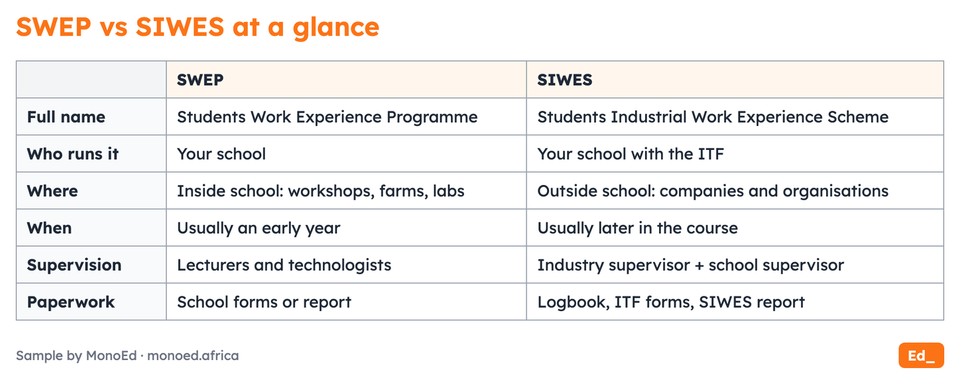
SIWES vs SWEP at a glance
| SWEP | SIWES | |
|---|---|---|
| Full name | Students Work Experience Programme | Students Industrial Work Experience Scheme |
| Who runs it | Your school | Your school with the ITF |
| Where | Inside school: workshops, farms, labs | Outside school: companies and organisations |
| When | Usually an early year | Usually later in the course |
| Who supervises | Lecturers and technologists | An industry supervisor plus a school supervisor |
| Paperwork | School forms or reports | Logbook, ITF forms and a SIWES report |
| Who finds the place | The school | Usually you, with your school's letter |
The exact year and duration depend on your school and course. Follow your department's handbook.
Do I need to do both?
If your department runs SWEP, yes. SWEP is part of your school's programme and SIWES is a separate requirement. Doing one does not replace the other.
Is SWEP the same as IT?
No. IT (Industrial Training) is another name for SIWES, mostly used in polytechnics. See SIWES vs IT. SWEP is the school-based programme that comes before.
How to get ready for SIWES while doing SWEP
- Take SWEP seriously. The skills you learn are the ones companies expect you to have.
- Keep notes and photos of what you did. They help with your CV.
- Ask seniors where they did SIWES and start a list of companies.
- Prepare your CV early. See the SIWES CV guide.
When it is time to look for a SIWES place, the SIWES Finder lets you search organisations by course and state.
Frequently Asked Questions (FAQs)
What is the full meaning of SWEP?
Students Work Experience Programme.
What is the full meaning of SIWES?
Students Industrial Work Experience Scheme.
Which comes first, SWEP or SIWES?
SWEP usually comes first, in an early year. SIWES comes later.
Do all students do SWEP?
No. It is mainly for engineering, agriculture and some science and technology courses, and it depends on the school.
Does the ITF pay for SWEP?
SWEP is a school programme. SIWES is the scheme the ITF is involved in. Ask your school about any SWEP fees or allowances.
Do I need a logbook for SWEP?
Some schools give a SWEP workbook or ask for a report. It is not the same as the SIWES logbook.
About the Author
Mohammad-Jamiu B. Balogun, GMNSE
AI Security Researcher · Founder, MonoEd Africa
Mohammad-Jamiu is a First-Class Telecommunications Engineer and Best Graduating Student, BUK '24, and an AI security researcher. He founded MonoEd Africa to give Nigerian students AI-powered academic tools — from SIWES logbooks to final year projects. His work has reached over 10,000 students across Nigeria.