15 ChatGPT Prompts for Your Final Year Project (and Where ChatGPT Goes Wrong)
15 ChatGPT prompts that actually help with a Nigerian final year project, from narrowing your topic to defence prep, plus the 5 places ChatGPT goes wrong.

Quick summary:
ChatGPT is useful for a final year project when you use it to think, not to write your project for you. Good prompts give it your topic, department and what you already have, then ask for something specific: narrower topic options, measurable objectives, a Chapter Two outline, an explanation of a statistical test, or likely defence questions. Never ask it for references or Chapter Four results. It often invents references, and it will make up results if you let it. Check every fact it gives you.
Many Nigerian students now open ChatGPT before they open Microsoft Word. That is fine. Used well, ChatGPT can save you hours of confusion. Used badly, it can hand you fake references, made-up results and a chapter your supervisor rejects in five minutes.
This guide gives you 15 prompts that actually help, how to use each one, and the five places ChatGPT goes wrong for a Nigerian project.
Before you start, check what your school allows. Some departments ask you to declare AI use. See can you use AI for your final year project.
How to write a good prompt
ChatGPT gives generic answers to generic questions. A good prompt has four parts:
- Who you are: "I am a final year Economics student at a Nigerian university."
- What you have: your topic, your objectives, a paragraph you wrote, your SPSS output.
- What you want: one specific thing, not "write my Chapter Two".
- The format: "Give me 5 options", "Use a table", "Explain like I'm new to statistics".
Replace everything in [square brackets] below with your own details.
Prompts for choosing and narrowing your topic
1. Narrow a broad idea
I am a final year [department] student in Nigeria. I am interested in [broad area, e.g. mobile banking]. Suggest 8 narrow, researchable project topics I could complete in one semester with a small budget. For each, say what data I would need and where I would get it in Nigeria.
Why it works: it forces ChatGPT to think about data you can actually collect, which is where most topics fail.
2. Check if your topic is too broad
Here is my proposed project topic: "[your topic]". Is it too broad for an undergraduate project in Nigeria? If yes, give me 3 narrower versions that name a specific population, place or time period.
See also how to choose a final year project topic.
Prompts for Chapter One
3. Turn your aim into measurable objectives
My project topic is "[topic]". My general aim is to [aim]. Write 4 specific objectives that are measurable. Start each with a verb such as determine, assess, examine or compare. Then write one research question that matches each objective.
Your objectives, research questions and hypotheses must match each other. See research objectives, questions and hypotheses.
4. Find the gap for your statement of the problem
Here are summaries of three studies I read: [paste your own short notes]. Based only on these notes, what did these studies not cover that my study on "[topic]" could address? Do not add any studies I did not mention.
Why it works: "based only on these notes" stops ChatGPT from inventing studies.
5. Draft your scope
My study is on "[topic]". The population is [who], the location is [where], and the data covers [time period]. Write a short scope of the study paragraph, and a separate list of 3 realistic limitations, each with what I can do to reduce its effect.
Prompts for Chapter Two
6. Outline your literature review
I am writing Chapter Two for a project on "[topic]" in a Nigerian [department] department. Suggest headings and subheadings for the conceptual review, theoretical framework and empirical review. Do not give me any references.
7. Explain a theory in plain English
Explain [theory name] in simple English, as if to a final year student. Then explain how it could apply to a study on "[topic]" in Nigeria. Keep it under 250 words.
Always confirm the theory and its original author in a real textbook or journal before you cite it.
Prompts for Chapter Three
8. Choose a research design
My study on "[topic]" uses [questionnaire / interviews / an experiment / a system I built]. Which research design fits best, and why? Compare 2 options in a short table.
9. Draft questionnaire items
Write 5 Likert-scale questionnaire items (Strongly Agree to Strongly Disagree) to measure [variable] among [population] in Nigeria. Keep each item short, clear and about one idea only.
Then test them with a few classmates. See how to design a questionnaire people will fill.
Prompts for Chapter Four
10. Pick the right statistical test
My research question is "[question]". My variables are [variable 1, type] and [variable 2, type]. My sample size is [n]. Which statistical test should I use, and why? Explain the decision rule in plain English.
11. Interpret your own SPSS output
Here is my SPSS output: [paste your output]. Explain what it means in plain English, then write a short interpretation paragraph using only these figures. Do not change or add any numbers.
Why it works: the results come from your data. ChatGPT only helps you explain them. See how to analyse questionnaire data in SPSS.
Prompts for writing and editing
12. Improve your own paragraph
Here is a paragraph I wrote: [paste]. Improve the grammar and make it more academic, but keep my meaning and my citations exactly as they are. Show me what you changed.
13. Write your abstract from your own summary
Here is a summary of my project: topic [topic], method [method], sample [n], main findings [your findings], recommendation [recommendation]. Write a 200-word abstract in the past tense using only this information.
See how to write an abstract for a final year project.
Prompts for your defence
14. Predict panel questions
I am defending a final year project titled "[topic]". My method was [method] and my main finding was [finding]. List 15 questions a Nigerian project defence panel is likely to ask, from easy to hard.
15. Practise your answers
Ask me those questions one at a time. After each of my answers, tell me what was weak and how to say it better.
More in final year project defence questions and answers.
Where ChatGPT goes wrong for a Nigerian final year project
ChatGPT is a general assistant. Your project has rules it does not know. These are the five problems students run into most.
1. It invents references
Ask ChatGPT for sources and it will often give you authors, journals and years that look perfect but do not exist. It predicts what a reference should look like rather than looking one up. Supervisors check, and one fake reference can cast doubt on your whole project. See why ChatGPT invents citations.
2. It makes up results
If you ask for Chapter Four, ChatGPT will happily write "65% of respondents agreed..." from nowhere. Those figures are not your data. Submitting them is fabrication, and it falls apart the moment your panel asks how you got them.
3. It does not know your department's format
Every department has its own headings, order and citation style. ChatGPT gives you a generic structure unless you paste your supervisor's outline every time.
4. It forgets your earlier chapters
Each chat is separate. Chapter Three may describe different objectives from Chapter One, and Chapter Five may summarise findings you never had. Supervisors notice when chapters do not agree.
5. It cannot handle your supervisor's corrections in context
Pasting a correction into ChatGPT often gets you a rewrite of the whole section, which brings new problems for your supervisor to find.
Why we built a guided workflow instead
These five problems are the reason the MonoEd FYP Generator works step by step instead of as a chat box:
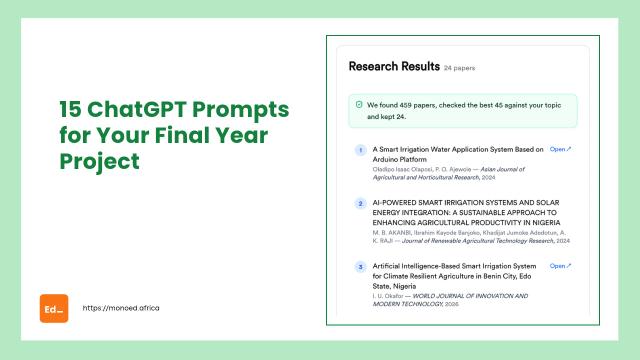
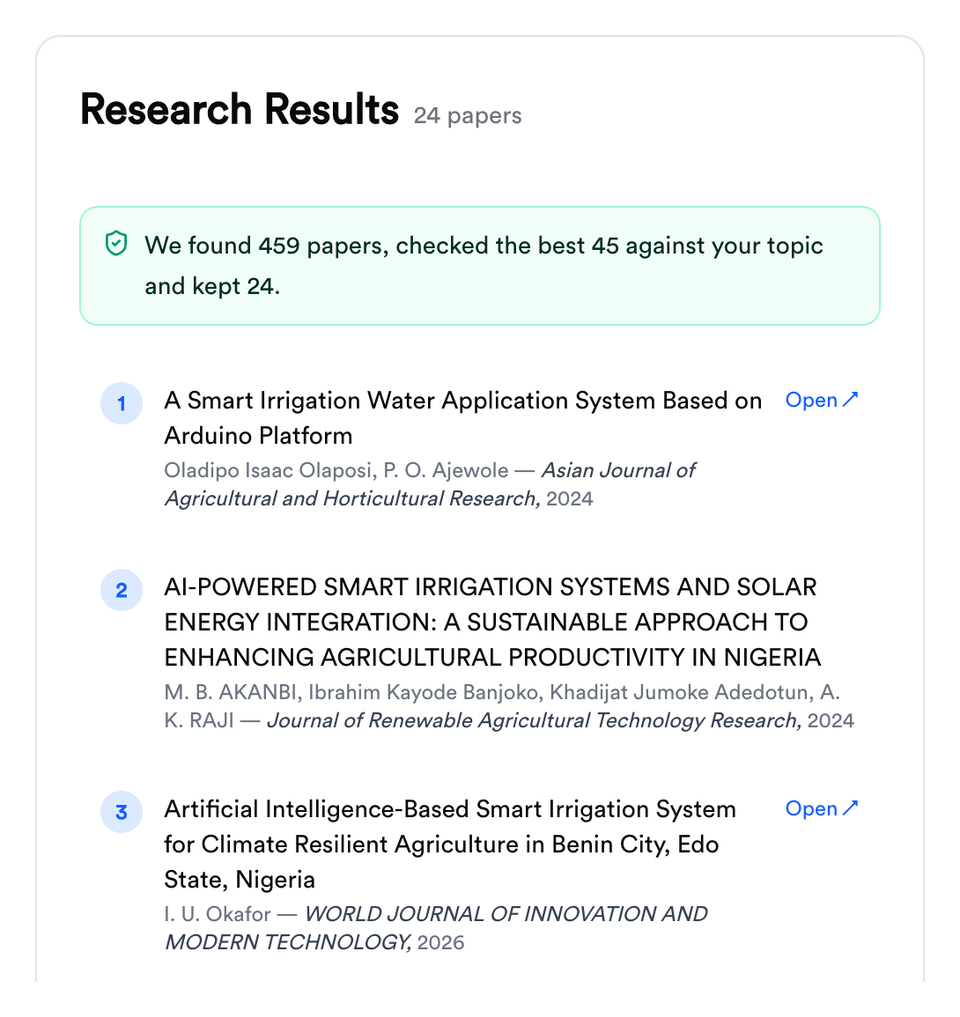
- Real sources first. It finds published papers on your topic and checks them against what your project is about before any chapter is written. Chapters cite only those papers, and you can open each one at its source.
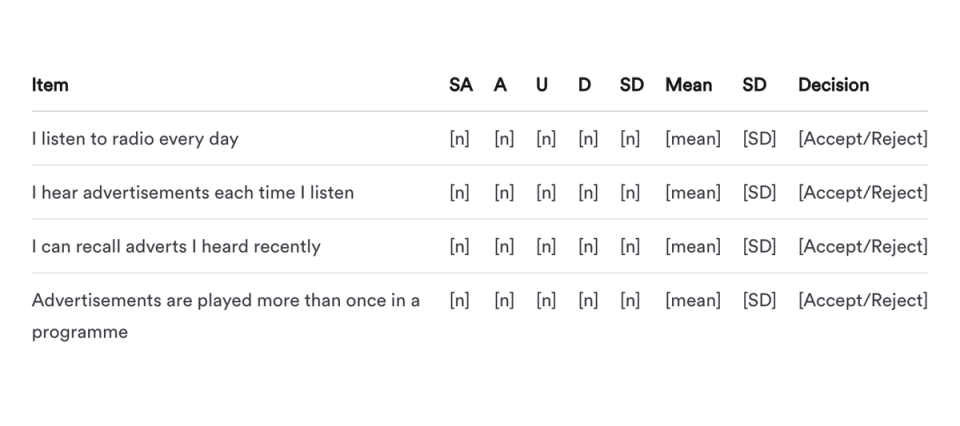
- Your results, not invented ones. It shows you what data to collect and from whom. Chapter Four tables are laid out for your study and left for you to fill in with your real figures.
- Your department's headings. Paste your supervisor's outline once and every chapter follows it.
- One project, not separate chats. Chapters are written from the same topic, objectives and sources, so they agree with each other.
- Supervisor corrections. Paste the comments or snap the marked pages. You get a checklist, and only the flagged parts are rewritten.
You still read it, add your details and make it yours. Chapters 1 and 2 of your first project are free.
Frequently asked questions
Can I use ChatGPT for my final year project?
Yes, for brainstorming, explanations, editing your own writing and defence practice, as long as your school allows it. Do not use it to invent references or results, and declare AI use if your department requires it.
What is the best ChatGPT prompt for a final year project?
The best prompts include your department, your topic, what you already have and one specific request. "Write my Chapter Two" is a weak prompt. "Suggest Chapter Two headings for a study on [topic], without references" is a strong one.
Can ChatGPT write my Chapter One?
It can draft one, but it will be generic, and it may include facts and references you cannot verify. Use it to outline and to improve your own writing, then check every claim.
Will my supervisor know I used ChatGPT?
Supervisors often recognise generic AI writing, and fake references are easy to spot once checked. Writing in your own words, from your own notes and data, is the safest approach. See how to use ChatGPT for research without getting flagged by Turnitin.
Can ChatGPT give me real references?
Not reliably. Search for sources in Google Scholar or your library, or use a tool that finds real published papers before it writes.
Is it plagiarism to use ChatGPT?
Copying AI text and presenting it as your own work can break your school's rules even if it is not copied from a person. Check your department's AI policy and see what Turnitin percentage is acceptable.
About the Author
Mohammad-Jamiu B. Balogun, GMNSE
AI Security Researcher · Founder, MonoEd Africa
Mohammad-Jamiu is a First-Class Telecommunications Engineer and Best Graduating Student, BUK '24, and an AI security researcher. He founded MonoEd Africa to give Nigerian students AI-powered academic tools — from SIWES logbooks to final year projects. His work has reached over 10,000 students across Nigeria.