How to Handle Supervisor Corrections on Your Final Year Project (Without Starting Over)
Your chapter came back full of red ink? How to read supervisor corrections, turn them into a checklist, fix them in order and resubmit without starting over.

Quick summary:
To handle supervisor corrections, first read every comment without changing anything. Then turn the comments into a numbered checklist, sort them into big changes (structure, objectives, methodology) and small ones (grammar, references, formatting), and fix the big ones first. Change only what was flagged, keep a copy of the old version, and resubmit with a short note listing what you changed. If a comment is unclear, ask your supervisor one specific question instead of guessing.
Getting a chapter back covered in red ink feels bad. It is also normal. Almost every Nigerian final year student goes through two, three or more rounds of corrections before a supervisor signs off on a chapter.
Corrections are not a sign that your project is failing. They are your supervisor telling you exactly what they want to see. The students who finish fastest are not the ones with the fewest corrections. They are the ones who fix corrections properly the first time, so the same comment does not come back.
This guide shows you how.
Step 1: Read everything before you change anything
The first mistake most students make is opening Word and fixing the first comment they see. Do not do that.
Read the whole chapter and every comment first. Some comments only make sense together. A note on page 3 saying "objectives not clear" may be the reason for a note on page 12 saying "this does not answer your research question". Fix the first one properly and the second one may disappear.
While you read, notice the tone. "Rewrite" is different from "rephrase". "Remove" is different from "reduce". Your supervisor chose those words.
Step 2: Turn the comments into a checklist
Write every comment as a numbered item in a separate document or notebook. One line each, with the page number.
For example:
- Page 2: background too general, focus on Nigeria
- Page 4: statement of the problem does not show the gap
- Page 5: objective 3 is not measurable
- Page 7: scope should state the study area and period
- Page 9: Adeyemi (2019) not in the reference list
- Throughout: use past tense for what other studies found
A checklist turns a scary, marked-up chapter into a list of tasks you can finish one by one. It also makes it much harder to miss a comment, which is the most common reason the same correction comes back.
If your supervisor wrote on paper, take clear photos of each marked page before you start so you do not lose any handwritten notes.
Step 3: Sort big corrections from small ones
Not all corrections are equal. Sort your list into two groups.
Big corrections change what your project says:
- Changing or narrowing the topic
- Rewriting the statement of the problem
- Changing objectives, research questions or hypotheses
- Changing the research design, population or sample
- Restructuring a chapter or moving sections
Small corrections change how it is said:
- Grammar, spelling and tense
- Missing or wrongly formatted references
- Headings, numbering and font
- Table and figure labels
- Wordy or repeated sentences
Fix the big ones first. A change to your objectives may change your research questions, your methodology and your Chapter 4 tables. If you polish the grammar first, you will polish sentences you end up deleting.
Step 4: Follow the chain when you change something big
Big corrections in Chapter 1 almost always reach other chapters. When you change one of these, check everything connected to it:
| If you change... | Also check... |
|---|---|
| The topic or title | Title page, abstract, every chapter introduction |
| Objectives | Research questions, hypotheses, Chapter 3 methods, Chapter 4 tables, Chapter 5 summary |
| Research questions | Questionnaire items, Chapter 4 section headings |
| Population or sample | Sample size calculation, sampling technique, data collection procedure |
| Study area or period | Scope of the study, background, Chapter 3 |
Students often fix Chapter 1 perfectly and then get the same correction back in Chapter 3, because the methodology still describes the old objectives. Follow the chain.
Step 5: Change only what was flagged
When a section has a comment, fix that section. Do not rewrite the whole chapter because one part was marked.
There are two reasons for this. First, the parts your supervisor did not mark are parts they have already accepted. If you rewrite them, they have to read and approve them again, and they may find new problems. Second, a full rewrite makes it hard for your supervisor to see that you addressed their comments.
If you use AI to help with a correction, give it only the section that was flagged and the exact comment. Do not ask it to rewrite the full chapter.
Step 6: Keep the old version
Before you start, save a copy of the chapter with the date in the file name, for example Chapter2_v1_12Nov.docx. Make your corrections in a new copy.
Sometimes a supervisor changes their mind, or a second supervisor disagrees with the first. If you have the old version, you can go back in minutes instead of rewriting from memory.
Step 7: When a comment is unclear, ask one specific question
Supervisors write fast, and comments like "No!", "Expand" or "?" are common. If you genuinely cannot tell what a comment means, do not guess and hope.
Ask one specific question, ideally in person or in a short message:
- Weak: "Sir, I don't understand your corrections."
- Better: "Sir, on page 6 you wrote 'expand'. Should I add more studies to the empirical review, or explain the existing studies in more detail?"
A specific question shows you have read the comments and saves both of you time.
Step 8: Resubmit with a short note
When you hand in the corrected chapter, include a short list of what you changed. It can be a half page at the front or a message:
Corrections made to Chapter Two:
- Added four Nigerian studies to the empirical review (pages 18 to 21)
- Rewrote the theoretical framework around the Technology Acceptance Model
- Added missing references and corrected APA format
- Changed reported findings to past tense throughout
This makes your supervisor's next reading much faster, and a supervisor who can check your corrections quickly is more likely to approve the chapter quickly.
Common corrections Nigerian supervisors give (and what they usually mean)
| Comment | What it usually means |
|---|---|
| "Too general" | Narrow it to your study area, population or Nigerian context |
| "Where is the gap?" | Show what earlier studies did not cover that your study will |
| "Not measurable" | Rewrite the objective with a verb you can test: determine, assess, examine, compare |
| "Cite" or "Source?" | Add a reference for that claim, from a real published study |
| "Not in reference list" | Every in-text citation must appear in References, and the reverse |
| "Use past tense" | Findings of other studies and your own methods are reported in the past tense |
| "Rephrase" | Keep the idea, change the wording, often because it reads like copied text |
| "Align with your objectives" | This section does not clearly connect to what your study set out to do |
How long should corrections take?
Small corrections usually take a day or two. Big corrections to Chapter 1 or Chapter 3 can take a week, because of the chain effect. Try to resubmit within a week of getting your chapter back. Supervisors handle many students, and a quick, tidy resubmission keeps your project near the top of their pile.
Fix corrections faster with MonoEd
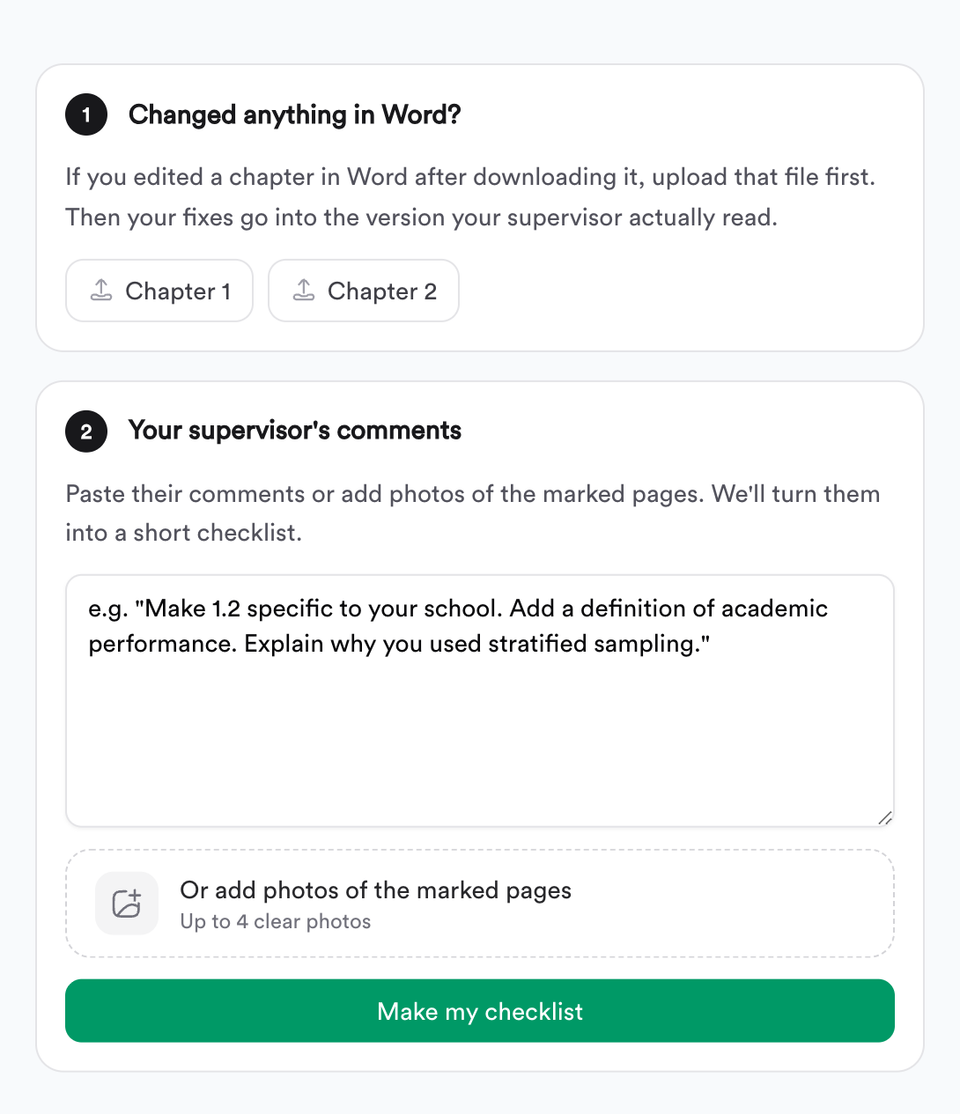
If you are writing with the MonoEd FYP Generator, Supervisor Fix Mode follows the same steps as this guide. Paste your supervisor's comments or take photos of the marked pages, and you get a short checklist of what they asked for. Only the parts they flagged are rewritten, and the rest of your chapter stays as it was. Version history keeps your earlier draft in case you need to go back.
Chapters 1 and 2 of your first project are free to write and read. Unlocking the full project, including Supervisor Fix Mode, costs ₦6,500 once, not per chapter.
Frequently asked questions
Is it normal to get many corrections on my project?
Yes. Two or three rounds of corrections per chapter is normal for Nigerian final year projects. Supervisors use corrections to bring your work to the standard your department expects.
Should I rewrite the whole chapter after corrections?
No. Change only the parts your supervisor flagged, plus anything those changes affect. Rewriting everything means your supervisor has to read and approve the whole chapter again.
What if my supervisor's corrections contradict each other?
Write down both comments with their dates and ask your supervisor which one to follow. If two supervisors disagree, the main supervisor usually has the final say, but ask politely rather than choosing yourself.
What if I don't agree with a correction?
You can explain your reasoning once, briefly and respectfully, with a source if you have one. If your supervisor still wants the change, make it. They sign off on your project.
Can I use AI to fix supervisor corrections?
You can use AI to help, as long as you give it the exact comment and only the flagged section, then check the result yourself. Never let AI change your data, results or references without checking them.
What if my supervisor rejects my topic after corrections?
Ask what kind of topic they would accept and whether any of your current work can be reused. Often your literature review and methodology can be adapted to a narrower version of the same topic. See how to choose a final year project topic.
About the Author
Mohammad-Jamiu B. Balogun, GMNSE
AI Security Researcher · Founder, MonoEd Africa
Mohammad-Jamiu is a First-Class Telecommunications Engineer and Best Graduating Student, BUK '24, and an AI security researcher. He founded MonoEd Africa to give Nigerian students AI-powered academic tools — from SIWES logbooks to final year projects. His work has reached over 10,000 students across Nigeria.