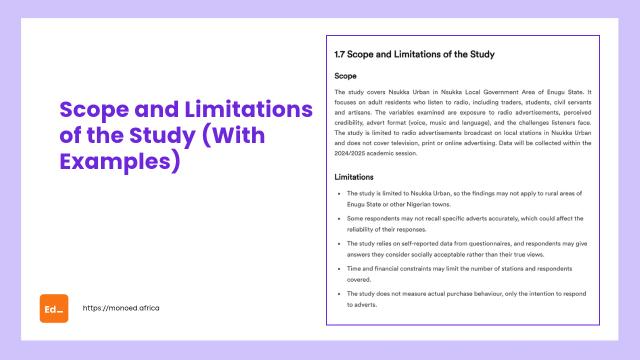
Scope and Limitations of the Study: How to Write Them in Chapter One (With Examples)
What goes in the scope of the study, what counts as a limitation, how they differ from delimitations, with examples for survey, software and engineering projects.

Quick summary:
The scope of the study states the boundaries you chose: the topic area, the population, the location and the time period your project covers. The limitations are the problems outside your control that affect your study, such as a small sample, limited access to data or respondents who may not answer honestly. Write the scope in the present or future tense as clear facts ("This study covers..."). Write limitations honestly, then say how you reduced their effect. Most Nigerian departments place both at the end of Chapter One, after the significance of the study.
The scope and limitations section is one of the shortest parts of Chapter One, and one of the most often corrected. Supervisors write "scope not clear" or "these are not limitations" because students mix the two up, or write something so general it could fit any project.
This guide explains what each one means, how to write them, and gives examples you can adapt for your own project.
What is the scope of the study?
The scope is the boundary of your study. It tells the reader exactly what your project covers and, by implication, what it does not.
A good scope answers four questions:
- What is being studied? The main variables or the system you are building.
- Who is being studied? The population or users.
- Where? The location, institution or organisation.
- When? The time period, if your data covers one.
The scope is your choice. You decided to study final year students instead of all students, or Ilorin instead of all of Kwara State. That is why the scope is written as a plain statement of fact.
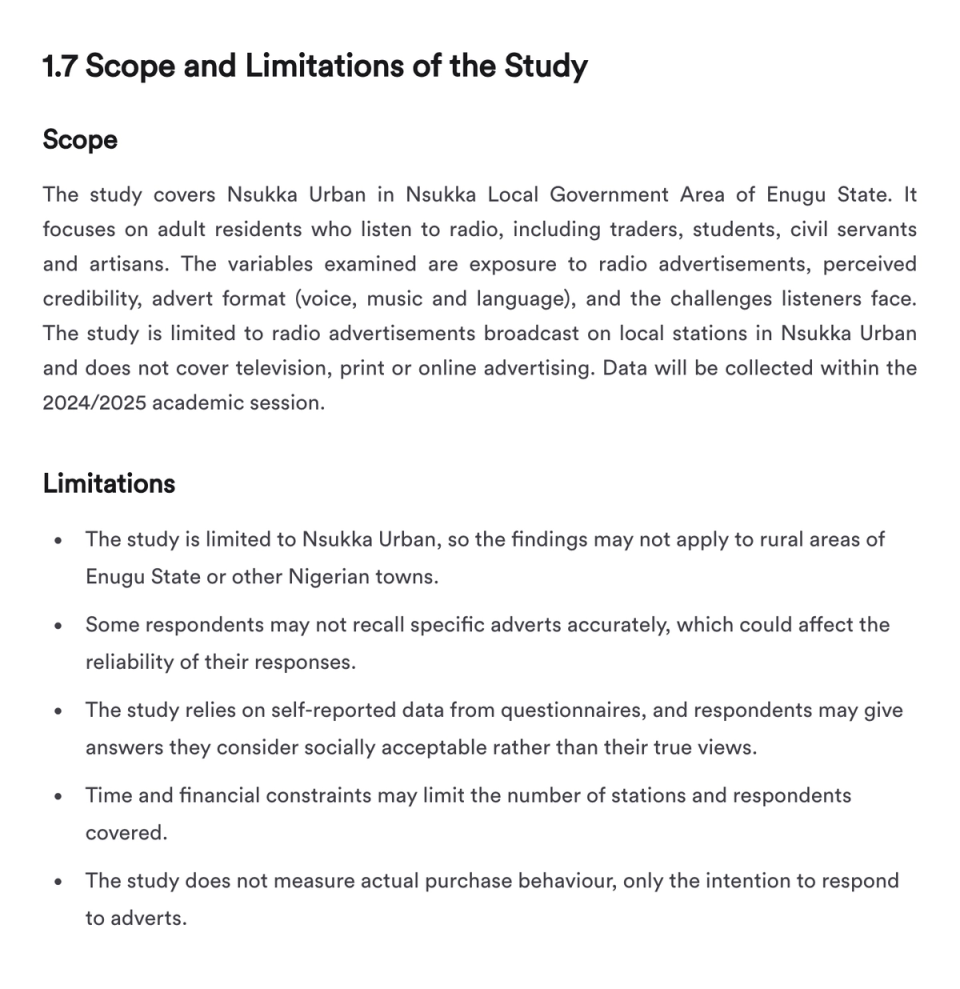
Example: scope for a questionnaire-based study
This study examines the effect of social media use on the study habits of undergraduate students. It covers final year students in the Faculty of Social Sciences, University of Ilorin, during the 2025/2026 academic session. The study focuses on WhatsApp, Instagram and TikTok, and on three aspects of study habits: time spent studying, concentration and assignment completion.
Notice how specific it is. A reader knows the population (final year students), the place (one faculty in one university), the period (one session) and the variables (three platforms, three aspects of study habits).
Example: scope for a software project
This project covers the design and implementation of a web-based student result management system for the Department of Computer Science, Kwara State Polytechnic. The system allows lecturers to upload scores, computes grade points and CGPA, and lets students view and print their results. It is built with PHP and MySQL. Online payment of fees and transcript requests are outside the scope of this project.
For software and engineering projects, the scope lists the features the system will have, the users, the technology and, very usefully, the features it will not have. That last sentence protects you at your defence when a panel member asks "why can't it do X?"
Example: scope for an engineering project
This project covers the design and construction of a GSM-based weather monitoring system that measures temperature, humidity and rainfall and sends readings by SMS. It uses an Arduino Uno, a DHT11 sensor, a rain sensor and a SIM800L GSM module. The system was tested at the Faculty of Engineering, over a period of two weeks. Wind speed and solar radiation measurement are not covered.
What are the limitations of the study?
Limitations are problems you could not control that may affect your results or how far they apply. Every study has them. Stating them honestly shows your supervisor and your defence panel that you understand your own research.
Common limitations in Nigerian final year projects include:
- Sample size. A small sample, because of time or cost, means results may not apply to the wider population.
- Access to respondents or data. Some respondents refused to take part, or an organisation would not release records.
- Self-reported data. Respondents may give answers they think are expected instead of honest ones.
- Time. The project had to fit into one or two semesters.
- Funds. Equipment, printing or travel costs limited what could be done.
- Components (for engineering projects). Cheaper sensors were used, which limits accuracy.
- Internet and power. Unreliable power or network affected testing.
How to write a limitation properly
A limitation has two parts: the problem and what you did about it. The second part is what most students leave out.
Weak:
The researcher was limited by time and finance.
This is the most common sentence in Nigerian Chapter Ones, and supervisors are tired of it. It does not say how time or money affected the study, or what you did.
Better:
The study was limited to 120 respondents from one faculty because of the time available for the project. As a result, the findings may not apply to all students of the university. To reduce this, respondents were selected by stratified random sampling so that every department in the faculty was represented.
For an engineering project:
The DHT11 sensor used in this project has an accuracy of about plus or minus 2°C, which is lower than that of professional weather instruments. Readings were therefore compared against a calibrated thermometer during testing, and the differences are reported in Chapter Four.
Scope vs limitations vs delimitations
Some departments, especially in education and the social sciences, ask for delimitations as well. Here is the difference:
| Scope | Delimitations | Limitations | |
|---|---|---|---|
| What it is | What the study covers | Boundaries you chose and why | Problems you could not control |
| Who decides it | You | You | Circumstances |
| Example | Final year students, UNILORIN, 2025/2026 | Only final year students, because they have the longest experience of university study habits | Some students did not return questionnaires |
| Tense | Present or future | Present or future | Past (in the final report) |
If your department only asks for "Scope and Limitations", the delimitations usually go inside the scope paragraph, as part of explaining your boundaries.
Common mistakes
- Mixing them up. "This study is limited to Lagos State" is scope, not a limitation. You chose Lagos.
- Being too general. "This study covers students in Nigeria" is not a usable scope for a project with 150 respondents.
- Listing limitations with no effect. Explain how each limitation affects your findings.
- Too many limitations. Three or four real ones are enough. Ten limitations make your study sound unreliable.
- Not matching the rest of the project. If your scope says one faculty, Chapter Three must sample from that faculty. If it says 2025/2026, your data must come from that session.
- Forgetting to update them. Write limitations in the future tense in your proposal, then update them in the past tense once your study is done, based on what actually happened.
Where does it go, and how long should it be?
In most Nigerian universities and polytechnics, Scope and Limitations comes near the end of Chapter One, after the Significance of the Study and before the Definition of Terms. Some departments make them two separate headings (1.6 Scope of the Study, 1.7 Limitations of the Study). Check your department's format or your supervisor's outline.
Half a page to one page is usually enough for both. See how to write Chapter One for the full order, and how to write your research objectives, since your scope should match your objectives exactly.
Get a Chapter One that matches your study
The MonoEd FYP Generator drafts Chapter One, including the scope and limitations, from your own topic, school and department, and from real published papers it checks against your topic first. If your supervisor gave you an outline with separate headings, paste it in and Chapter One follows it. Chapters 1 and 2 of your first project are free.
Frequently asked questions
What is the difference between scope and limitation of the study?
The scope is the boundary you chose: what, who, where and when your study covers. Limitations are problems outside your control, such as a small sample or limited access to data, that affect how far your results apply.
Is "time and finance" a valid limitation?
Only if you explain how it affected the study and what you did about it. On its own, "the researcher was limited by time and finance" is too vague and is often marked down.
Should scope and limitations be separate headings?
It depends on your department. Many use one heading, "Scope and Limitations of the Study". Others use two. Follow your department's format or your supervisor's outline.
What tense should I use?
Write the scope in the present or future tense in your proposal ("This study covers..."). In the final report, describe limitations in the past tense, because they are things that happened during the study.
How many limitations should I include?
Three or four real limitations are usually enough. Choose the ones that genuinely affected your study.
Can the scope change after my proposal is approved?
Yes, if your supervisor agrees, for example if you could not reach the original population. Update the scope, your methodology and your title page wherever the change applies.
About the Author
Mohammad-Jamiu B. Balogun, GMNSE
AI Security Researcher · Founder, MonoEd Africa
Mohammad-Jamiu is a First-Class Telecommunications Engineer and Best Graduating Student, BUK '24, and an AI security researcher. He founded MonoEd Africa to give Nigerian students AI-powered academic tools — from SIWES logbooks to final year projects. His work has reached over 10,000 students across Nigeria.