Computer Science Final Year Projects with Source Code and Documentation (2026)
Explore Computer Science final year projects with source code and documentation. See real Python and PHP examples, features, setup tips and how to get started.

Getting a Computer Science final year project topic approved is only the beginning. You still need to develop the software, set up its database, test the features and explain how everything works during your project defence.
If you're looking for Computer Science final year projects with source code and documentation, this guide explains what a complete project should contain, the types of systems you can build and how to prepare the software for your defence.
We'll also explore three working project examples developed through MonoEd using Python and PHP.
Quick Summary
- Project examples: Student Clearance Management System, Car Wash Management System and Examination Malpractice Incident Reporting System.
- Programming languages: Python with Flask and SQLite, or PHP with MySQL.
- Important deliverables: Working source code, database setup, installation instructions, technical documentation, screenshots and testing information.
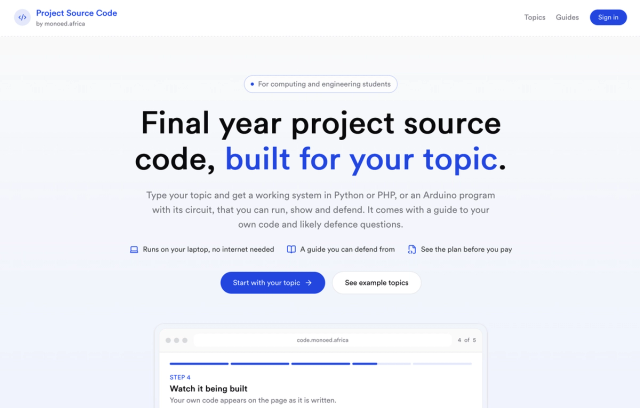
- Custom projects: MonoEd Project Source Code helps students define and generate software around their approved project topics.
- Pricing: MonoEd currently charges ₦13,500 for a supported project, with the proposed system available for review before payment.
- Academic documentation: Chapters One to Five are separate from the technical documentation that explains your software.
What Is Final Year Project Source Code?
Final year project source code refers to the programming files used to build the software developed as part of a student's academic project.
For example, if your topic is Design and Implementation of a Student Clearance Management System, the source code contains the instructions that allow students to submit requests, officers to approve them and administrators to manage the clearance process.
A complete software project usually has several components:
| Component | Purpose |
|---|---|
| Source code | Contains the programming logic and functionality |
| Database | Stores records such as users, requests and transactions |
| User interface | Allows people to interact with the system |
| Installation instructions | Explains how to set up and run the application |
| Technical documentation | Describes the architecture, files and system workflows |
| Screenshots and test results | Demonstrates implemented functionality and observed behaviour |
Having source code does not automatically mean the application works. You should be able to install it, connect its database, use its features and explain the important parts.
Likewise, technical documentation is not the same as an academic report containing Chapters One to Five.
Types of Computer Science Projects You Can Build
Computer Science final year projects cover much more than student management systems.
Depending on your approved topic, you might develop an application for managing records, automating business operations, analysing data or demonstrating a computing concept.
Here are some practical categories.
| Category | Example Project Topics |
|---|---|
| Record management | Student Clearance System, Library Management System, Hostel Allocation System |
| Booking and sales | Hotel Reservation System, Car Wash Management System, Online Bus Ticket Booking |
| Educational systems | Computer-Based Test System, Course Registration System, Student Result Processing |
| Dashboards | Student Performance Dashboard, Sales Analysis Dashboard |
| Machine learning | Student Performance Prediction, Spam Email Detection |
| Cybersecurity | Password Strength Checker, Two-Factor Authentication System |
These are examples of systems that can be developed, not a claim that every one is already available as a completed download.
For a broader collection, explore 110+ final year project topics with source code options on MonoEd. You can select an existing example or enter your own approved topic.
3 Computer Science Final Year Project Examples
The following examples show applications already built through MonoEd's Project Source Code tool. Each has different features, user roles and database requirements.
1. Student Clearance Management System Using Python
Project topic: Design and Implementation of a Student Clearance Management System
Technology: Python, Flask and SQLite.
This system helps students submit clearance requests and track approvals from different university units.
Instead of checking each office manually, students can view their clearance progress through the application.
Main features:
- Student clearance applications.
- Approval or rejection by authorised unit officers.
- Progress tracking across seven clearance units.
- Officer comments and decision timestamps.
- Printable clearance slips after all required approvals.
- Administrative reports and CSV exports.
How it works
A student submits a clearance request. The relevant officers review the application and record their decisions.
The application stores these decisions in a database and updates the student's clearance progress.
Once all seven units approve, the system allows the student to print a clearance slip.
The database includes tables such as users, units, clearance_requests and clearance_unit_decisions.
During project defence, you could demonstrate how a student submits a request, how an officer approves it and why the application prevents printing an incomplete clearance slip.
Payments and notifications in this example are simulated rather than connected to live external services.
Explore the Student Clearance Management System and screenshots
2. Car Wash Management System Using PHP and MySQL
Project topic: Design and Implementation of a Car Wash Management System
Technology: PHP and MySQL/MariaDB.
A car wash management system helps a business organise customer records, vehicle bookings, wash services and payment records.
This application demonstrates how a small business can move from manual record-keeping to a computerised workflow.
Main features:
- Customer and vehicle registration.
- Car wash bookings.
- Service selection and pricing.
- Job status tracking.
- Duplicate active booking prevention.
- Payment recording.
- Daily reports and summaries.
How it works
When a customer arrives, an attendant registers the vehicle and creates a booking.
The wash job moves through three stages:
Waiting → In progress → Completed
After completion, a cashier can record the payment, while a manager can view daily transactions.
The database uses separate tables for customers, vehicles, bookings, services and payments.
A useful feature to demonstrate during defence is how the system prevents a vehicle from having multiple active bookings simultaneously.
The application records payments but does not process actual bank transactions.
Explore the Car Wash Management System and screenshots
3. Examination Malpractice Incident Reporting System
Project topic: Design and Implementation of an Examination Malpractice Incident Reporting and Management System
Technology: PHP and MySQL/MariaDB.
This system allows authorised school staff to document examination incidents, review reported cases and maintain a history of actions.
It demonstrates how role-based access and database records can support an administrative process.
Main features:
- Examination incident submission.
- Reporter, examination officer and administrator accounts.
- Restricted access to incident records.
- Case review and status updates.
- Decision notes and dated case histories.
- CSV exports.
How it works
A reporter submits an incident. An examination officer reviews the report and records the appropriate action.
The application stores the original incident and subsequent decisions separately, preserving a history of changes.
The database includes three main tables:
users: Stores user accounts and roles.incident_reports: Stores reported incidents.case_history: Stores decisions, notes and status changes.
During defence, you can demonstrate how an authorised officer accesses a report and how the system prevents one reporter from viewing another reporter's incident.
The system records decisions made by authorised users. It does not automatically establish whether an allegation is true.
Explore the Examination Malpractice Reporting System and screenshots
How to Get Source Code for Your Own Final Year Project Topic
The examples above demonstrate existing systems, but your supervisor may have approved a completely different topic.
You might need a CBT system with timed examinations, a hospital appointment application or a dashboard that analyses school performance.
Rather than choosing an unrelated existing system, you can use MonoEd Project Source Code to define a software project based on your requirements.
Here's how the process works.
Step 1: Enter Your Project Topic
Provide your approved project topic, department and institution.
For example:
Design and Implementation of an Online Examination (CBT) System.
Your project does not need to appear in MonoEd's example topic list.
Step 2: Define the System Requirements
Answer a few questions about the application.
These may include who will use the system, what information it should store, which features it needs and whether you prefer Python or PHP.
Suggested answers are provided to help you define the scope.
Step 3: Review the Project Plan Before Payment
MonoEd prepares a proposed system plan showing:
- User roles and permissions.
- Main features.
- Application screens.
- Database requirements.
- Included functionality and limitations.
You can review the plan before paying anything. This helps you check whether the proposed system matches your approved topic.
Step 4: Get Your Project Built
After approving the plan and completing payment, the project is built and checked.
Most supported projects are ready within 10 to 40 minutes, although completion depends on the system and its validation.
You receive access to your project files, documentation and supporting materials.
Start your final year project with MonoEd
What Do You Get with MonoEd Project Source Code?
MonoEd's project package is designed to provide both the application and the materials needed to understand and demonstrate it.
1. Working source code
The application is developed around the topic and requirements you provided. Supported software projects use Python or PHP.
2. Project-specific documentation
A guide explains the application's architecture, files, database tables and important workflows. It is provided in PDF, Word and text formats.
3. Twenty defence questions and answers
You receive questions based on your own project, with answers referencing its features, functions and files.
4. Screenshots
Screenshots of the application's main screens are provided for reference when preparing Chapter Four of your project report.
5. Installation instructions
You receive instructions explaining how to install and run the application on a Windows laptop, including guidance for common setup problems.
6. Online project preview
For Python projects, MonoEd provides a 30-minute online version that lets you explore the application in your browser.
7. Three change requests
If your supervisor requests a supported modification, you can submit the change through your project page. The affected functionality is rebuilt and checked.
These materials help you study the delivered application, but you still need to test it yourself and understand your contribution before submission.
For a more detailed breakdown, read What You Get with a Final Year Project from MonoEd.
Python or PHP: Which Should You Choose?
MonoEd supports two main technology options for software projects.
| Python | PHP | |
|---|---|---|
| Framework/setup | Flask | Plain PHP |
| Database | SQLite | MySQL |
| Local setup | Python and project dependencies | XAMPP |
| Suitable examples | Dashboards, prediction systems, management applications | Booking systems, record management, school applications |
| Offline use | Supported after setup | Supported after setup |
The best option depends on your topic and the language you're comfortable explaining.
If your department has taught you PHP and MySQL extensively, choosing PHP might make project defence easier.
If you're developing a dashboard or machine learning application, Python may be more suitable.
Read Python or PHP for Your Final Year Project for a detailed comparison.
Can You Run Your Final Year Project Without Internet?
Many final year project systems can run locally on a laptop after the required software has been installed.
MonoEd's supported software projects are designed for offline use after setup.
For Python projects, the application uses Flask and SQLite. For PHP projects, XAMPP provides the local web server and database environment.
You should install the system and test its main features before defence day.
These guides explain the setup process:
What Are the Limitations?
Not every project topic can be developed within a small final year project software package.
MonoEd focuses on manageable applications suitable for learning and demonstration.
Its software projects are limited to a scope of up to seven screens.
The platform currently does not support native Android or iPhone applications, network simulations such as Packet Tracer or NS-3, or production integrations that process real payments or send actual SMS messages.
Payment and SMS functionality, where relevant, is simulated and clearly labelled.
MonoEd's Project Source code tool also supports selected Arduino Uno projects with code, component lists, wiring diagrams and simulation files. However, physical hardware assembly and testing are the student's responsibility.
You can inspect the supported categories and exclusions on the Project Topics page.
How Much Does Final Year Project Source Code Cost?
MonoEd currently lists its supported project package at ₦13,500, paid once after reviewing the proposed system plan.
You can enter your topic, answer the requirements questions and inspect the plan without payment.
The package includes the software, technical documentation, screenshots, defence questions, installation guidance and supported change requests.
The price covers the source-code project package, not the written academic report containing Chapters One to Five.
If you also need structured assistance with your written chapters, MonoEd's FYP Report Generator is a separate tool.
Preparing Your Source Code for Project Defence
Receiving working software is not the final step. You need to understand how it works and demonstrate that it meets your objectives.
Before your defence:
- Install and run the application on your laptop.
- Test the important workflows.
- Understand the database tables and their relationships.
- Identify the files and functions responsible for important features.
- Practise explaining the system's inputs, processing and outputs.
- Prepare screenshots and record actual test results.
- Make sure your documentation matches the delivered application.
For example, if you built a Student Clearance Management System, you should be able to explain how approval decisions are stored and how the system determines whether a student is eligible for a clearance slip.
Your Chapter Three should describe the design and methodology, while Chapter Four should present the implemented system and testing evidence, following your institution's requirements.
Read From Your System to Chapters Three and Four and How to Defend Your Final Year Project Software for more guidance.
Frequently Asked Questions (FAQs)
Where can I get Computer Science final year projects with source code?
You can find open-source examples on GitHub and other software repositories. You can also use MonoEd Project Source Code to generate a supported application around your approved topic, with accompanying technical documentation.
Does MonoEd provide complete project documentation?
MonoEd provides a technical guide explaining the software's files, architecture, database and important workflows, together with installation instructions and defence questions. Chapters One to Five are not included in the source-code package.
Can I get free Computer Science project source code?
Yes. Some developers publish source code for free on GitHub. Before using a repository, check its licence, dependencies, installation instructions and suitability for your project requirements.
Can I use my own approved project topic?
Yes. You can enter your own topic, even if it is not listed among MonoEd's examples. The platform generates a proposed plan that shows what can be built and any limitations.
Can I modify the source code after downloading it?
Yes. You can study and modify the delivered code. MonoEd also includes three supported change requests. After making modifications, test the affected functionality and update your documentation accordingly.
Does MonoEd support Python and PHP projects?
Yes. Supported software projects use Python with Flask and SQLite or plain PHP with MySQL. Selected microcontroller projects use Arduino C++.
Can I build a project with source code in 30 minutes?
MonoEd states that most supported projects are ready within 10 to 40 minutes after payment. This is an estimated generation and validation time, not a guarantee for every topic. You should still allow time to install, review and test your application.
Is AI-generated source code allowed for final year projects?
This depends on your institution's academic integrity policy. MonoEd uses AI to help build projects, and students are expected to understand the delivered code and disclose AI assistance as required. Your submitted work should accurately represent what you developed, tested and contributed.
Conclusion
A useful Computer Science final year project should do more than contain source-code files. It should solve a defined problem, work as intended and be understandable enough for you to explain its design, database and functionality.
Whether you're developing a student clearance system, CBT application, business management platform or data dashboard, make sure the implementation matches your approved project objectives.
If you already have a project topic and need a working system with documentation, start with MonoEd Project Source Code. You can define your requirements and review the proposed system before deciding whether to pay.
About the Author
Mohammad-Jamiu B. Balogun, GMNSE
AI Security Researcher · Founder, MonoEd Africa
Mohammad-Jamiu is a First-Class Telecommunications Engineer and Best Graduating Student, BUK '24, and an AI security researcher. He founded MonoEd Africa to give Nigerian students AI-powered academic tools — from SIWES logbooks to final year projects. His work has reached over 10,000 students across Nigeria.