English Proficiency Letter in Nigeria: Sample and How to Get One
See an English proficiency letter sample, a request letter you can copy, who signs it in Nigerian universities, what it costs and when it replaces IELTS.

Quick summary: An English proficiency letter, also called a medium of instruction letter, is written by your school to confirm that you were taught and examined in English. You request it from the Registrar or Exams and Records office. Some universities and scholarships accept it in place of IELTS, others don't, so confirm with the receiver before you pay for one.
If you schooled in Nigeria, you have written exams in English all your life. A school abroad may still want that on paper. Sometimes a one-page letter is enough. Sometimes it won't help at all, and it's better to know which before you spend money.
What is an English proficiency letter?
It is an official letter stating that English was the language of teaching and assessment for your programme. It doesn't score your English the way IELTS or TOEFL does.
The same letter goes by a few names: proficiency in English letter, medium of instruction (MOI) letter, proof of English proficiency, and English language waiver letter.
English proficiency letter sample
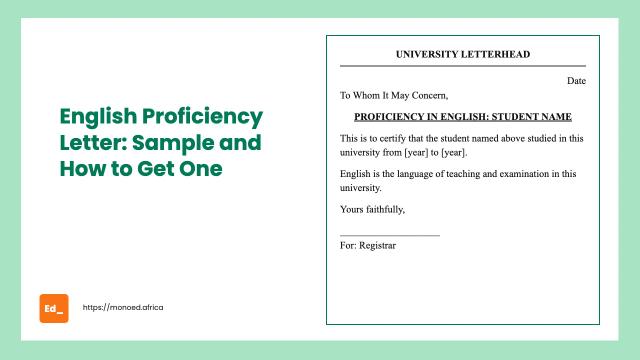
This shows what your school will normally issue. Use it to check that your letter has the right details. Don't type and sign it yourself, because receivers can verify it with your school.
[UNIVERSITY LETTERHEAD]
[Reference number]
[Date]
To Whom It May Concern,
PROFICIENCY IN ENGLISH: [FULL NAME], [MATRIC NUMBER]
This is to certify that [full name] was a student of the Department of [department], [university], from [year] to [year], and was awarded [degree and class] in [month and year].
English is the official language of teaching and examination in this university. All courses in the programme, including the final year project, were taught and assessed in English.
Please contact [official email] if you need to verify this letter.
Yours faithfully,
[Signature and stamp]
[Name]
For: Registrar
Request letter you can copy
Some schools take requests through a portal. Others ask for a written application like this.
[Your address]
[Date]
The Registrar,
[University and address]
Attention: Exams and Records
Dear Sir/Madam,
REQUEST FOR ENGLISH PROFICIENCY LETTER
I graduated from the Department of [department] in [year] with matric number [number]. I am applying to [school or scholarship], which requires evidence that my programme was taught and assessed in English.
Please issue an English proficiency letter for this purpose. It should be sent to [email or address] by [date]. I have attached my statement of result and payment receipt.
Thank you.
Yours faithfully,
[Signature]
[Full name, phone and email]
How to get an English proficiency letter
- Confirm it will be accepted. Ask the receiver, and check whether they want special wording or direct delivery.
- Find your school's channel. It may be the transcript portal, Exams and Records, or the Registrar's office.
- Apply with your details. You will normally need your matric number, graduation year and statement of result or certificate.
- Pay the official fee. Keep the receipt and reference number.
- Check the letter. Look at the spelling of your name, the dates, the degree, the signature and the stamp.
Two examples from November 2026:
- UNN takes requests on its iTranscript portal, either with a transcript request or on their own.
- LASU lists Proficiency in English at ₦10,000 on its Exams and Records portal. The Registrar signs it.
Does it replace IELTS?
It depends on who is receiving it. These UK examples show how different the rules are.
| University | What it accepts from Nigerian applicants |
|---|---|
| Leeds | WAEC English at C6. No further test if your Nigerian degree of at least two years was taught in English, though research degrees can differ |
| Birmingham | WAEC English at C6 for undergraduates. No test for postgraduates with a Nigerian degree |
| Sheffield | WASSCE English at grade C or above in place of IELTS |
| Edinburgh | All applicants must prove English ability, with requirements set by programme |
So you may need no letter at all. Your WAEC result or degree could already cover it. Check the exact course page, because rules change and competitive courses can ask for more.
Admission and visa are separate
A university waiving IELTS doesn't settle every visa question. For a UK Student visa, a university can assess your English itself for degree-level study. If you are relying on a non-UK degree taught in English as your visa evidence, GOV.UK says you need an assessment from Ecctis. A letter from your school alone is not that assessment. Ask your university which route it will put on your CAS.
For other countries, read the official immigration page as well as the school's.
When the letter may not be enough
- The course sets a test score for everybody, as some health and law courses do
- The receiver only accepts degrees finished within a certain number of years
- The letter is from your department but they asked for the Registrar
- It has no date, stamp or contact for verification
- The visa route needs an approved test or a formal assessment
Applying for funding too? See fully funded scholarships without IELTS and the scholarship guide.
You can often apply for both together. See how to get your transcript in Nigeria.
FAQs
Who signs an English proficiency letter?
Usually the Registrar or an officer signing for the Registrar. Some receivers accept a Dean or HOD, but ask first.
How long does it take?
It varies from a few days to several weeks. Apply at least a month before your deadline.
Does it expire?
The letter may have no expiry date, but the receiver can insist on a recent letter or a recent degree.
Can HND graduates get one?
Yes, you can request one from your polytechnic's registry. Confirm that the receiver accepts it from a polytechnic.
Is WAEC English enough on its own?
For some schools, yes. Others set a minimum grade, limit the age of the result or accept it only for undergraduate entry.
About the Author
Mohammad-Jamiu B. Balogun, GMNSE
Founder & Product Architect, MonoEd Africa
Mohammad-Jamiu is a First-Class Telecommunications Engineer and Best Graduating Student of Bayero University, Kano (Class of 2024), and the founder of MonoEd Africa. An AI engineer and product architect, he designs and builds MonoEd's guided workflows for SIWES logbooks and reports, final year projects and academic tools such as the GPA calculator, helping students produce better work and build the skills the AI era demands. MonoEd's tools have reached more than 20,000 students across Nigeria.