How to Write a Teaching Practice Report: Format and Samples (2027)
A simple teaching practice report format for NCE and B.Ed students, with sample acknowledgement, introduction, challenges and recommendations you can adapt.
After weeks of teaching, many student teachers find the report harder than the TP itself. This guide gives you a clear structure and short samples for the sections people struggle with most.
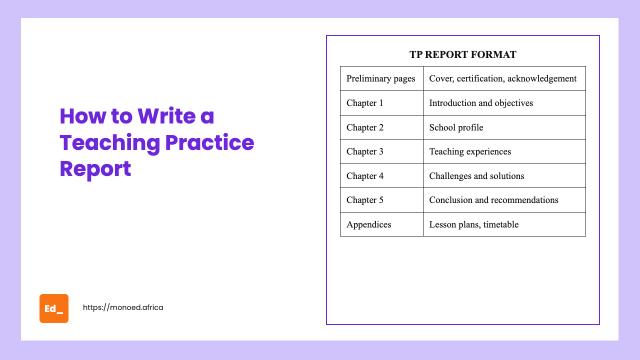
Typical TP report format
Faculties differ, but most TP reports follow this pattern:
| Section | What to include |
|---|---|
| Cover page | Title, your name, matric number, department, school of TP, session |
| Certification | Statement signed by your supervisor or TP coordinator |
| Dedication | Optional, one or two lines |
| Acknowledgement | Thank the principal, cooperating teacher, supervisors, family |
| Table of contents | Chapters and page numbers |
| Chapter 1: Introduction | Meaning of teaching practice, its objectives, duration and where you were posted |
| Chapter 2: School profile | History, location, mission, staff, number of pupils, facilities, administrative structure |
| Chapter 3: Experiences | Classes and subjects taught, topics covered, methods and materials used, extra activities |
| Chapter 4: Challenges and solutions | Problems faced and how you handled them |
| Chapter 5: Summary, conclusion and recommendations | Lessons learnt and suggestions for the school, the faculty and future student teachers |
| References | If you cited sources |
| Appendices | Sample lesson plans, timetable, photos of instructional materials |
If your faculty gives a template, use it exactly.
Chapter 1: what to write
- A short definition of teaching practice and why it matters for teacher training.
- The objectives of TP, for example: to expose student teachers to real classrooms, apply teaching methods, and develop classroom management skills.
- When and where you did your TP, and for how long.
Sample introduction:
Teaching practice is a compulsory part of teacher education that gives student teachers the chance to apply what they have learnt in a real school under supervision. I was posted to Government Secondary School, Karu, from 3rd February to 14th March 2027, where I taught Biology in SS1 and SS2. This report describes the school, my teaching experiences, the challenges I faced and the lessons I learnt.
Chapter 2: the school profile
Collect this information early, while you are still in the school:
- Year founded and short history
- Location and catchment area
- Number of teachers and pupils
- Facilities: classrooms, laboratories, library, sports
- Administrative structure (principal, vice principals, heads of department)
Ask the principal's office or the school's records for accurate figures. A simple organogram in the appendix helps.
Chapter 3: your experiences
Be specific. A table makes this easy to read:
- Class
- SS1
- Topic taught
- Classification of living things
- Method and materials
- Discussion, charts
- Class
- SS2
- Topic taught
- The cell
- Method and materials
- Demonstration, microscope
- Class
- SS1
- Topic taught
- Nutrition in plants
- Method and materials
- Practical, leaves and iodine
| Week | Class | Topic taught | Method and materials |
|---|---|---|---|
| 1 | SS1 | Classification of living things | Discussion, charts |
| 2 | SS2 | The cell | Demonstration, microscope |
| 3 | SS1 | Nutrition in plants | Practical, leaves and iodine |
Also mention extra duties: assembly, sports, exam invigilation, clubs. Your lesson notes are the best source here. See how to write lesson notes for secondary school.
Chapter 4: challenges (sample)
- Large class sizes: "My SS1 class had over 70 pupils, which made it hard to give individual attention. I used group work and moved around the class during activities."
- Lack of instructional materials: "The laboratory had few working microscopes, so I prepared charts and used real samples from the school garden."
- Irregular attendance on market days: "I repeated key points at the start of each lesson for pupils who missed the previous one."
Always pair each challenge with what you did. Supervisors want to see problem-solving, not complaints.
Chapter 5: conclusion and recommendations (sample)
Conclusion:
Teaching practice gave me practical experience in lesson planning, classroom management and evaluation. It confirmed my interest in teaching and showed me areas I need to improve, especially managing large classes.
Recommendations:
- The school should provide more instructional materials for science subjects.
- The faculty should increase the number of supervision visits so student teachers get more feedback.
- Future student teachers should prepare their lesson plans at least a week ahead.
Sample acknowledgement
I thank God for strength throughout my teaching practice. My sincere gratitude goes to the principal of Government Secondary School, Karu, for accepting me, and to my cooperating teacher, Mrs. A. Bello, for her guidance. I also thank my supervisors for their corrections and encouragement, and my family for their support.
For more examples, see how to write an acknowledgement. The format is very similar for TP reports.
Write it in your own words
Many students copy old TP reports from seniors or online. Supervisors notice, and departments that check for plagiarism will flag it. Write from your own notes and diary, and check your report before you submit with our Plagiarism and AI Checker (first 1,500 words free). See also how to avoid plagiarism.
New to TP? Start with our teaching practice in Nigeria guide.
Frequently Asked Questions
What is the format of a teaching practice report?
Preliminary pages, then chapters on the introduction, school profile, experiences, challenges and solutions, and summary with recommendations, plus appendices.
How many pages should a TP report be?
Follow your faculty's guideline. Many reports are between 15 and 30 pages, including appendices.
What should I write in the challenges of teaching practice?
Real problems you faced, such as large classes or lack of materials, and exactly how you handled each one.
Can I use a SIWES report format for my TP report?
The preliminary pages are similar, but the chapters differ. A TP report focuses on the school, your teaching and classroom experiences.
Should I include lesson plans in my TP report?
Yes. Most faculties expect sample lesson plans in the appendix.
About the Author
Mohammad-Jamiu B. Balogun, GMNSE
Founder & Product Architect, MonoEd Africa
Mohammad-Jamiu is a First-Class Telecommunications Engineer and Best Graduating Student of Bayero University, Kano (Class of 2024), and the founder of MonoEd Africa. An AI engineer and product architect, he designs and builds MonoEd's guided workflows for SIWES logbooks and reports, final year projects and academic tools such as the GPA calculator, helping students produce better work and build the skills the AI era demands. MonoEd's tools have reached more than 20,000 students across Nigeria.