Micro Teaching: Meaning, Skills, Set Induction and a Sample Plan (2027)
What micro teaching is, the teach, feedback and reteach cycle, the core skills (set induction, questioning, closure) and a sample micro lesson plan.

Before teaching practice in a real school, most Nigerian education departments and colleges run micro teaching. It is your chance to practise in a safe space, make mistakes in front of classmates instead of 60 pupils, and get detailed feedback.
What is micro teaching?
Micro teaching scales teaching down:
| Real lesson | Micro lesson |
|---|---|
| 35 to 45 minutes | About 5 to 10 minutes |
| 30 to 70 pupils | About 5 to 10 peers |
| Many skills at once | One or two skills at a time |
| Feedback after some time | Immediate feedback |
The idea was developed at Stanford University in the 1960s and is now standard in teacher education worldwide.
The micro teaching cycle
- Plan a short lesson focused on one skill.
- Teach it to your peer group.
- Feedback from your lecturer and peers (often using an observation checklist).
- Replan using the feedback.
- Reteach the same or a similar lesson.
- Feedback again, to see if you improved.
If your department records lessons, watch your video. It is the fastest way to notice habits like talking to the board or speaking too fast.
Core micro teaching skills
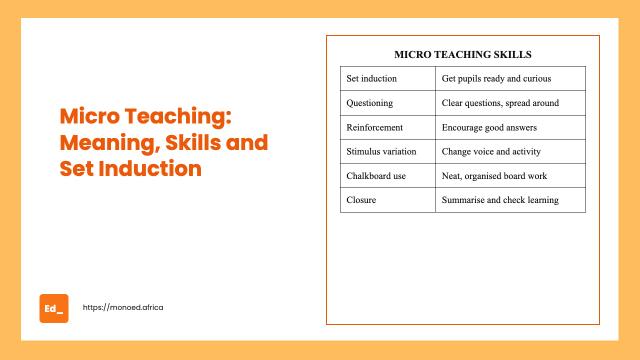
| Skill | What it means | Example |
|---|---|---|
| Set induction | Getting pupils ready and interested at the start | A question, picture, story or demonstration linked to the topic |
| Questioning | Asking clear questions at different levels and spreading them across the class | "Why do you think plants need sunlight?" |
| Reinforcement | Encouraging good answers and effort | Praise, nodding, writing a pupil's answer on the board |
| Stimulus variation | Changing your voice, movement and activities to keep attention | Moving around, using gestures, switching from talk to activity |
| Explanation | Making ideas clear with examples | Step-by-step explanation with a real-life example |
| Use of chalkboard / whiteboard | Neat, organised, readable board work | Headings, clear handwriting, not blocking the board |
| Use of instructional materials | Using charts, models and real objects well | Showing a real leaf when teaching photosynthesis |
| Closure | Ending the lesson by summarising and checking learning | Recap questions, summary on the board |
Set induction in detail
Set induction is the most commonly practised skill because it appears on every teaching practice assessment form. A good set induction:
- Is short (one to three minutes in a micro lesson).
- Connects to what pupils already know.
- Raises curiosity about the new topic.
- Leads naturally into the lesson.
Examples:
- Biology (respiration): "Hold your breath for 10 seconds. Why did you feel uncomfortable?"
- Economics (demand): "If the price of garri doubles tomorrow, what will your family do?"
- English (adjectives): Show a picture and ask pupils to describe it in one word.
Sample micro lesson plan
| Item | Details |
|---|---|
| Subject | Basic Science |
| Class | JSS2 (peers acting as pupils) |
| Topic | States of matter |
| Skill focus | Set induction and questioning |
| Duration | 8 minutes |
| Objective | By the end of the lesson, pupils should be able to name the three states of matter with one example each |
| Materials | Ice cube, cup of water, picture of steam |
- Time
- 2 min
- Teacher activity
- Shows ice, water and a picture of steam. Asks, "What is the same about these three?"
- Pupil activity
- Observe and answer
- Time
- 4 min
- Teacher activity
- Explains solid, liquid and gas, asking questions to different pupils
- Pupil activity
- Answer and give examples
- Time
- 2 min
- Teacher activity
- Recap questions; summarises on the board
- Pupil activity
- Answer recap questions
| Stage | Time | Teacher activity | Pupil activity |
|---|---|---|---|
| Set induction | 2 min | Shows ice, water and a picture of steam. Asks, "What is the same about these three?" | Observe and answer |
| Development | 4 min | Explains solid, liquid and gas, asking questions to different pupils | Answer and give examples |
| Closure | 2 min | Recap questions; summarises on the board | Answer recap questions |
For full-length lessons during TP, see our lesson plan format for secondary school and lesson plan vs lesson note.
Tips for micro teaching day
- Practise your lesson aloud with a timer. Five minutes goes very fast.
- Focus on the assigned skill. Do not try to show everything.
- Bring your materials. Even one real object makes a difference.
- Face your audience, not the board.
- Accept feedback calmly and write it down. Your reteach score is often what counts.
Micro teaching prepares you for teaching practice, and the same lesson-planning skills help in your final year project if you research teaching methods. See project topics for education students.
Frequently Asked Questions
What is micro teaching?
A teacher training method where a student teacher teaches a short lesson to a small group of peers, focusing on one skill, then gets feedback and reteaches.
What are the skills of micro teaching?
Common skills include set induction, questioning, reinforcement, stimulus variation, explanation, use of the chalkboard, use of instructional materials and closure.
What is set induction?
The way a teacher starts a lesson to get pupils ready and interested, such as a question, picture or demonstration linked to the topic.
How long is a micro teaching lesson?
Usually about 5 to 10 minutes, depending on your department.
Who invented micro teaching?
It was developed at Stanford University in the United States in the 1960s.
About the Author
Mohammad-Jamiu B. Balogun, GMNSE
Founder & Product Architect, MonoEd Africa
Mohammad-Jamiu is a First-Class Telecommunications Engineer and Best Graduating Student of Bayero University, Kano (Class of 2024), and the founder of MonoEd Africa. An AI engineer and product architect, he designs and builds MonoEd's guided workflows for SIWES logbooks and reports, final year projects and academic tools such as the GPA calculator, helping students produce better work and build the skills the AI era demands. MonoEd's tools have reached more than 20,000 students across Nigeria.