Teaching Practice in Nigeria: Duration, TP File, Assessment and Tips (2027 Guide)
How teaching practice works for NCE and B.Ed students: how long it lasts, what goes in your TP file, how supervisors assess you, and how to get a good TP grade.
For education students, teaching practice is where your training meets a real classroom. It carries credit units, it affects your CGPA, and for many students it decides whether they enjoy teaching. This guide explains how TP works in Nigerian universities and colleges of education, and how to do well.
TP at a glance
| Item | B.Ed (university) | NCE (college of education) |
|---|---|---|
| When | Usually 300 and 400 level (TP I and TP II) | Within the NCE programme, set by your college |
| Length | Often about 4 to 6 weeks per round, longer in some schools | Set by your college (one federal college states 24 weeks and 6 credit units) |
| Where | A secondary or primary school approved by your faculty | A school approved by your college |
| Assessed by | University supervisors, sometimes moderated by an external examiner | College supervisors |
These figures differ between institutions. Your faculty's TP handbook or posting letter is the final word.
Before TP starts
- Attend the TP orientation. It explains posting, dress code, attendance and assessment.
- Collect your posting letter and report to the school principal on the first day.
- Meet your cooperating teacher, the school teacher who will guide you in your subject.
- Get the scheme of work and timetable for the classes you will teach.
- Do micro teaching seriously. Most departments run it before TP. See our micro teaching guide.
What goes in your TP file
Most supervisors expect a neat TP file (sometimes called a TP folder) that they can check on every visit. Common contents:
| Item | Notes |
|---|---|
| Cover page | Your name, matric number, subject, school, session |
| Posting letter | From your faculty or college |
| School timetable and your teaching timetable | Highlight your periods |
| Scheme of work | For each class you teach |
| Lesson plans / lesson notes | One for every lesson, arranged by date |
| Record of work | What you taught each week |
| Attendance record | Your own attendance and any class register duties |
| Supervisor's comments | Keep every comment sheet |
| Instructional materials list | Charts, models and other aids you made |
Your department may add or remove items. Ask your TP coordinator for the official list.
Strong lesson plans are the core of your file. Follow our guides on lesson plan format for secondary school, how to write lesson notes for secondary school, lesson notes for primary school and the difference between a lesson plan and a lesson note.
How supervision works
University TP handbooks describe supervision in three stages:
- Pre-observation: the supervisor checks your lesson plan and asks about the lesson.
- Observation: the supervisor watches you teach a full lesson period (about 40 minutes in many secondary schools).
- Post-observation feedback: the supervisor discusses strengths and what to improve, in writing.
Visits are usually spread across the TP period, so expect more than one. NCCE's teaching practice supervisor toolkit also suggests student teachers keep a logbook or diary of their TP experience.
How you are assessed
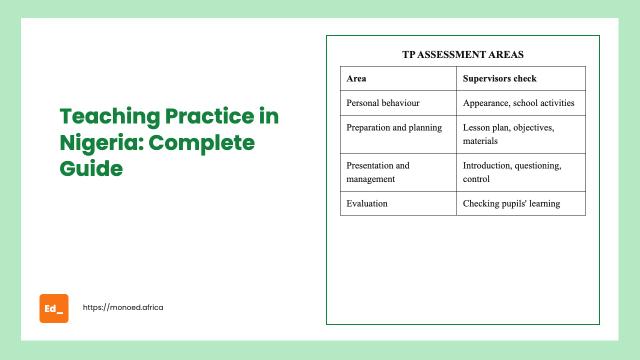
NCCE's TESSA supervisor toolkit groups TP assessment into four areas. Many universities use similar criteria:
| Area | What supervisors look at |
|---|---|
| Personal behaviour | Appearance, contribution to school activities, self-awareness |
| Lesson preparation and planning | Detail and accuracy of your lesson plan, clear objectives (cognitive, affective, psychomotor), sequencing of content, suitable activities and instructional materials |
| Lesson presentation and classroom management | Interesting introduction, mastery of subject, logical development, use of voice and chalkboard, questioning spread across learners, pupil participation, classroom control, summary and conclusion |
| Evaluation | How you check that pupils have learnt |
The observation form also records the class, the number of boys and girls, the subject, topic and subtopic, and notes on your lesson plan, objectives, materials and how you linked to pupils' previous knowledge.
Tips for a good TP grade
- Prepare every lesson plan in advance. A missing lesson plan on a supervision day is one of the quickest ways to lose marks.
- Start with a strong set induction (introduction). It shows up on every assessment form.
- Use instructional materials, even simple charts or real objects.
- Ask questions to many pupils, not only the front row.
- End with a summary and evaluation. Many student teachers run out of time and skip this.
- Dress formally and be punctual. Personal behaviour is assessed.
- Keep your TP file up to date every day.
After TP: the report
Most institutions ask for a TP report at the end. See how to write a teaching practice report for the format and samples.
Education students also write a final year project. If you are planning yours, see final year project topics for education students and current research topics in education.
Frequently Asked Questions
How long is teaching practice in Nigeria?
It depends on the institution. B.Ed students often do two rounds of about four to six weeks each in 300 and 400 level. NCE colleges set their own length.
What is a TP file?
A folder of your teaching documents for supervisors to check: posting letter, timetable, scheme of work, lesson plans, record of work and supervisor comments.
How is teaching practice graded?
Supervisors assess your personal behaviour, lesson planning, lesson presentation and classroom management, and how you evaluate pupils' learning.
Can I fail teaching practice?
Yes. TP carries credit units, so a poor grade affects your CGPA. Missing lesson plans or absence can lead to failure.
Do I need a lesson plan for every lesson?
Yes. Supervisors expect a lesson plan for every lesson you teach during TP.
About the Author
Mohammad-Jamiu B. Balogun, GMNSE
Founder & Product Architect, MonoEd Africa
Mohammad-Jamiu is a First-Class Telecommunications Engineer and Best Graduating Student of Bayero University, Kano (Class of 2024), and the founder of MonoEd Africa. An AI engineer and product architect, he designs and builds MonoEd's guided workflows for SIWES logbooks and reports, final year projects and academic tools such as the GPA calculator, helping students produce better work and build the skills the AI era demands. MonoEd's tools have reached more than 20,000 students across Nigeria.