How to Read for Exams in University: A Simple Study Timetable That Works (2027)
A realistic way to read for exams as a Nigerian university student: a 4-week plan, a sample daily timetable, active reading methods and what to do the week before.

Most students do not fail because they are not smart enough. They fail because they start too late, read without testing themselves, or spread their time evenly across courses that are not equal. This guide gives you a plan you can actually follow, even with lectures, hostel noise and NEPA.
Step 1: Map your exams (30 minutes)
Make a simple table:
- Units
- 3
- Exam date
- 14 Feb
- How confident am I? (1 to 5)
- 2
- Units
- 3
- Exam date
- 16 Feb
- How confident am I? (1 to 5)
- 4
- Units
- 2
- Exam date
- 18 Feb
- How confident am I? (1 to 5)
- 3
| Course | Units | Exam date | How confident am I? (1 to 5) |
|---|---|---|---|
| MTH 201 | 3 | 14 Feb | 2 |
| CSC 203 | 3 | 16 Feb | 4 |
| GST 201 | 2 | 18 Feb | 3 |
High-unit, low-confidence courses get the most time. A 3-unit course affects your GPA three times as much as a 1-unit course. See course codes and units explained.
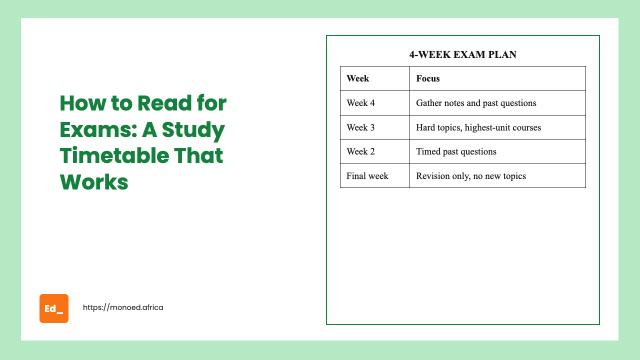
Step 2: A 4-week plan
| Week | Focus |
|---|---|
| Week 4 before exams | Gather notes, past questions and the course outline. Fill gaps from missed lectures |
| Week 3 | Learn the hard topics in your weakest, highest-unit courses |
| Week 2 | Past questions for every course, timed. Fix what you get wrong |
| Final week | Revision only: summaries, formulas, definitions. No new topics |
Starting even two weeks before is far better than the night before. If you are already in crunch time, read how to pass an exam in one night for damage control, then plan better next semester.
Step 3: A sample daily timetable
| Time | Activity |
|---|---|
| 6:00 to 7:00 am | Review yesterday's topics (quick recall) |
| 8:00 am to 2:00 pm | Lectures, or study block 1 if free |
| 4:00 to 5:00 pm | Study block: hardest course |
| 5:00 to 5:15 pm | Break |
| 5:15 to 6:15 pm | Study block: second course |
| 8:00 to 9:30 pm | Past questions (timed) |
| 9:30 to 10:00 pm | Summarise what you learnt in one page |
| 11:00 pm | Sleep |
Adjust it to your lecture timetable and when you focus best. Some students do better at night; just protect your sleep. More on this in how to manage time as a Nigerian student.
Step 4: Read actively, not passively
- Test yourself. Close the note and write what you remember. Then check.
- Past questions are gold. Lecturers often repeat question patterns. Do them under exam time limits.
- Teach someone. Explain a topic to a roommate or study partner.
- One-page summaries. For each topic, list the key definitions, formulas and diagrams.
- Space it out. Revisit topics after one day, three days and a week. It sticks far better than one long session.
Dealing with real-life problems
- Noisy hostel: library early morning, empty lecture halls in the evening, earplugs. See how to focus in a noisy hostel and the best time to use the school library.
- No light: charge a rechargeable lamp and power bank; plan reading for daylight hours when possible.
- Feeling sleepy: short walks, water and a 20-minute nap work better than another cup of coffee. See how to stay awake for TDB without coffee.
- Too many courses: prioritise by units and difficulty, not by which is easiest to read.
The week of the exam
- Do one final timed past paper per course.
- Sleep at least six to seven hours.
- Eat properly. See how to stay healthy during exams.
- Prepare your exam kit the night before: ID card, exam docket, pens, calculator. Leave your phone outside the hall: phones count as exam malpractice in many schools.
Track the result of your effort
After results come out, enter them in our free CGPA calculator to see your GPA and class of degree, and how much each semester moves you. Seeing the numbers helps you plan the next semester's reading.
Frequently Asked Questions
How many hours should I read per day for exams?
Quality matters more than hours. Three to five focused hours a day, with breaks, is enough for most students if you start early.
When should I start reading for exams?
About four weeks before is ideal. Two weeks is the minimum for a full course load.
Is it better to read at night or in the morning?
Read when you focus best, but do not sacrifice sleep. Many students find early mornings quieter in the hostel.
How do I remember what I read?
Test yourself instead of rereading, do past questions, and revisit topics after a few days.
What should I do the night before an exam?
Light revision of your summaries, prepare your exam kit, and sleep early.
About the Author
Mohammad-Jamiu B. Balogun, GMNSE
Founder & Product Architect, MonoEd Africa
Mohammad-Jamiu is a First-Class Telecommunications Engineer and Best Graduating Student of Bayero University, Kano (Class of 2024), and the founder of MonoEd Africa. An AI engineer and product architect, he designs and builds MonoEd's guided workflows for SIWES logbooks and reports, final year projects and academic tools such as the GPA calculator, helping students produce better work and build the skills the AI era demands. MonoEd's tools have reached more than 20,000 students across Nigeria.