Exam Malpractice in Nigeria: What Counts, the Penalties and How to Stay Safe (2027)
What counts as exam malpractice in Nigerian universities and public exams, the penalties (from cancelled papers to expulsion), and how innocent students get caught.

Every exam season, some students lose a semester, a year or their whole degree because of malpractice. Some planned to cheat. Others simply did not know a small thing, like a phone in their pocket or notes in their bag, counts as malpractice.
What counts as exam malpractice?
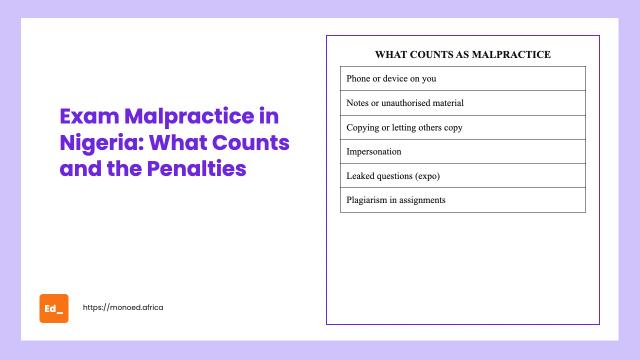
Most Nigerian universities treat these as malpractice:
- Bringing unauthorised materials into the hall: notes, textbooks, written papers, "microchips".
- Having a phone, smartwatch or any device on you during the exam, even if it is switched off. Many schools treat this as malpractice once it is found on you.
- Copying from another student or allowing someone to copy from you.
- Talking, signalling or passing notes during the exam.
- Impersonation: writing an exam for someone else, or getting someone to write for you.
- Leaked questions: buying, selling or using exam questions before the exam.
- Swapping or smuggling answer scripts in or out of the hall.
- Writing on your body, clothes or desk.
- Threatening, assaulting or bribing an invigilator or lecturer.
Penalties in Nigerian universities
Each university sets its own sanctions through its Senate and student disciplinary regulations. The general pattern is:
| Offence level | Typical sanction |
|---|---|
| Minor (talking, small notes found but not used) | Warning, or the paper cancelled |
| Moderate (copying, unauthorised material used) | Paper cancelled, suspension or rustication for one or more semesters |
| Serious (impersonation, leaked questions, assault) | Expulsion, and possible police case |
Cases usually go to a malpractice or disciplinary committee, where you are invited to explain. Read your student handbook so you know your school's exact rules.
A real example: NOUN's sanctions
The National Open University of Nigeria publishes its examination misconduct policy (reviewed December 2024). It shows how seriously schools take this:
| Sanction | Examples of offences (NOUN policy) |
|---|---|
| Rustication (made to leave the university) | Impersonation, substituting answer scripts, exam leakage, forging results or documents, refusing to be searched, assaulting an invigilator |
| Suspension for four semesters | Copying, bringing in notes, a mobile phone or any unauthorised gadget, writing on your body or clothes, not submitting your answer script |
| Suspension for two semesters | Unruly behaviour, leaving the hall without permission, unnecessary discussion with other candidates |
| Paper cancelled | Exposing your script for someone to copy, exchanging scripts or question papers, "giraffing", writing before the start or after the end, breaking the sitting arrangement |
Notice that simply bringing a phone into the hall can mean losing two years at NOUN. Other universities have their own lists, but the pattern is similar.
Penalties in WAEC, NECO and JAMB
Public exams fall under the Examination Malpractices Act 1999, which creates malpractice offences with fines and other penalties, and lets exam bodies withhold or cancel results. In 2025, the Federal Government also directed a three-year ban across external exam bodies for candidates caught in malpractice. If you are writing UTME or WASSCE, a single incident can block you from every exam body for years.
Plagiarism and AI misuse count too
Malpractice is not only in the exam hall. Copying someone else's work into your assignment, term paper, seminar or final year project without citing it is academic misconduct. Many departments now check projects with plagiarism tools and some also look for AI-written text.
Before you submit, run your work through a checker that shows exactly which lines match a source. Our Plagiarism and AI Checker checks your first 1,500 words free and links each match to its source, so you can cite it or rewrite it. Read how to avoid plagiarism in your final year project and what similarity percentage is acceptable.
How innocent students get caught (and how to avoid it)
- Leave your phone outside the hall or wherever your school says. "It was switched off" rarely works as a defence.
- Empty your pockets and bag before you enter. Old notes in a pocket can be treated as unauthorised material.
- Don't let anyone copy from you. Both students are usually sanctioned.
- Write only on the answer booklet. Rough work on question papers or scraps can look suspicious.
- Don't buy "expo". Leaked questions are often fake, and buying them is an offence.
- If you are accused, stay calm, write an honest statement, and attend every committee meeting. Bring a parent or guardian if allowed.
The safer route: prepare properly
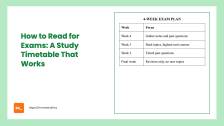
Most malpractice starts with panic about failing. A simple plan helps: read how to read for exams with a study timetable, how to stay healthy during exams and how to avoid carryover in first year.
Frequently Asked Questions
What is exam malpractice?
Any act that gives a student an unfair advantage in an exam, such as using notes, phones, copying, impersonation or leaked questions.
What is the punishment for exam malpractice in Nigerian universities?
It depends on the school and the offence. Sanctions range from cancelling the paper to suspension, rustication and expulsion.
Is having a phone in the exam hall malpractice?
In many Nigerian universities, yes, even if it is switched off. Check your school's rules and leave it outside.
What law covers exam malpractice in Nigeria?
The Examination Malpractices Act 1999 covers public examinations such as WAEC, NECO and JAMB. Universities apply their own Senate regulations.
Is plagiarism a form of malpractice?
Yes. Copying other people's work into assignments or projects without citing it is academic misconduct and can be punished.
About the Author
Mohammad-Jamiu B. Balogun, GMNSE
Founder & Product Architect, MonoEd Africa
Mohammad-Jamiu is a First-Class Telecommunications Engineer and Best Graduating Student of Bayero University, Kano (Class of 2024), and the founder of MonoEd Africa. An AI engineer and product architect, he designs and builds MonoEd's guided workflows for SIWES logbooks and reports, final year projects and academic tools such as the GPA calculator, helping students produce better work and build the skills the AI era demands. MonoEd's tools have reached more than 20,000 students across Nigeria.