Top 15+ Free Academic Journals and Databases for Nigerian Students in 2026
Find the best free academic journals and databases for Nigerian students. This 2026 list includes Google Scholar, AJOL, DOAJ, CORE, PubMed Central, HINARI, OJN, Crossref, Semantic Scholar, and more to help you research faster and write a stronger project or literature review.

Finding high quality academic journals is one of the biggest challenges Nigerian students face when writing a final year project, seminar paper, or assignment. Many universities do not have active subscriptions to premium databases like Elsevier, ProQuest, or JSTOR, so students often end up relying on random Google results or low quality blogs.
The good news is that there are powerful global and African open access databases that give you free access to articles, theses, conference papers, datasets, and reports. These resources will help you build a stronger literature review for Chapter Two, support your arguments with credible research, and increase your chances of impressing your supervisor.
This 2026 guide lists the best free journals and databases every Nigerian student should use.
📙 Final Year Project Tools 🔥
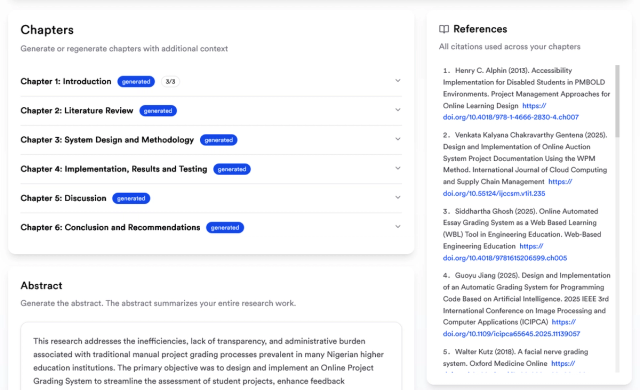
FYP Report Generator — Generate full project chapters and citations.
https://fyp.monoed.africa
Project Topic Generator — Get supervisor-ready project topics instantly.
https://topics.monoed.africa
1. Why Nigerian Students Need Free Academic Databases
Most students in Nigeria struggle with research because:
- many library subscriptions have expired
- paid journals cost in dollars
- some campuses have slow or limited internet
- students do not know which platforms offer free access
Open access platforms solve this problem by giving you direct access to peer reviewed research from reputable universities and publishers. They save time, reduce stress, and help you produce stronger academic work.
2. Global Open Access Databases
These are the best places to start any research project.
1. Google Scholar
Best for: general academic search
Google Scholar indexes millions of articles, theses, books, and court opinions. It often links to free PDF versions stored in university repositories. You can also copy citations in APA, MLA, or Chicago format. Every Nigerian student should start here.
2. DOAJ (Directory of Open Access Journals)
Best for: quality controlled journals
DOAJ verifies every journal before listing it, which protects you from predatory publishers. It contains over ten thousand peer reviewed open access journals covering medicine, education, engineering, and social sciences.
3. CORE
Best for: maximum number of articles
CORE aggregates research from thousands of repositories worldwide. It has more than two hundred million open access papers. It is one of the richest sources for literature review materials.
4. BASE (Bielefeld Academic Search Engine)
Best for: theses and dissertations
BASE provides access to more than a hundred million documents. Many are full text student theses, which are very useful for seeing complete methodology examples, sampling techniques, and chapter structures.
3. African Focused Journals and Databases
These are the best sources when you need local context for your literature review.
5. AJOL (African Journals Online)
Best for: African research across all fields
AJOL is the largest platform for African published academic journals. It hosts more than five hundred peer reviewed journals, including many Nigerian titles. Many articles are free to read.
6. Open Journals Nigeria (OJN)
Best for: free Nigerian journals
OJN provides open access journals covering education, social sciences, natural sciences, engineering, management, and health. This is a strong source for locally relevant studies.
7. Nigerian Journals Online (NJOL)
Best for: Nigerian academic publications
NJOL lists journals published in Nigeria. It improves visibility for Nigerian research and is useful when your supervisor insists on using local studies.
8. Research4Life (HINARI, AGORA, ARDI)
Best for: institutions with active subscriptions
These programs provide free or low cost access for developing countries. HINARI focuses on health, AGORA focuses on agriculture, and ARDI focuses on innovation. Check your university library portal to see if you have access.
4. Subject Specific Databases
Use these when your project falls under a particular discipline.
9. PubMed Central
Best for: medicine, nursing, public health, and life sciences
PubMed Central offers millions of free biomedical articles. It is essential for anyone writing a health related project. It also provides easy citation tools.
10. SSRN (Social Science Research Network)
Best for: management, economics, law, and humanities
SSRN hosts working papers, preprints, and journal articles from top researchers worldwide. It is very rich for topics in business, governance, and social issues.
11. EThOS (British Library Theses)
Best for: full research models and methodology guides
EThOS provides access to more than five hundred thousand doctoral theses. These documents are valuable for designing your own methodology and understanding proper academic writing formats.
12. arXiv
Best for: computer science, mathematics, and physics
arXiv hosts preprints for advanced scientific fields. Many Nigerian engineering and computer science students rely on it for algorithm research, AI, cryptography, and statistical modelling.
5. Extra Useful Platforms
These are not always peer reviewed but still provide helpful academic materials.
13. Semantic Scholar
Best for: AI powered article discovery
Semantic Scholar is an advanced academic search engine created by the Allen Institute for AI. It uses machine learning to highlight key papers, influential citations, and open access versions of articles. It is especially helpful for computer science, engineering, social sciences, and education research. The interface is clean, fast, and better at filtering than Google Scholar.
14. Crossref
Best for: DOI lookup and citation accuracy
Crossref is one of the most reliable tools for verifying publication details. You can use it to check DOIs, confirm authors, and retrieve accurate citation metadata. It is useful when writing your reference list, especially for students struggling with citation errors. Some DOI links also lead to free full text versions.
15. Science.gov
Best for: scientific and technical information
Science.gov searches more than sixty databases and two thousand scientific websites. It provides access to millions of pages of United States government research and technical reports.
16. ScienceOpen
Best for: research discovery
ScienceOpen is a search and publishing platform filled with open access articles. It allows filtering by discipline, publication year, and indexing type.
17. ResearchGate
Best for: requesting full PDF copies
ResearchGate is a network for researchers. Many authors upload free copies of their papers. You can also request a PDF directly from the author. This is helpful when the article is behind a paywall.
6. Bonus Tip for Hard to Access Papers
Sometimes an article is not freely available. Nigerian students often rely on alternative access tools. The most common method is to search for the article title inside Google Scholar to see if any university has uploaded a free PDF. This simple trick works for many papers.
7. Quick Tips for Nigerian Students Using These Databases
- read the abstract first before downloading any article
- combine global and African sources for a stronger literature review
- verify publication dates so you do not cite outdated work
- save all PDFs and export citations into Zotero or Mendeley
- always check your university library portal for institutional access
Conclusion
You do not need expensive subscriptions to write a strong project in Nigeria.
With open access platforms like Google Scholar, CORE, AJOL, DOAJ, OJN, PubMed Central, and SSRN, you can find credible academic materials for free.
These fifteen-plus resources give you everything you need to craft a solid literature review and produce a high quality final year project.
About the Author
Mohammad-Jamiu B. Balogun, GMNSE
AI Security Researcher · Founder, MonoEd Africa
Mohammad-Jamiu is a First-Class Telecommunications Engineer and Best Graduating Student (BUK), and an AI security researcher. He founded MonoEd Africa to give Nigerian students AI-powered academic tools — from SIWES logbooks to final year projects. His work has reached over 10,000 students across Nigeria.