30 Library and Information Science Project Topics for Nigerian Students
30 library and information science project topics for Nigerian students, from e-resources and digitisation to reading culture and records management.

Library and information science has changed quickly. Libraries now manage e-journals, institutional repositories and digital records alongside books, and students search Google before they ask a librarian. That gives you plenty of current topics.
Most projects focus on one library (your university library is the easiest) and one group of users or staff. You measure how they use a service, what problems they face, or how well a system works.
Here are 30 ideas grouped by area.
Treat these as a starting point for a talk with your supervisor. Your department has the final say.
What makes a good library science topic
- One library or type of library. Academic, public, school or special library.
- One group. Undergraduates, postgraduates, lecturers or library staff.
- One service or problem. E-resources, digitisation, reference services, funding or reading habits.
- Access. A library that will let you distribute questionnaires to its users or staff.
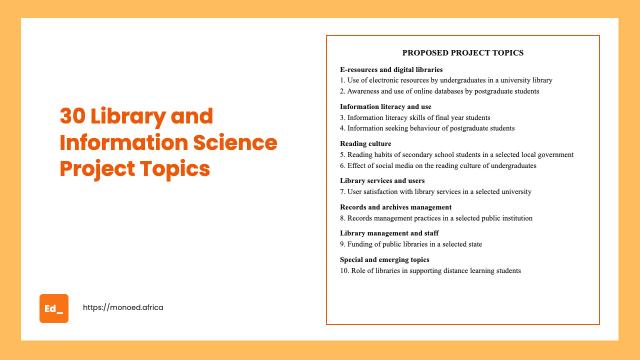
30 library and information science project topics
E-resources and digital libraries
- Use of electronic resources by undergraduates in a university library
- Awareness and use of online databases by postgraduate students
- Challenges of digitising records in a selected academic library
- Use of institutional repositories by lecturers
- Adoption of library management software in academic libraries
Information literacy and use
- Information literacy skills of final year students
- Information seeking behaviour of postgraduate students
- Use of AI tools such as ChatGPT for academic information by undergraduates
- Awareness of plagiarism and citation among undergraduates
- Information needs of rural farmers in a selected community
Reading culture
- Reading habits of secondary school students in a selected local government
- Effect of social media on the reading culture of undergraduates
- Role of public libraries in promoting reading culture
- Influence of school libraries on students' academic performance
Library services and users
- User satisfaction with library services in a selected university
- Reference services in academic libraries
- Library services for visually impaired students
- Use of library space and facilities by undergraduates
Records and archives management
- Records management practices in a selected public institution
- Preservation of archival materials in a state archive
- Electronic records management in a selected organisation
- Challenges of preserving newspapers in academic libraries
Library management and staff
- Funding of public libraries in a selected state
- Job satisfaction among library staff
- Staff training and service delivery in academic libraries
- Security of library materials and theft prevention
Special and emerging topics
- Role of libraries in supporting distance learning students
- Marketing of library services to undergraduates
- Use of mobile phones to access library services
- Library services to prison inmates in a selected correctional centre
Choosing a library science topic you can finish
Use your university library. You know the system, and staff are more willing to help their own students.
Pick users you can reach. Final year students in your faculty, or staff of one library, are realistic groups.
Keep the questionnaire focused. Fifteen to twenty-five questions on one service or problem gives clearer results than a survey covering everything.
More help: how to choose a final year project topic and how to design a questionnaire people will fill.
Writing your library science project
Most departments use five chapters, with a questionnaire analysed using frequencies, percentages and mean scores in Chapter Four. Theories such as the Technology Acceptance Model suit e-resource topics, while information seeking models suit user studies.
- Chapter One
- Chapter Two: literature review
- Chapter Three: methodology
- Interpret Likert scale mean scores
If you did your SIWES in a library, see how to fill a SIWES logbook for library and information science.
Frequently Asked Questions
What are good library and information science project topics?
Topics on e-resource use, digitisation, information literacy, reading culture and user satisfaction are current and easy to research.
Which theory can I use?
The Technology Acceptance Model, the Unified Theory of Acceptance and Use of Technology and information seeking models such as Wilson's model are common.
How do I collect data?
Most students use a questionnaire for library users or staff, sometimes with observation or an interview with the librarian.
Can I write about AI in libraries?
Yes. Topics on how students use AI tools to find information, and how libraries respond, are new and interesting to panels.
How many chapters does the project have?
Most use five. Check your department's format.
About the Author
Mohammad-Jamiu B. Balogun, GMNSE
Founder & Product Architect, MonoEd Africa
Mohammad-Jamiu is a First-Class Telecommunications Engineer and Best Graduating Student of Bayero University, Kano (Class of 2024), and the founder of MonoEd Africa. An AI engineer and product architect, he designs and builds MonoEd's guided workflows for SIWES logbooks and reports, final year projects and academic tools such as the GPA calculator, helping students produce better work and build the skills the AI era demands. MonoEd's tools have reached more than 20,000 students across Nigeria.