30 Midwifery Project Topics and Ideas for Nigerian Students
30 midwifery project topics for Nigerian students, from antenatal care and safe delivery to postnatal and newborn care, with tips on ethics approval and access.

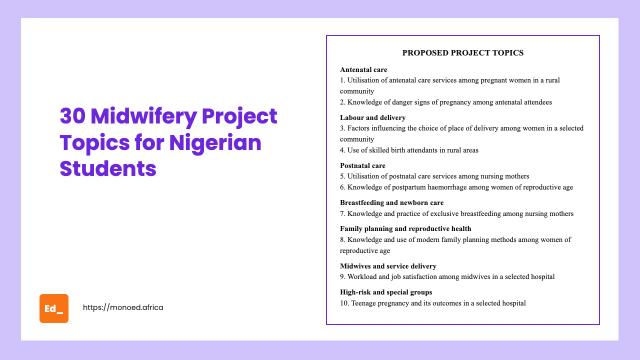
Midwifery projects deal with some of the most important health problems in Nigeria: women who skip antenatal care, deliveries without skilled attendants, and newborns who miss early care. That makes them meaningful, but it also means you will be working with pregnant women, mothers and health workers, so access and ethics matter as much as the topic.
Most midwifery projects measure knowledge, attitude, practice or use of a service among women in one hospital, primary health centre or community. Choose a place where you did your clinical posting if you can, because you already know the staff and the routine.
Here are 30 ideas grouped by area.
Treat these as a starting point for a talk with your supervisor. Get facility permission and ethical approval before you collect any data.
What makes a good midwifery topic
- One group of women or staff. Antenatal attendees, nursing mothers, women of reproductive age, or midwives in one facility.
- One thing to measure. Knowledge, practice, attitude, use of a service or satisfaction.
- One place. A named hospital, primary health centre or community.
- Realistic access. Facilities that will let you collect data within your timeline.
30 midwifery project topics
Antenatal care
- Utilisation of antenatal care services among pregnant women in a rural community
- Knowledge of danger signs of pregnancy among antenatal attendees
- Factors affecting late booking for antenatal care
- Use of intermittent preventive treatment of malaria in pregnancy
- Knowledge and practice of birth preparedness among pregnant women
- Nutritional practices of pregnant women attending a primary health centre
Labour and delivery
- Factors influencing the choice of place of delivery among women in a selected community
- Use of skilled birth attendants in rural areas
- Women's experience of respectful maternity care in a selected hospital
- Knowledge and use of the partograph among midwives
- Fear of childbirth among first-time mothers
- Attitude of women towards caesarean section
Postnatal care
- Utilisation of postnatal care services among nursing mothers
- Knowledge of postpartum haemorrhage among women of reproductive age
- Postpartum depression among nursing mothers in a selected hospital
- Cultural practices during the postnatal period in a selected community
Breastfeeding and newborn care
- Knowledge and practice of exclusive breastfeeding among nursing mothers
- Practice of kangaroo mother care among mothers of low birth weight babies
- Cord care practices among nursing mothers
- Immunisation completion among infants in a selected community
Family planning and reproductive health
- Knowledge and use of modern family planning methods among women of reproductive age
- Factors influencing male involvement in family planning
- Unmet need for family planning in a selected community
- Awareness of cervical cancer screening among women
Midwives and service delivery
- Workload and job satisfaction among midwives in a selected hospital
- Knowledge of emergency obstetric care among midwives
- Challenges of midwifery practice in rural primary health centres
- Use of the Midwives Service Scheme in a selected state
High-risk and special groups
- Teenage pregnancy and its outcomes in a selected hospital
- Knowledge of prevention of mother-to-child transmission of HIV among pregnant women
Choosing a midwifery topic you can finish
Start with your clinical posting. You know the facility, the staff and the patient flow. A problem you saw there is the easiest to justify and to research.
Get approvals early. Ethics committees can take weeks. Apply as soon as your topic is approved, and keep a copy of the approval letter for your appendix.
Keep the questionnaire short and simple. Many respondents will be busy mothers. Short questions in plain English, or translated into a local language with help, get better responses.
Respect privacy. Never collect names, and get informed consent from every respondent.
More help: how to choose a final year project topic and how to calculate sample size.
Writing your midwifery project
Most midwifery projects use five chapters. Chapter Two often uses a nursing or health behaviour model, such as the Health Belief Model. Chapter Three must state your ethical approval, consent process, sampling method and instrument. Chapter Four presents your results in tables with interpretation.
For more health topics, see nursing project topics and public health project topics.
Frequently Asked Questions
What are good midwifery project topics?
Topics on antenatal care use, danger signs of pregnancy, place of delivery, exclusive breastfeeding and family planning are common and researchable.
Do I need ethical approval for a midwifery project?
Usually yes, because you are collecting data from patients or health workers. Apply early through your school or the facility's ethics committee.
Which theory can I use?
The Health Belief Model, the Theory of Planned Behaviour and nursing models such as Orem's self-care model are common choices.
How many respondents do I need?
It depends on the population. Many projects use 100 to 200 women. Use a sample size formula and agree the number with your supervisor.
How many chapters does a midwifery project have?
Most use five. Check your school's format.
About the Author
Mohammad-Jamiu B. Balogun, GMNSE
Founder & Product Architect, MonoEd Africa
Mohammad-Jamiu is a First-Class Telecommunications Engineer and Best Graduating Student of Bayero University, Kano (Class of 2024), and the founder of MonoEd Africa. An AI engineer and product architect, he designs and builds MonoEd's guided workflows for SIWES logbooks and reports, final year projects and academic tools such as the GPA calculator, helping students produce better work and build the skills the AI era demands. MonoEd's tools have reached more than 20,000 students across Nigeria.