NOUN Project Defence (2026): How Moderation and Defence Work, Likely Questions and How to Prepare
How NOUN project moderation and defence work, what the panel asks, how to prepare your presentation, corrections and final binding colours. Based on NOUN guidance.

Quick summary:
At NOUN, you submit soft-bound copies of your project for moderation and defence. A panel of academic staff in your area (with external moderators for some programmes) examines your work and asks questions about it. After the oral defence, you collect your corrections from the Project Desk Officer at your Study Centre, make them, and submit hard-bound copies. Undergraduate projects are bound in purple. NOUN has said that study centre levies for defence and moderation are not approved fees.
For many NOUN students, the project defence is the first time they meet their examiners face to face. You may have written your whole project with little contact with your supervisor, and now you have to explain it to a panel.
This guide explains how NOUN's project moderation and defence work, the questions panels usually ask, and how to prepare. It is based on NOUN's research project manual, NOUN policy documents and university notices. Your faculty and Study Centre set the exact dates and arrangements, so follow their instructions.
How NOUN project defence works
- You finish your project with your supervisor's approval. Your supervisor confirms the work is ready.
- You submit soft-bound copies for moderation and defence. NOUN's research manual says students "submit soft bound copies of their projects for moderation and defense". Your Study Centre will tell you how many copies and when.
- Moderation. NOUN describes project moderation as inviting external examiners to check undergraduate projects written by its students and supervised by NOUN staff. It is a quality check on your work and your supervisor's.
- Oral defence. NOUN's assessment policy describes defence as the evaluation of your completed research by academic staff in your area of specialisation, before a constituted panel.
- Corrections. After results are released, you collect your corrections. In January 2026, NOUN required students to collect their corrections in person from the Project Desk Officer at their Study Centre.
- Final hard-bound copies. After corrections, you submit hard-bound copies.
For postgraduate students, moderation and defence are often held zonally. For example, NOUN's South-west exercise for PGD moderation and master's defence was held over four days at the Lagos office, with internal and external moderators.
Do you pay for NOUN project defence?
Your project fee is paid through the university's official channels. NOUN issued an internal memo after complaints that some Study Centres were charging students extra levies to take part in defence and moderation. The memo said these levies were not approved by University Management, called them illegal, and directed that affected students be refunded.
Students are expected to pay their own transport to the venue. If anyone asks you to pay an unofficial "defence fee", ask for the official notice or report it to your Study Centre Director or through support.nou.edu.ng.
Questions NOUN panels commonly ask
Panels want to know that you did the work and understand it. Expect questions like these:
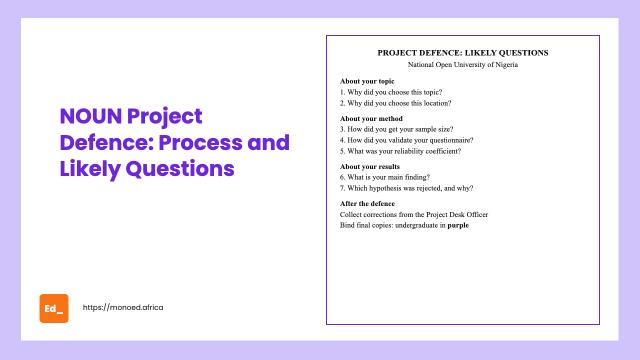
About your topic
- Why did you choose this topic?
- What problem does your study address?
- Why did you choose this location or organisation?
About your literature
- Which theory did you use, and why?
- Name two studies close to yours. How is your study different?
- What gap does your study fill?
About your method (Chapter Three)
- What research design did you use, and why?
- What is your population, and how did you get your sample size?
- Which sampling technique did you use?
- How did you validate your questionnaire?
- How did you test reliability, and what was the result?
About your results
- What is your main finding?
- Which hypothesis was rejected, and what does that mean?
- Why did you use this statistical tool?
About your recommendations
- Who should act on your recommendations?
- What would you do differently if you repeated the study?
- What should future researchers study next?
For more questions with sample answers, see final year project defence questions and answers.
How to prepare for your NOUN defence
One week before
- Read your whole project again, especially Chapters Three and Four.
- Write a one-page summary: topic, objectives, method, three main findings, recommendations.
- Know your numbers: population, sample size, reliability coefficient, and the result of each hypothesis.
- Check the arrangements with your Study Centre: date, venue, time, number of copies, and whether you need slides.
Your presentation
- If slides are allowed, keep them short: title, problem and objectives, method, main findings, recommendations. See our guide to project defence PowerPoint slides.
- Practise out loud with a timer. Most presentations are short.
On the day
- Arrive early with your copies, your matric number and your ID card.
- Dress neatly and simply.
- Listen to the whole question before answering.
- If you do not know, say so honestly and explain how you would find out.
- Write down every comment the panel makes. These become your corrections.
After the defence: corrections and binding
- Collect your corrections when your Study Centre announces them. NOUN has required in-person collection from the Project Desk Officer.
- Make every correction and show your supervisor.
- Bind the final copies in the correct colour. NOUN's research manual sets these colours:
| Level | Binding colour |
|---|---|
| Undergraduate | Purple (the school colour) |
| PGDE | Navy blue |
| Master's | Black |
| PhD | Leaf green |
The manual also lists items to submit with the final project, including a letter of introduction from your Head of Department to the field, a letter of attestation from where the study was carried out, and your instruments. Check with your Study Centre for the current list and number of copies.
If you have not written your project yet
Make sure your project follows the NOUN research project format, and that your methodology is solid. Most defence questions come from Chapter Three.
More for NOUN students
- NOUN project proposal format, with a sample
- NOUN project topics by faculty
- NOUN research project format
- NOUN research methodology (Chapter Three)
- NOUN project cover page and title page
- NOUN seminar format and presentation guide
- NOUN CGPA calculator (free)
FAQs
What happens at NOUN project defence?
You present your project to a panel of academic staff, who ask questions about your topic, literature, method, results and recommendations. You then collect corrections and submit final hard-bound copies.
Is NOUN project defence virtual or physical?
It depends on your programme, faculty and session. NOUN has used both. Check the notice from your faculty or Study Centre.
What colour is NOUN undergraduate project binding?
Purple, the school colour. PGDE is navy blue, master's is black and PhD is leaf green.
Do I need to pay a fee for NOUN project defence?
Pay only official fees through NOUN's channels. NOUN has said that levies charged by some Study Centres for defence and moderation were not approved fees.
Where do I collect my NOUN project corrections?
From the Project Desk Officer at your Study Centre, in person, when NOUN announces that corrections are ready.
About the Author
Mohammad-Jamiu B. Balogun, GMNSE
Founder & Product Architect, MonoEd Africa
Mohammad-Jamiu is a First-Class Telecommunications Engineer and Best Graduating Student of Bayero University, Kano (Class of 2024), and the founder of MonoEd Africa. An AI engineer and product architect, he designs and builds MonoEd's guided workflows for SIWES logbooks and reports, final year projects and academic tools such as the GPA calculator, helping students produce better work and build the skills the AI era demands. MonoEd's tools have reached more than 20,000 students across Nigeria.