NOUN Research Methodology (2026): How to Write Chapter Three of Your NOUN Project, With Examples
How to write Chapter Three (methodology) for a NOUN project: the eight sub-headings in NOUN's research manual, what to write under each, and a full example.

Quick summary:
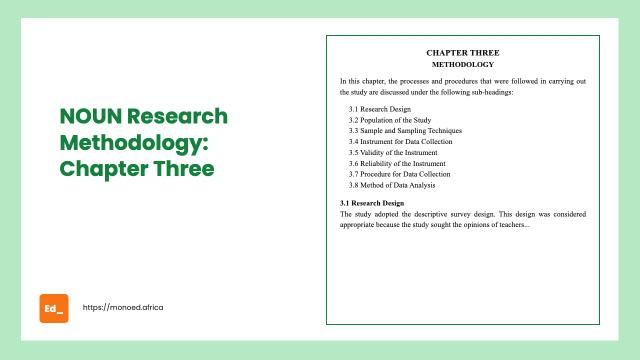
NOUN's research project manual sets Chapter Three (Methodology) under eight sub-headings: 3.1 Research Design, 3.2 Population of the Study, 3.3 Sample and Sampling Techniques, 3.4 Instrument for Data Collection, 3.5 Validity of the Instrument, 3.6 Reliability of the Instrument, 3.7 Procedure for Data Collection, and 3.8 Method of Data Analysis. Start with a short introduction, justify every choice you make, and write in the past tense because the chapter describes what you did.
Chapter Three is where most NOUN projects lose marks, and it is also where most defence questions come from. The good news is that NOUN's research manual gives a clear structure. If you follow it and justify each choice, your chapter will be solid.
This guide follows the NOUN Research Project Manual and Format. Some faculties and supervisors adjust the headings slightly, so check with your supervisor.
NOUN Chapter Three format
The manual says to start with an introductory statement like this:
In this chapter, the processes and procedures that were followed in carrying out the study are discussed under the following sub-headings.
Then use these sub-headings:
| Section | What to write |
|---|---|
| 3.1 Research Design | The design you used and why it suits your study |
| 3.2 Population of the Study | Everyone your findings apply to, with numbers |
| 3.3 Sample and Sampling Techniques | Your sample size, how you chose it, and why |
| 3.4 Instrument for Data Collection | Your questionnaire, interview guide, test or records, and how it is structured and scored |
| 3.5 Validity of the Instrument | How experts checked that the instrument measures what it should |
| 3.6 Reliability of the Instrument | How you tested consistency, and the result |
| 3.7 Procedure for Data Collection | Step by step, how you collected the data |
| 3.8 Method of Data Analysis | The statistical tools you used, and why |
What to write under each heading
3.1 Research Design
Name the design and justify it. The most common at NOUN:
- Descriptive survey: to describe opinions, practices or levels (for example, teachers' use of ICT)
- Correlational: to find relationships between variables (for example, study habits and CGPA)
- Quasi-experimental: to test the effect of a method using groups (common in Education)
- Case study: to study one organisation in depth (common in Management Sciences)
Example: The study adopted the descriptive survey design. This design was considered appropriate because the study sought the opinions of teachers on the use of ICT in teaching, without manipulating any variable.
3.2 Population of the Study
The manual defines the population as "the totality of all the respondents to whom the findings of the study will be generalized". Give the number and the source of the figure.
Example: The population of the study comprised all 1,240 teachers in the 18 public secondary schools in Ikorodu Local Government Area of Lagos State (Source: Ikorodu LGEA, 2026).
3.3 Sample and Sampling Techniques
State your sample size, how you calculated it, the technique you used to select respondents, and why.
Example: Using Taro Yamane's formula at a 5% margin of error, a sample of 303 teachers was determined. Stratified random sampling was used to select teachers from each school in proportion to the number of teachers in the school, so that every school was represented.
You can work out the sample size with our free Taro Yamane sample size calculator, or read how to calculate sample size.
3.4 Instrument for Data Collection
The manual asks you to describe each instrument in detail: "how it is patterned, sectioned and scaled in terms of expected responses and weightings".
Example: The instrument for data collection was a structured questionnaire titled "Teachers' Use of ICT Questionnaire (TUICTQ)". It had two sections. Section A sought respondents' demographic data. Section B contained 20 items on a four-point scale: Strongly Agree (4), Agree (3), Disagree (2) and Strongly Disagree (1).
3.5 Validity of the Instrument
Explain how the instrument was validated: usually face and content validity by your supervisor and other experts.
Example: The face and content validity of the instrument were established by the supervisor and two lecturers in Educational Technology, National Open University of Nigeria. Their corrections were used to produce the final version.
3.6 Reliability of the Instrument
State the method (test-retest, split-half, Cronbach's alpha), how you did it, and the result.
Example: The instrument was administered to 20 teachers in Kosofe LGA, who were not part of the study. Their responses were analysed using Cronbach's alpha, which gave a reliability coefficient of 0.82. This showed the instrument was reliable.
Not sure what counts as a good value? See acceptable Cronbach's alpha values.
3.7 Procedure for Data Collection
Describe step by step how you collected the data: letter of introduction, who administered the questionnaire, how long it took, how many copies came back.
Example: With a letter of introduction from the Head of Department, the researcher visited the sampled schools with two research assistants. The questionnaire was administered and collected on the spot over two weeks. Of the 303 copies distributed, 291 were correctly filled and returned, a return rate of 96%.
3.8 Method of Data Analysis
Name the tools and justify them. The manual lists percentages, frequency counts, mean, standard deviation, chi-square, t-test, ANOVA and charts.
Example: Research questions were answered using mean and standard deviation. A mean of 2.50 and above was taken as agreement, and below 2.50 as disagreement. The hypotheses were tested using the t-test at 0.05 level of significance.
Common Chapter Three mistakes
- Writing in the future tense. Your final project describes what you did, so use the past tense ("was used", "were selected").
- No justification. Every choice needs a "because".
- Population without numbers or a source.
- Sample size with no formula or working.
- Validity and reliability mixed up. Validity is "does it measure the right thing?"; reliability is "does it give consistent results?"
- Analysis tools that do not match your research questions and hypotheses.
Chapter Three and your defence
Most defence panels spend a lot of time on Chapter Three. Be ready to explain your design, population, sample size, sampling technique, validity, reliability coefficient and analysis tools in your own words. See NOUN project defence for likely questions.
For the full chapter structure, see the NOUN research project format. For a general guide with more examples from other universities, see how to write Chapter Three.
More for NOUN students
- NOUN project proposal format, with a sample
- NOUN project topics by faculty
- NOUN research project format
- NOUN project cover page and title page
- NOUN project defence: process and likely questions
- NOUN seminar format and presentation guide
- NOUN CGPA calculator (free)
FAQs
What are the sub-headings of Chapter Three in a NOUN project?
Research design, population, sample and sampling techniques, instrument for data collection, validity, reliability, procedure for data collection, and method of data analysis.
Is NOUN research methodology written in the past or future tense?
In the final project, use the past tense. In a proposal, you may use the future tense because the study has not been done yet.
Which research design is best for a NOUN project?
There is no single best design. Descriptive survey is the most common, but choose the design that matches your objectives and justify it.
How do I calculate sample size for my NOUN project?
Many NOUN students use Taro Yamane's formula. Our free calculator shows the full working you can copy into Chapter Three.
Where is the NOUN research methodology PDF?
NOUN publishes its Research Project Manual and Format on its website. Your course materials for your research methods course also cover methodology.
About the Author
Mohammad-Jamiu B. Balogun, GMNSE
Founder & Product Architect, MonoEd Africa
Mohammad-Jamiu is a First-Class Telecommunications Engineer and Best Graduating Student of Bayero University, Kano (Class of 2024), and the founder of MonoEd Africa. An AI engineer and product architect, he designs and builds MonoEd's guided workflows for SIWES logbooks and reports, final year projects and academic tools such as the GPA calculator, helping students produce better work and build the skills the AI era demands. MonoEd's tools have reached more than 20,000 students across Nigeria.