NOUN Seminar Format (2026): Paper Structure, Sample Outline and Presentation Guide
The NOUN seminar paper format, a sample outline you can follow, how the presentation is marked, and tips for presenting confidently. Based on NOUN course guides.

Quick summary:
A NOUN seminar paper usually follows this outline: introduction (overview, problem, research questions and objectives), literature review, methodology, results and discussion, conclusion and recommendations, and references in APA style. It is presented in sections, not long chapters. For the presentation, NOUN course guides recommend PowerPoint, and time limits are short: about 10 minutes of talk with time for questions. In one NOUN assessment sheet, literature review carries 15 marks and content, confidence, answering questions, grammar, conclusion and APA citation each carry 10.
Many NOUN programmes have a seminar course in the final year. For a lot of students, it is the first time they present academic work in front of a panel, and the instructions are spread across course guides most people never download.
This guide puts the format together from NOUN's own seminar course guides, with a sample outline and the marking criteria from a real NOUN assessment sheet. Seminar rules differ by course, so check your own course guide on the NOUN website for your exact course code.
What is a NOUN seminar?
A seminar is a short research paper on a topic approved by your supervisor, which you then present to a panel. The panel usually includes your facilitator and other academic staff at your Study Centre.
NOUN's Co-operative Seminar guide (CRD 409) lists what the seminar is meant to build:
- Analytical and research skills
- Confidence in public presentation
- Academic writing and reporting skills
- Basic statistical analysis
NOUN seminar paper format
The CRD 409 course guide sets out this outline:
- Introduction
- General overview
- Problem definition, research questions and objectives
- Literature review on the topic
- Research methodology
- Study location
- Data and sampling procedure
- Analytical techniques
- Results and discussion
- Conclusion and recommendations
- References
The PGD Economics seminar guideline (ECO721) uses a similar structure, in numbered sections rather than chapters:
| Section | Sub-sections |
|---|---|
| Section One: Introduction | Background, statement of the problem, objectives, research questions, hypotheses, scope, significance |
| Section Two: Literature Review | Conceptual framework, theoretical framework, empirical review, literature gap |
| Section Three: Research Methodology | Research design, data analysis techniques, sources of data (plus model specification for economics) |
How long should a NOUN seminar paper be?
It depends on the course. The PGD Economics guideline sets 25 to 30 pages for the introduction, main section and conclusion together. Undergraduate seminars are often shorter. Ask your facilitator if your course guide does not say.
Formatting
Unless your course guide says otherwise, use the same rules as NOUN projects:
- A4 paper, Times New Roman, 12 point
- Double line spacing, 1-inch margins
- Justified text
- APA referencing (the CRD 409 assessment sheet awards marks for correct APA citation)
Sample NOUN seminar outline
Topic: Access to Microcredit and the Growth of Small Businesses in Kubwa, Abuja
Cover page: topic, your name, matric number, course code and title (for example, CRD 409: Co-operative Seminar), programme, Study Centre, supervisor, month and year
Abstract (about 150 to 250 words): what you studied, how, what you found and what you recommend
1. Introduction
- 1.1 Overview of small businesses and microcredit in Nigeria
- 1.2 Statement of the problem
- 1.3 Research questions
- 1.4 Objectives
2. Literature review
- 2.1 Concept of microcredit
- 2.2 Concept of small business growth
- 2.3 Theory (for example, the financial intermediation theory)
- 2.4 Review of related studies
- 2.5 Gap in literature
3. Methodology
- 3.1 Study area: Kubwa, Bwari Area Council
- 3.2 Population and sample
- 3.3 Data collection
- 3.4 Method of analysis
4. Results and discussion
5. Conclusion and recommendations
References (APA)
Need a topic? NOUN's CRD 409 guide suggests areas such as business feasibility studies, micro-credit, cooperative finance, pricing and demand analysis, and cooperatives and development. Other courses have their own lists in their course guides. You can also generate topics for your course with our free tool.
How the NOUN seminar presentation works
From NOUN's seminar course guides:
- Time: CRD 409 gives each student 10 minutes to present, followed by questions. The MBA graduate seminar uses 15 minutes in total: 10 to present and 5 for questions.
- Slides: NOUN recommends Microsoft PowerPoint where the facility exists. CRD 409 also asks students to submit a printout of the slides at least a day before the presentation.
- Equipment: Some guides expect students to arrange what they need, such as a laptop and projector. Ask your Study Centre what is provided.
- Timing: Seminar presentations often hold near the end of the semester, on a date set by your Study Centre coordinator.
How you are marked
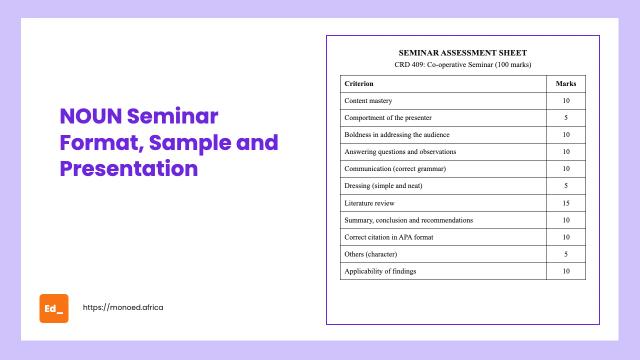
This is the assessment sheet in the CRD 409 course guide (100 marks):
| Criterion | Marks |
|---|---|
| Content mastery (comprehensiveness) | 10 |
| Comportment of the presenter | 5 |
| Boldness in addressing the audience | 10 |
| Answering questions and observations | 10 |
| Communication (correct grammar) | 10 |
| Dressing (simple and neat) | 5 |
| Literature review (texts, journals, government reports) | 15 |
| Summary, conclusion and recommendations | 10 |
| Correct citation in APA format | 10 |
| Others (character) | 5 |
| Applicability of findings | 10 |
Your own course may use a different sheet, but the same things matter almost everywhere: know your work, speak clearly, cite properly and answer questions calmly.
How to prepare your slides
A simple plan that fits a 10-minute slot:
- Title slide: topic, name, matric number, course code
- Introduction and problem (1 to 2 slides)
- Objectives and research questions (1 slide)
- Literature review summary (1 to 2 slides)
- Methodology (1 slide)
- Results (2 to 3 slides, with simple charts or tables)
- Conclusion and recommendations (1 slide)
- Thank you and questions
Keep text short. One idea per slide, and no full paragraphs. CRD 409's own advice is to leave about a quarter of your time for questions and to check that you finish within your limit.
Writing the seminar report
Some programmes ask for a written seminar report after the presentation. If you need help structuring it, our seminar report format guide explains each section, and the MonoEd Seminar Report tool can draft a report with a NOUN title page that you then edit and make your own.
Common NOUN seminar mistakes
- Reading slides word for word. Panels mark confidence and mastery.
- Going over time. Practise with a timer.
- Weak literature review. It is the highest-scoring section on the CRD 409 sheet.
- Mixed referencing styles. Use APA throughout.
- Not knowing your own method. Be ready to explain your sample and analysis.
More for NOUN students
- NOUN project defence: process and likely questions
- GST302 business plan sample
- NOUN project proposal format, with a sample
- NOUN project topics by faculty
- NOUN SIWES guide: portal, logbook and report
- NOUN research project format
- How to write Chapter One of your NOUN project
- How NOUN calculates your GPA and CGPA
- NOUN CGPA calculator (free)
FAQs
What is the format of a NOUN seminar paper?
Introduction, literature review, methodology, results and discussion, conclusion and recommendations, and references in APA style. Postgraduate guides arrange these as numbered sections.
How many pages is a NOUN seminar paper?
It varies. The PGD Economics guideline sets 25 to 30 pages. Undergraduate seminars are often shorter, so follow your course guide.
How long is a NOUN seminar presentation?
Usually about 10 minutes of presentation, plus time for questions. Check your course guide for your exact limit.
Do I need PowerPoint for my NOUN seminar?
NOUN's seminar guides recommend PowerPoint where the facility exists. Some ask for a printout of your slides a day before.
Where can I find my seminar course guide?
On the NOUN website's course materials section. Search for your course code, for example CRD 409.
Is a seminar the same as a final year project?
No. A seminar is shorter and is presented to a panel. Your final year project is a full research report. See the NOUN research project format for the project.
About the Author
Mohammad-Jamiu B. Balogun, GMNSE
Founder & Product Architect, MonoEd Africa
Mohammad-Jamiu is a First-Class Telecommunications Engineer and Best Graduating Student of Bayero University, Kano (Class of 2024), and the founder of MonoEd Africa. An AI engineer and product architect, he designs and builds MonoEd's guided workflows for SIWES logbooks and reports, final year projects and academic tools such as the GPA calculator, helping students produce better work and build the skills the AI era demands. MonoEd's tools have reached more than 20,000 students across Nigeria.