GST302 Business Plan Sample (2026): Template, Format and a Full Worked Example
A complete GST302 business plan sample for NOUN students, with the format from the course material, a template you can copy and a worked break-even example.

Quick summary:
A GST302 business plan should cover: executive summary, the business idea and industry background, the entrepreneur(s) and ownership, business objectives, the product or service, market research and competitors, the marketing plan, management and staffing, legal form and permits, premises, and financial information (start-up capital, sources of finance, projected profit, break-even analysis and cash flow). In GST302, the business plan presentation carries 20% of your total score and the enterprise you build from it carries 30%, so the plan is worth taking seriously.
GST302 (Business Creation and Growth) is compulsory for NOUN undergraduates, and the business plan is the part most students worry about. Many end up copying a plan from a WhatsApp group, which is risky: the course material warns that plagiarism "is highly penalized", and a copied plan is hard to defend when you have to turn it into a real enterprise.
This guide gives you the format from the GST302 course material, a template you can follow section by section, and a complete sample plan with simple, realistic numbers. Use the sample to understand the structure, then write your own plan for a business you could actually start.
How GST302 is graded
According to the GST302 course guide:
| Assessment | Maximum score |
|---|---|
| Business plan presentation | 20% |
| Enterprise (turning your plan into a real business) | 30% |
| Forum discussions and portfolio (needs at least 75% participation) | 10% |
| Final e-exam (60 multiple choice questions, 1 hour 30 minutes) | 40% |
So 50% of your grade depends on the business plan and the enterprise that comes from it. The course guide also says you upload your business plan on the designated platform at the scheduled time, so watch for announcements from your Study Centre and GST302 Desk Officer.
These figures come from the course guide edition we read (first edition, 2018). If your facilitator gives different instructions, follow theirs.
What a GST302 business plan should contain
The course material lists these parts of a written business plan:
- The business idea: what the product or service is, with background on the industry
- The entrepreneurs: who the founders are, their skills, and the ownership structure
- Business objectives: what the business wants to achieve, its advantage over competitors, and the image it wants
- The product or service: a technical description (for example, how you produce it, where you buy stock, or how you deliver the service)
- The market: market size and trends, target customers, competitors, your unique selling point, and your marketing programme (pricing, packaging, promotion, distribution)
- Management and operations: staff needed, their skills and training
- Business organisation: legal form (sole trader, partnership or company), business name registration, licences, taxes, insurance and premises
- Financial information: capital needed, sources of finance, cost of finance, projected profit and loss, break-even analysis, cash flow forecast
It also says the executive summary should appear first.
GST302 business plan template
Copy these headings into your document and fill each one.
Cover page
- Business name
- Business plan, GST302: Business Creation and Growth
- Your name, matric number, programme, Study Centre
- Month and year
1. Executive summary (half a page, written last)
- What the business does, for whom, where
- How much money you need and what it will be used for
- Expected sales and when the business will break even
2. Business description
- Business idea and the problem it solves
- Industry background (two or three sentences on the sector in Nigeria and your area)
- Type of business (new, part-time, seasonal, expansion)
- Objectives: short term (first 12 months) and long term (3 to 5 years)
3. The entrepreneur(s)
- Name, experience and skills of each owner
- Ownership share
4. Products or services
- What you sell, how it is made or delivered, suppliers
5. Market analysis
- Target customers
- Market size estimate
- Competitors and their weaknesses
- Your unique selling point
6. Marketing plan
- Price, promotion, place (location and distribution), packaging
7. Management and organisation
- Legal form, registration, licences and permits
- Staff, roles and pay
- Premises
8. Financial plan
- Start-up capital table
- Sources of funds
- Monthly costs (fixed and variable)
- Sales forecast
- Break-even analysis
- Projected profit for the first year
9. Risks and how you will handle them
10. Conclusion
Full GST302 business plan sample
The sample below is for a small drinks business. All the figures are examples for illustration. Use real prices from your own area in your plan.
Cover page
FreshZobo Drinks
Business plan for GST302: Business Creation and Growth
[Your name], [Matric number], [Programme], [Study Centre]
[Month, Year]
1. Executive summary
FreshZobo Drinks will produce and sell chilled zobo and kunu in 50cl bottles in Kubwa, Abuja. Our customers are office workers, students and shop owners who want an affordable, hygienic local drink. We will sell directly from a small outlet and supply nearby shops and canteens.
We need ₦805,000 to start, mainly for a chest freezer, production equipment, first stock and three months of operating costs. Funding will come from personal savings (₦300,000), family support (₦200,000) and a cooperative loan (₦305,000). At ₦500 per bottle, the business breaks even at about 460 bottles a month, or roughly 18 bottles per working day. We expect to pass this point in the second month.
2. Business description
Business idea. Zobo and kunu are popular across Nigeria, but much of what is sold by the roadside is unbranded and stored in reused containers. FreshZobo will sell freshly made drinks in sealed, labelled bottles, kept cold, at a price close to street prices.
Industry background. Locally made drinks are a growing small-business area in Nigerian cities, helped by the high cost of imported soft drinks. Packaged food and drinks must meet NAFDAC requirements, so we will start small and work towards NAFDAC listing as we grow.
Type of business. New, full-time.
Objectives.
- Sell at least 700 bottles a month by month 3
- Supply 10 shops or canteens in Kubwa within 6 months
- Obtain NAFDAC listing within 12 months
- Open a second outlet within 3 years
3. The entrepreneur
[Your name] has three years of experience selling food items and managing stock in a family business, and is studying [your programme] at the National Open University of Nigeria. The business is a sole proprietorship, fully owned by [your name].
4. Products
- Zobo (hibiscus drink with ginger and pineapple), 50cl, ₦500
- Kunu (millet drink), 50cl, ₦500
Production will take place in a clean, dedicated kitchen space. Ingredients will be bought weekly from Kubwa market. Each bottle is sealed and labelled with the production date.
5. Market analysis
Target customers: office workers and traders along the Kubwa expressway, students, and small shops and canteens that buy for resale.
Market size: Kubwa has many offices, schools and shops within a short distance of our location. If only 30 customers a day buy one bottle, we sell about 780 bottles a month.
Competitors: roadside zobo sellers (cheap but no branding or guaranteed hygiene) and soft drinks (more expensive).
Unique selling point: fresh, sealed, labelled and chilled, at a price close to roadside sellers.
6. Marketing plan
- Price: ₦500 per bottle; ₦450 for shops buying 20 bottles or more
- Promotion: WhatsApp status and a WhatsApp catalogue, free tasting on launch week, flyers to nearby offices
- Place: a small outlet near the Kubwa expressway, plus delivery to shops twice a week
- Packaging: clear bottles with a simple printed label showing the name, ingredients and production date
7. Management and organisation
- Legal form: sole proprietorship, registered as a business name with the Corporate Affairs Commission (CAC)
- Permits: local government trading permit; NAFDAC listing planned within 12 months
- Staff: the owner (production and sales) and one sales assistant paid ₦40,000 a month
- Premises: a rented shop space with power for the freezer
8. Financial plan
Start-up capital
| Item | Cost (₦) |
|---|---|
| Chest freezer | 350,000 |
| Cooking pots, sieves and containers | 80,000 |
| Bottle sealing tool | 60,000 |
| First stock (ingredients, bottles, labels) | 100,000 |
| Branding and flyers | 40,000 |
| Registration and permits (estimate) | 60,000 |
| Working capital (one month of fixed costs) | 115,000 |
| Total | 805,000 |
Sources of funds
| Source | Amount (₦) |
|---|---|
| Personal savings | 300,000 |
| Family support | 200,000 |
| Cooperative loan | 305,000 |
| Total | 805,000 |
Monthly fixed costs
| Cost | Amount (₦) |
|---|---|
| Rent | 30,000 |
| Power and gas | 25,000 |
| Sales assistant | 40,000 |
| Delivery (transport) | 20,000 |
| Total | 115,000 |
Variable cost per bottle
| Cost | Amount (₦) |
|---|---|
| Ingredients | 150 |
| Bottle and label | 70 |
| Sugar and flavouring | 30 |
| Total | 250 |
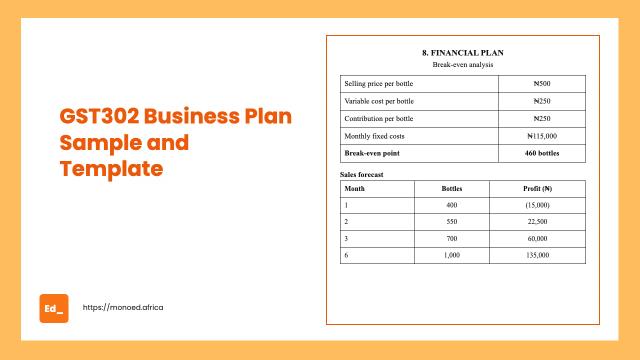
Break-even analysis
- Selling price per bottle: ₦500
- Variable cost per bottle: ₦250
- Contribution per bottle: ₦500 minus ₦250 = ₦250
- Break-even point: fixed costs divided by contribution = ₦115,000 ÷ ₦250 = 460 bottles a month
- Working 26 days a month, that is about 18 bottles a day
Sales forecast and profit (first six months)
| Month | Bottles sold | Contribution (₦) | Fixed costs (₦) | Profit (₦) |
|---|---|---|---|---|
| 1 | 400 | 100,000 | 115,000 | (15,000) |
| 2 | 550 | 137,500 | 115,000 | 22,500 |
| 3 | 700 | 175,000 | 115,000 | 60,000 |
| 4 | 800 | 200,000 | 115,000 | 85,000 |
| 5 | 900 | 225,000 | 115,000 | 110,000 |
| 6 | 1,000 | 250,000 | 115,000 | 135,000 |
The loss in month 1 is covered by the working capital in the start-up budget.
9. Risks and how we will handle them
| Risk | Response |
|---|---|
| Power cuts spoil stock | Produce in small daily batches; keep ice packs |
| Ingredient prices rise | Buy in bulk when prices are low; review the price every quarter |
| Competition from cheaper sellers | Compete on hygiene, branding and reliable supply to shops |
| Slow sales at the start | Free tastings and discounts for shops that buy in bulk |
10. Conclusion
FreshZobo Drinks meets a real need for affordable, hygienic local drinks in Kubwa. With ₦805,000 in start-up capital, the business can break even at about 18 bottles a day and grow to supply shops across the area within six months.
Tips for a strong GST302 plan
- Pick a business you can really start. The enterprise is worth 30%, so a plan for an oil refinery will not help you. Choose something small: food, tailoring, phone accessories, tutoring, POS services, cleaning, printing.
- Use real local prices. Visit the market or ask sellers. Examiners notice made-up numbers.
- Show your break-even working. Write the formula and every step, like the sample above.
- Keep the executive summary for last. It summarises everything else.
- Write it yourself. The course material warns against plagiarism, and you will be asked about your plan.
How the presentation works
The business plan presentation is part of your continuous assessment. Arrangements are made through your Study Centre and the GST302 Desk Officer, and some incubation centres now share GST302 notices online. Confirm the date, format and upload instructions with your Study Centre rather than relying on forwarded messages.
For the slides, keep to the same order as your plan: the idea, the market, how you will sell, the numbers (start-up cost and break-even) and what you have done so far. If you need help preparing slides, our seminar presentation guide for NOUN covers slide planning and timing.
More for NOUN students
- How to pass NOUN e-exams and POP exams
- NOUN TMA guide: login, submission and scores
- How NOUN calculates your GPA and CGPA
- NOUN SIWES guide: portal, logbook and report
- NOUN project proposal format, with a sample
- NOUN seminar format and presentation guide
- NOUN CGPA calculator (free)
FAQs
What is GST302 in NOUN?
GST302 is Business Creation and Growth, a compulsory two-unit general studies course. You write and present a business plan, then turn the idea into an enterprise.
How many marks is the GST302 business plan?
The course guide gives the business plan presentation a maximum of 20% and the enterprise a maximum of 30%. Forum participation and your portfolio carry 10%, and the e-exam carries 40%.
What should be in a GST302 business plan?
An executive summary, business description, the entrepreneur(s), products or services, market analysis, marketing plan, management and organisation, a financial plan with break-even analysis, risks and a conclusion.
Can I use a business plan sample from the internet?
Use samples to understand the structure only. Your plan must be your own work for a business you can actually run, because the course material penalises plagiarism and you will build the enterprise from it.
How do I calculate break-even for my GST302 business plan?
Divide your monthly fixed costs by the contribution per unit (selling price minus variable cost per unit). The answer is the number of units you must sell each month to cover your costs.
About the Author
Mohammad-Jamiu B. Balogun, GMNSE
Founder & Product Architect, MonoEd Africa
Mohammad-Jamiu is a First-Class Telecommunications Engineer and Best Graduating Student of Bayero University, Kano (Class of 2024), and the founder of MonoEd Africa. An AI engineer and product architect, he designs and builds MonoEd's guided workflows for SIWES logbooks and reports, final year projects and academic tools such as the GPA calculator, helping students produce better work and build the skills the AI era demands. MonoEd's tools have reached more than 20,000 students across Nigeria.