How to Pass NOUN e-Exams and POP Exams (2026): Format, Pass Mark, Virtual Exams and Study Tips
How NOUN e-exams and POP exams work, the 40% pass mark, how TMAs count, virtual exams, remarking and tips to pass. Based on NOUN's FAQ.

Quick summary:
NOUN uses two exam types. e-Exams are taken on a computer and are usually multiple choice. Pen-on-paper (POP) exams are essay-type and are taken mainly from 300 level upwards. Your exam counts for 70% of your course score and your TMAs for 30%. Undergraduates need 40% to pass (50% for nursing and postgraduate programmes). To pass, register your courses for the exam on time, do all three TMAs for every course, and study past questions alongside your course materials.
Studying at NOUN means preparing for exams mostly on your own, often while working. Many students fail courses not because the exam was hard, but because they missed a step: they did not register the course for the exam, skipped TMAs, or did not know how the exam worked.
This guide explains the rules from NOUN's official FAQ and assessment policy, then gives practical tips for both exam types.
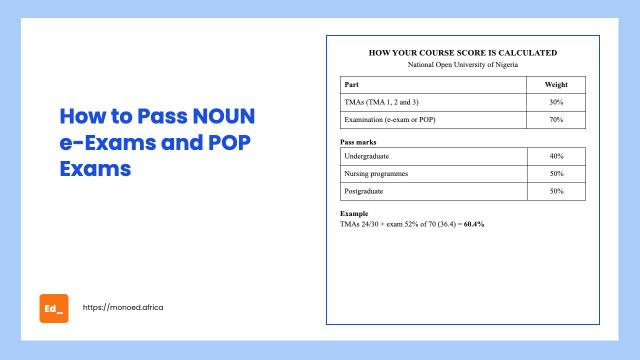
How your NOUN course score is calculated
From NOUN's FAQ:
| Part | Weight |
|---|---|
| TMAs (Tutor-Marked Assignments) | 30% |
| Examination (e-exam or POP) | 70% |
Pass marks:
- Undergraduate: 40% and above
- Nursing programmes: 50% and above
- Postgraduate programmes: usually 50% and above
Some programmes vary, so check your programme handbook.
Example: You score 24 out of 30 in your TMAs and 52% in the exam. Your exam contributes 52% of 70 = 36.4. Your total is 24 + 36.4 = 60.4%.
This is why TMAs matter so much. A student who scores 25/30 in TMAs needs only 15 marks out of 70 in the exam to reach 40%.
e-Exam vs POP exam
| e-Exam | POP (pen-on-paper) | |
|---|---|---|
| How | On a computer at an exam centre | Written answer booklet |
| Questions | Usually multiple choice | Essay-type |
| Who | Mostly 100 and 200 level courses | Mainly 300 level and above |
| Remarking | Not available | Available through the portal, for a fee |
NOUN's assessment policy describes e-exams as "usually multiple-choice questions" and POP as essay-type, taken by students "from 300 Levels and above". Your exam timetable shows which type each of your courses uses.
Before the exam: steps you must not miss
- Register your courses for the exam. On your student portal, click Courses, then "Register courses for exam", and select each course. Keep your email active, because NOUN sends a token during this process.
- Check that your TMAs appear. Courses you have not registered for the exam will not show on your TMA portal. Registrations take about two working days to reflect.
- Do all three TMAs for every course. See our NOUN TMA guide.
- Check the exam timetable for your course dates, times and type (e-exam or POP).
- Know your exam centre and plan how you will get there.
How to pass NOUN e-exams
- Practise with the clock. e-Exams are timed, and the timer keeps running. Answer easy questions first.
- Read every option before you choose. Many options look alike.
- Do not leave blanks. Multiple choice questions usually have no negative marking, but confirm the instructions on screen.
- Use past questions to learn the pattern, not to memorise answers. Questions are drawn from a bank, so the same topics come back in different forms.
- Read the summaries at the end of each unit of your course material. Many questions come from key definitions and lists.
- Arrive early with your exam slip and ID. Late arrivals can lose time or be refused.
How to pass NOUN POP exams
- Answer the question asked. Read each question twice and underline the command word: define, explain, discuss, compare.
- Plan before you write. Spend two minutes listing your points.
- Use headings and short paragraphs. Examiners mark points, so make each point easy to find.
- Give Nigerian examples. They show understanding.
- Manage your time. Divide the exam time by the number of questions you must answer, and move on when time is up.
- Write legibly. An examiner cannot mark what they cannot read.
A simple study plan for working students
- Start early. Spread your courses across the weeks before exams.
- One course at a time. Read the course material unit by unit, and write a one-page summary of each unit.
- Use the course forum and facilitation sessions. Your facilitator often hints at what matters.
- Study past questions in the last two weeks, timing yourself.
- Protect your sleep before exam days.
Virtual exams (remote)
NOUN offers a virtual exam for some students, taken from wherever they are using a computer and internet. From NOUN's Directorate of Examinations and Assessment (DEA):
- You register on your student portal under "Register for Virtual Exam".
- It costs ₦5,000 per course, deducted from your e-wallet.
- Registration closes with normal course and exam registration.
- Approval is not automatic. You upload supporting documents in one PDF, for example:
- Students outside Nigeria: passport data page, visa page, address and phone number abroad
- Health and other reasons: medical documents, or evidence of official duty away from your Study Centre
Enquiries go to the email listed on the DEA website.
After the exam: results, remarking and failed courses
- Results: check your result statement on your portal. Your CGPA may go up or down as new results are released.
- Incomplete result: means a TMA or exam score is missing. Raise an e-ticket at support.nou.edu.ng.
- Remarking: not available for e-exams. For POP exams, you can apply through your portal (Registry, then Request for Re-marking of Scripts) and pay the fee.
- Failed courses: must be re-registered and retaken.
Want to know where you stand? Use our free NOUN CGPA calculator, and read how NOUN calculates your GPA and CGPA.
More for NOUN students
- NOUN TMA guide: login, submission and scores
- How NOUN calculates your GPA and CGPA
- GST302 business plan sample
- NOUN SIWES guide: portal, logbook and report
- NOUN project topics by faculty
- NOUN CGPA calculator (free)
FAQs
What is the pass mark in NOUN?
40% for undergraduates, 50% for nursing programmes, and usually 50% for postgraduate programmes.
How much do TMAs count in NOUN?
30% of your course score. The exam counts for 70%.
What is the difference between NOUN e-exam and POP exam?
An e-exam is computer-based and usually multiple choice. A POP exam is written on paper and is essay-type, mainly for 300 level and above.
Can I request a remark of my NOUN e-exam?
No. NOUN does not offer remarking for e-exams. You can request a remark for POP exams through your portal.
How much is the NOUN virtual exam fee?
₦5,000 per course, according to NOUN's Directorate of Examinations and Assessment, deducted from your e-wallet when you register.
What happens if I fail a NOUN course?
You must re-register the course and take it again.
About the Author
Mohammad-Jamiu B. Balogun, GMNSE
Founder & Product Architect, MonoEd Africa
Mohammad-Jamiu is a First-Class Telecommunications Engineer and Best Graduating Student of Bayero University, Kano (Class of 2024), and the founder of MonoEd Africa. An AI engineer and product architect, he designs and builds MonoEd's guided workflows for SIWES logbooks and reports, final year projects and academic tools such as the GPA calculator, helping students produce better work and build the skills the AI era demands. MonoEd's tools have reached more than 20,000 students across Nigeria.