35 Political Science Project Topics and Ideas for Nigerian Students
35 political science project topics for Nigerian students on elections, security, federalism, foreign policy and youth politics, with tips on choosing one.

Political science gives you more interesting material than almost any other department. Elections, insecurity, federalism, the EndSARS protest, Nigeria's foreign policy: there is no shortage of problems to study. The difficulty is narrowing one down to a project you can finish in a semester.
The trick is to fix three things: one issue, one place and one period. "Democracy in Nigeria" is too big. "Vote buying in the 2023 governorship election in Kwara State" is a project.
Here are 35 topics grouped by area.
Treat these as a starting point for a talk with your supervisor. Your department has the final say.
What makes a good political science topic
- One issue. Vote buying, insecurity, party defection, federal character, a foreign policy decision.
- A defined place and period. One state, one election, one administration.
- Data you can get. Questionnaires for voters or students, interviews, INEC reports, newspapers and official documents.
- A theory that fits. Elite theory, structural-functionalism, rational choice, frustration-aggression or realism, depending on your topic.
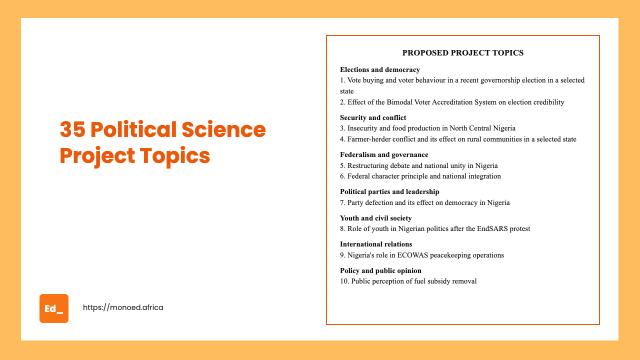
35 political science project topics
Elections and democracy
- Vote buying and voter behaviour in a recent governorship election in a selected state
- Effect of the Bimodal Voter Accreditation System on election credibility
- Voter apathy among undergraduates in a selected university
- Role of the Independent National Electoral Commission in conducting credible elections
- Electoral violence and democratic consolidation in Nigeria
- Social media and political participation during the 2023 general elections
Security and conflict
- Insecurity and food production in North Central Nigeria
- Farmer-herder conflict and its effect on rural communities in a selected state
- Banditry and school enrolment in North West Nigeria
- Role of community policing in reducing crime in a selected area
- Kidnapping and its effect on economic activities in a selected state
- Military intervention in internal security operations and civil-military relations
Federalism and governance
- Restructuring debate and national unity in Nigeria
- Federal character principle and national integration
- Local government autonomy and grassroots development
- Revenue allocation and resource control in the Niger Delta
- State police debate and internal security in Nigeria
Political parties and leadership
- Party defection and its effect on democracy in Nigeria
- Internal party democracy in major Nigerian political parties
- Godfatherism and governance in a selected state
- Women's representation in the National Assembly
- Political leadership and corruption in Nigeria
Youth and civil society
- Role of youth in Nigerian politics after the EndSARS protest
- Civil society organisations and democratic governance
- Not Too Young To Run Act and youth participation in elections
- Student unionism and political awareness in a selected university
International relations
- Nigeria's role in ECOWAS peacekeeping operations
- Nigeria and the African Continental Free Trade Area
- Effect of the Russia-Ukraine war on Nigeria's economy
- Nigeria-China relations and infrastructure development
- Nigeria's foreign policy towards its neighbours
- Effect of the Niger coup on ECOWAS relations
Policy and public opinion
- Public perception of fuel subsidy removal
- Media and political communication in Nigeria
- Religion and voting behaviour in a selected state
Choosing a political science topic you can finish
Avoid topics that need classified data. Security topics are interesting, but you will not get military records. Use perception surveys, interviews with residents or published reports instead.
Be careful with sensitive questions. Asking people who they voted for, or about religion and ethnicity, can make respondents uncomfortable. Ask about attitudes and experiences, keep responses anonymous, and agree the wording with your supervisor.
Use documents well. INEC reports, election observer reports, newspapers and government white papers are strong secondary sources for many topics.
More help: how to choose a final year project topic and research objectives, questions and hypotheses.
Writing your political science project
Most departments use five chapters. Chapter Two should explain your key concepts, your theoretical framework and recent studies. Chapter Three describes your research design, population and data sources. Many political science projects combine a questionnaire with documentary sources.
- Chapter One
- Chapter Two: literature review
- Chapter Three: methodology
- Chapter Four: results
- Chapter Five
Frequently Asked Questions
What are good political science project topics?
Topics on vote buying, voter apathy, insecurity, party defection, youth participation and Nigeria's role in ECOWAS are current and researchable.
Which theory should I use?
Elite theory suits topics on power and godfatherism, structural-functionalism suits governance topics, frustration-aggression suits conflict topics, and realism suits international relations topics.
How do I get data for a political science project?
Questionnaires and interviews for primary data, and INEC reports, newspapers, observer reports and government documents for secondary data.
Can I write about a recent election?
Yes. Recent elections are popular topics. Focus on one state or one issue, and use published results and reports.
How many chapters does a political science project have?
Most use five. Check your department's format.
About the Author
Mohammad-Jamiu B. Balogun, GMNSE
Founder & Product Architect, MonoEd Africa
Mohammad-Jamiu is a First-Class Telecommunications Engineer and Best Graduating Student of Bayero University, Kano (Class of 2024), and the founder of MonoEd Africa. An AI engineer and product architect, he designs and builds MonoEd's guided workflows for SIWES logbooks and reports, final year projects and academic tools such as the GPA calculator, helping students produce better work and build the skills the AI era demands. MonoEd's tools have reached more than 20,000 students across Nigeria.