SIWES Logbook for Mechanical Engineering: How to Fill It (With a Filled Sample)
How to fill your SIWES logbook as a Mechanical Engineering student, with a filled sample for your first weeks and entries for common workshop jobs.


Mechanical Engineering SIWES gives you plenty to write about: workshops, machines, maintenance, welding and fabrication. The problem is that many students write "worked in the workshop" and lose marks.
Here's how to write strong daily entries, with a filled sample you can follow. Follow your school's logbook format first. This post covers what to write inside the spaces your logbook gives you.
What a good Mechanical Engineering entry contains
Answer these questions each day:
- What did I do? The job or task.
- Which machine, tool or equipment did I use?
- How did I do it? The main steps, in order.
- What did I measure or check? Readings, dimensions, settings.
- What did I learn? One clear lesson.
- Safety: PPE or procedure followed, if relevant.
Three to six lines is enough. Write in the first person and past tense.
Weak entry versus strong entry
Weak:
Today I worked in the workshop and learned about machines.
Strong:
Today I assisted the technician in replacing a worn bearing on a conveyor roller. We isolated the motor, removed the roller with a bearing puller, fitted the new bearing and checked the shaft alignment with a dial gauge. I learned that the bearing must be pressed on evenly to avoid damage.
Filled sample: first weeks (fictional, for style only)
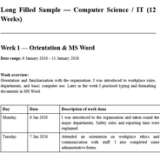
Week 1, Day 1
Today I resumed at the maintenance workshop and was introduced to my supervisor and the technicians. I was given a safety briefing on the use of PPE, fire exits and the lock out and tag out procedure. I toured the workshop and was shown the main machines. I learned that no machine is touched before it is isolated.
Week 1, Day 2
I observed the technicians carry out preventive maintenance on a belt conveyor. I helped to check the belt tension, grease the bearings with a grease gun and clean the rollers. I learned the importance of a maintenance schedule in reducing breakdowns.
Week 1, Day 3
I was shown how to use the vernier caliper and micrometer. I measured the diameters of three shafts and recorded them in a table. I learned to read the main and vernier scales correctly and to check the zero error before measuring.
Week 1, Day 4
I watched and assisted in turning a bushing on the lathe machine. I held the workpiece in the chuck, set the cutting tool and observed the depth of cut being adjusted. I learned the difference between roughing and finishing cuts.
Week 1, Day 5
I helped to service the air compressor by draining condensate, cleaning the intake filter and checking the oil level. I learned why compressed air systems need regular draining.
Week 1 summary
This week I was introduced to the maintenance workshop. I learned safety rules, took part in conveyor maintenance, practised precision measuring and observed lathe work and compressor servicing. I learned that safe isolation and regular maintenance are central to mechanical work.
More sample entries for different tasks
Welding
Today I assisted with arc welding repair of a cracked bracket. I cleaned the joint with a wire brush, set the welding current, and watched the technician weld while I wore a welding helmet and gloves. I learned the importance of joint preparation for a strong weld.
Pumps
I helped to dismantle a centrifugal pump for inspection. I noted the condition of the impeller and the mechanical seal and recorded the parts in the job card. I learned the main parts of a centrifugal pump and how seal wear causes leaks.
Drawings
I was given an engineering drawing of a replacement bracket and asked to read the dimensions and tolerances. I marked out the workpiece for cutting. I learned to read first-angle projection and tolerances.
Generators
I helped to service a diesel generator by changing the engine oil and oil filter and checking the coolant level. I learned the service interval and the order of the steps.
Automotive workshop
Today I helped diagnose a vehicle with a rough idle. We used a scan tool to read fault codes, found a misfire on cylinder three and replaced the spark plug. I learned how fault codes guide diagnosis.
HVAC / refrigeration
I assisted a technician in charging a split air conditioner after a leak repair. I observed the use of manifold gauges and learned how to read pressure values.
Tips specific to Mechanical Engineering
- Name the machine. "Centrifugal pump" is better than "pump".
- Include numbers when you took them. Dimensions, pressures, speeds, torque values. Only write values you really took or were given.
- Say what you did, not just what you saw. If you only watched, say so, and add what you learned.
- Show safety. One line on PPE or isolation shows you understand workshop discipline.
- Link to your courses. Machine design, thermodynamics, fluid mechanics and workshop practice give your entries depth.
- Keep a small notebook in your pocket to jot tasks during the day, then write the entry that evening.
If the week was slow
Describe what you observed or studied, and any small tasks you did. See what to write in the logbook when no work was done.
Getting signatures
Show your industry-based supervisor your entries every week. See how to fill your SIWES logbook properly for the full signing process.
Drafting entries faster
Tell the MonoEd SIWES Logbook your course, company and tasks and it drafts weekly entries in the right style. You still copy them into your official logbook by hand and get your supervisor to sign.
When training ends, connect it to the SIWES Report Generator so your real weeks feed your report draft. See the Mechanical Engineering SIWES report guide. Still looking for a placement? Read SIWES placement for Mechanical Engineering students in Lagos and Abuja.
Frequently Asked Questions (FAQs)
How do I fill a Mechanical Engineering SIWES logbook?
Write one short entry a day naming the task, the machine or tool, the steps, any measurements and what you learned. End each week with a summary and get it signed.
How many lines per entry?
Three to six.
What if I only watched and didn't do any work?
Say so honestly, then add what you learned and any small tasks you helped with.
Should I write about safety?
Yes. One line on PPE or isolation shows good practice.
What if I work in a small workshop?
That's fine. Describe the jobs you did, such as fabrication, repair and servicing, in the same format.
Who signs it?
Your industry-based supervisor signs weekly, and your school supervisor signs when they visit.
About the Author
Mohammad-Jamiu B. Balogun, GMNSE
AI Security Researcher · Founder, MonoEd Africa
Mohammad-Jamiu is a First-Class Telecommunications Engineer and Best Graduating Student, BUK '24, and an AI security researcher. He founded MonoEd Africa to give Nigerian students AI-powered academic tools — from SIWES logbooks to final year projects. His work has reached over 10,000 students across Nigeria.