SIWES Weekly Report: What to Write and a Sample You Can Follow
What to write in your SIWES weekly summary, with samples for a busy week, a slow week and your very first week.


Most SIWES logbooks have space at the end of each week for a summary, and some schools also ask for a separate weekly report. Students often leave it blank or copy the same line every week, and that costs marks.
Here's what to write, with samples. Follow your school's logbook format first. Some call it a weekly summary, others a weekly report, and the style below works for both.
Weekly summary versus daily entries
- Daily entry: what you did on one day, in three to six lines.
- Weekly summary: a short paragraph that joins the week together and shows progress.
The weekly summary should not just repeat Monday to Friday. It should show the pattern: what you started, what you completed, and what you learned.
If you are still struggling with daily entries, read how to fill your SIWES logbook and what to write when there was little work.
What to include in a weekly report
- Where you worked: the unit or department.
- Main tasks: two or three, in simple words.
- Tools or equipment: what you used.
- What you learned: one clear skill or lesson.
- Challenges or observations (if any): one line.
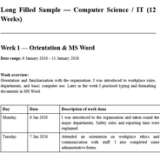
Sample: a normal week
This week I was attached to the network unit. I helped to lay and label LAN cables in a new office, crimped RJ45 connectors with a crimping tool, and tested each cable with a cable tester. I also assisted in configuring a switch under the supervision of the network engineer. I learned the correct wiring order for network cables and how to confirm that a connection works before handing it over.
Sample: first week
This was my first week at [Company Name]. I was introduced to the staff and shown the safety rules of the workplace. I was attached to the [unit], where I observed how daily tasks are handled and was given a tour of the tools and equipment. I learned how the department is organised and what is expected of me during the training.
See also how to fill your logbook for the first week.
Sample: a slow week
Work was slow this week because of a power outage that affected the workshop for two days. During this time I studied the maintenance manual for the generator and observed the technicians servicing it. On the other days I assisted with cleaning and testing the air filters and checking oil levels. I learned the importance of regular maintenance in reducing breakdowns.
Sample: accounting or business student
This week I worked in the accounts department. I helped to sort and file invoices, enter payment records into the spreadsheet and reconcile the petty cash book with the supervisor. I learned how daily transactions are recorded and why accuracy in data entry matters.
Sample: laboratory student
This week I worked in the microbiology laboratory. I prepared culture media, sterilised glassware in the autoclave and helped to streak plates from sample specimens. I learned aseptic technique and the importance of labelling every plate correctly.
Sample: mass communication student
This week I worked in the newsroom. I helped to proofread news scripts, sourced images for two online stories and sat in during an editorial meeting. I learned how stories are selected and edited before they are published.
Mistakes to avoid
- Copying the same summary every week. Supervisors notice.
- One-line summaries like "I worked well".
- Listing days instead of showing progress.
- Writing things you did not do.
- Leaving it blank. An empty summary looks lazy.
How the weekly report helps your final report
Your weekly summaries become the raw material for Chapter Three, your work done chapter. If your summaries are specific, writing the final report is much easier. See the KWASU SIWES report format and how to write a SIWES report.
Drafting them faster
The MonoEd SIWES Logbook takes what you did and turns it into weekly entries and summaries. You still copy them into your official logbook by hand and get your supervisor to sign.
When your training ends, you can connect it to the SIWES Report Generator so your real weeks feed your report draft.
Frequently Asked Questions (FAQs)
What is a SIWES weekly report?
A short summary of your week, usually written at the end of each logbook week. It covers your tasks, the tools you used and what you learned.
How long should it be?
Three to five sentences, in one short paragraph.
Is it different from the logbook?
The logbook has your daily entries and a weekly summary. Some schools or companies also want a separate weekly report. Ask your coordinator what applies to you.
Who signs it?
Your industry-based supervisor, usually every week. Your school supervisor checks it during visits.
Can I write it at the end of the month?
It's better to write it each week while you still remember. Leaving it to the end makes entries vague.
What if I did the same thing all week?
Describe the task, what improved with practice, and what you learned from the repetition.
About the Author
Mohammad-Jamiu B. Balogun, GMNSE
AI Security Researcher · Founder, MonoEd Africa
Mohammad-Jamiu is a First-Class Telecommunications Engineer and Best Graduating Student, BUK '24, and an AI security researcher. He founded MonoEd Africa to give Nigerian students AI-powered academic tools — from SIWES logbooks to final year projects. His work has reached over 10,000 students across Nigeria.