KWASU SIWES Report Format: The 5-Chapter Structure Explained
KWASU SIWES report format explained: the 5-chapter structure, what goes in each chapter, which pages to include and a sample table of contents.

Quick summary:
Kwara State University (KWASU) students write their SIWES report in five chapters: introduction, company profile, work done, equipment used, and a summary with problems and recommendations. There is no dedication page, and the abstract is called a Report Overview. This guide shows what goes in each chapter and gives a sample table of contents.
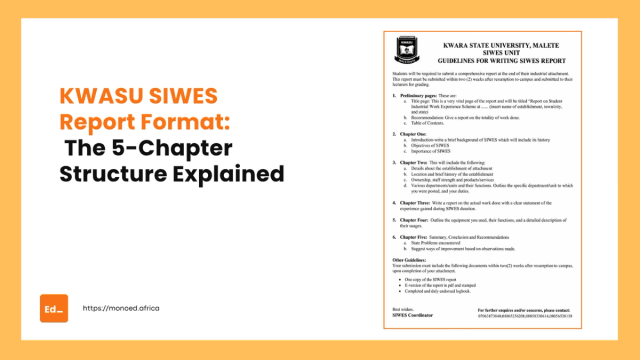
If you are doing SIWES as a Kwara State University (KWASU) student, your report may not look like the four-chapter samples you find online. The KWASU SIWES unit uses a five-chapter structure, and it separates the work you did from the equipment you used.
This guide explains that structure chapter by chapter, which pages to include, and what to write in each section, so you can match your school's format.
Check with your department first. This format follows the KWASU SIWES unit guideline. Some departments add their own requirements, so confirm with your SIWES coordinator or supervisor before you print.
The KWASU SIWES report: A quick look
| Chapter | Title | What it covers |
|---|---|---|
| One | Introduction | Background of SIWES, its aims and objectives |
| Two | Profile of the Organisation | The company, its history, structure and departments |
| Three | Work Done During the Training | The tasks and activities you carried out |
| Four | Equipment Used | The tools and equipment you used, and how you used them |
| Five | Summary, Problems and Recommendations | What you learned, problems you faced and your recommendations |
The main difference from the common four-chapter format is that work done and equipment are in separate chapters. Many online samples put everything into one "Experience Gained" chapter.
Pages to include before Chapter One
Keep the preliminary pages the guideline asks for, and leave out the ones it does not.
- Cover page: your name, matric number, department, school, company and training period
- Certification page: for your supervisors' signatures. SIWES certification guide
- Report Overview: a short summary of your training. KWASU calls this the Report Overview, not the abstract. SIWES abstract guide
- Table of contents
- Acknowledgement: include it if your department expects it. SIWES acknowledgement guide
Leave out the dedication page. Unlike a final-year project, the KWASU SIWES guideline does not ask for one. Adding it will not help you.
Chapter One: Introduction
Chapter One gives the background to SIWES. It is the same in most formats, so you can write it once and reuse the structure.
Typical sections:
- Introduction and background of SIWES
- History of SIWES and the bodies that run it (ITF, NUC and others)
- Aims and objectives of SIWES
- Scope of the report
Keep it factual and keep it short. Your supervisor is looking for your own experience in the later chapters, not a long history lesson.
👉 How to write SIWES Chapter One
Chapter Two: Profile of the Organisation
Describe the company where you trained:
- Name, location and history of the company
- What the company does (its products or services)
- Vision, mission and core values, if the company publishes them
- Organisational structure and an organisational chart
- The departments, and the department you were attached to
The organogram is the part students most often struggle with. Draw it from the company's real structure, and name the department you worked in.
👉 How to draw an organogram for your SIWES report
Chapter Three: Work Done During the Training
This is the heart of your report. Chapter Three records what you actually did, not what the company does.
Write it in the first person, in the past tense, and be specific:
- Group your work by task, project or unit, with a heading for each
- For each one, explain the purpose, the steps you followed and the result
- Say what you did yourself and what you only observed
- Mention the people you worked with by role (for example, "my supervisor, a senior technician")
A weak entry says: "I learned about cable installation."
A strong entry says: "I helped run and terminate cable for a new office, labelling each run and testing it before handover."
If your course is laboratory based, such as Microbiology, write each test as its own subsection: the aim, principle, specimen, materials, procedure and results. This is much easier for a supervisor to read than one long paragraph.
Chapter Four: Equipment Used
This chapter is what makes the KWASU format different. It lists the tools and equipment you used and explains each one, so do not just write a list.
For every item, write three or four sentences covering:
- What it is
- What it does
- How you used it during your training
For example: "The digital multimeter is a handheld instrument that measures voltage, current and resistance. I used it to check supply voltage at distribution boards and to test cables for continuity before installation."
Group items sensibly: by department, by type of work, or as hardware and software. If you used software, include the version and what you used it for.
Chapter Five: Summary, Problems and Recommendations
Chapter Five closes the report. Cover the following in this order:
- Summary: a short recap of the training and what you gained
- Problems encountered: what went wrong or was difficult, such as limited equipment, supervision gaps or long commutes, and how you handled each one
- Conclusion: how the training connects to your course and career
- Recommendations: practical suggestions for the company, your school's SIWES unit and ITF
Be honest and constructive. A recommendation such as "the company should provide more hands-on time with the equipment" is better than "the company should improve."
Sample table of contents
1Cover Page
2Certification
3Report Overview
4Table of Contents
5Acknowledgement
6
7CHAPTER ONE: INTRODUCTION
8  1.1  Introduction
9  1.2  Background of SIWES
10  1.3  Aims and Objectives of SIWES
11  1.4  Scope of the Report
12
13CHAPTER TWO: PROFILE OF THE ORGANISATION
14  2.1  History of the Organisation
15  2.2  Vision and Mission
16  2.3  Organisational Structure
17  2.4  Departments and Functions
18
19CHAPTER THREE: WORK DONE DURING THE TRAINING
20  3.1  Introduction
21  3.2  Tasks and Activities Carried Out
22  3.3  (Your tasks, one subsection each)
23
24CHAPTER FOUR: EQUIPMENT USED
25  4.1  Introduction
26  4.2  Equipment and Tools Used
27  4.3  Skills Acquired
28
29CHAPTER FIVE: SUMMARY, PROBLEMS AND RECOMMENDATIONS
30  5.1  Summary
31  5.2  Problems Encountered and Solutions
32  5.3  Conclusion
33  5.4  Recommendations
34
35References
Rename the sections to suit your department if your supervisor asks for different headings. The five-chapter order should stay the same.
Common mistakes to avoid
- Using a four-chapter sample. If you copy an online sample with four chapters, your equipment will be buried inside the work done and your report won't match the guideline.
- Listing equipment without explaining it. Chapter Four needs a short explanation of each item and how you used it.
- Writing about the company instead of yourself. Chapter Two is about the company. Chapters Three and Four are about you.
- Adding a dedication page. It is not required.
- Vague work descriptions. Specific tasks, steps and outcomes are what supervisors look for.
- Copying logbook entries word for word. Use the logbook as notes, then rewrite them as a proper report.
Write your KWASU report in the right format
If you would rather not format all of this by hand, our SIWES report generator already knows the KWASU layout. Type "Kwara State University" on the create page and it switches to five chapters and leaves out the dedication page for you. You can read Chapters One and Two free before you decide to unlock the rest, and you can still switch pages on or off before you download a print-ready Word or PDF file.
FAQs
How many chapters does a KWASU SIWES report have?
Five. The chapters are Introduction, Profile of the Organisation, Work Done During the Training, Equipment Used, and Summary, Problems and Recommendations.
Does the KWASU SIWES report need a dedication page?
No. The KWASU SIWES guideline does not ask for a dedication. You should include a certification page and a Report Overview.
Is the abstract called a Report Overview at KWASU?
Yes. The guideline uses "Report Overview" for the one-page summary of your training, which most other schools call the abstract.
What is the difference between Chapter Three and Chapter Four?
Chapter Three describes the work you did, task by task. Chapter Four describes the equipment and tools you used, with a short explanation of what each is and how you used it.
Can I use a four-chapter SIWES report sample for KWASU?
You can use it as a guide for Chapters One and Two, but you will need to split the experience chapter into Work Done and Equipment Used, and move the conclusion and recommendations into Chapter Five.
Where do I write the problems I faced during SIWES?
In Chapter Five, together with how you solved each one. Describe each problem briefly, and say what you did about it.
Do all KWASU departments use the same SIWES report format?
The format here follows the KWASU SIWES unit guideline, but some departments add requirements. Confirm with your SIWES coordinator or supervisor before you print.
Can I generate a KWASU SIWES report automatically?
Yes. The MonoEd SIWES report generator switches to the five-chapter layout when you select Kwara State University, and you can preview Chapters One and Two free before unlocking the rest.
About the Author
Mohammad-Jamiu B. Balogun, GMNSE
AI Security Researcher · Founder, MonoEd Africa
Mohammad-Jamiu is a First-Class Telecommunications Engineer and Best Graduating Student, BUK '24, and an AI security researcher. He founded MonoEd Africa to give Nigerian students AI-powered academic tools — from SIWES logbooks to final year projects. His work has reached over 10,000 students across Nigeria.