Al-Hikmah University SIWES Report Format: The 5-Chapter Structure Explained
Al-Hikmah University SIWES report format explained: the 5 chapters, what to write in each, the pages to include, and a sample table of contents.
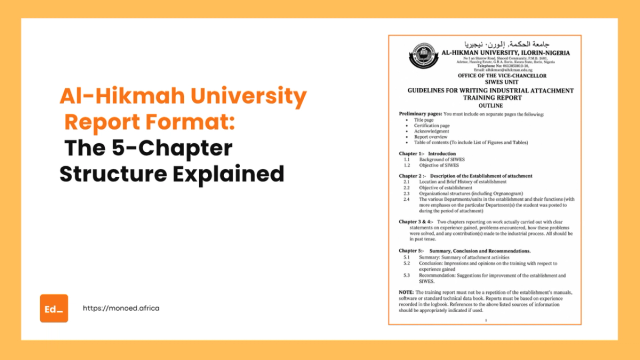
Quick summary:
Al-Hikmah University students write their SIWES report in five chapters: introduction, company profile, work done, experience gained with problems and solutions, and a closing chapter of summary, conclusion and recommendations. The report has a certification page, a Report Overview in place of an abstract, a list of figures and tables, and no dedication page.
If you are doing SIWES as an Al-Hikmah University student, the report you write may not match the four-chapter samples that fill the internet. The SIWES unit uses a five-chapter structure and asks for a few pages that other schools do not.
This guide goes through the format chapter by chapter, shows which pages to include, and gives a sample table of contents, so you can match your school's guideline.
Check with your department first. This format follows the Al-Hikmah SIWES unit's outline. Some departments add their own requirements, so confirm with your SIWES coordinator or supervisor before you print.
The Al-Hikmah SIWES report: A quick look
| Chapter | Title | What it covers |
|---|---|---|
| One | Introduction | Background of SIWES, its aims and objectives |
| Two | Profile of the Organisation | The company, its structure and departments |
| Three | Work Done During the Training | The tasks and activities you carried out |
| Four | Experience Gained, Problems and Solutions | What you learned, and the problems you met and how you solved them |
| Five | Summary, Conclusion and Recommendations | A close to the report, with suggestions |
The key difference from the common four-chapter format is that your training is spread over two chapters. One records the work you did, and the next reflects on what you gained and what went wrong.
Pages to include before Chapter One
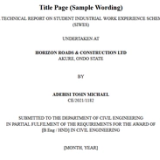
- Cover page: your name, matric number, department, school, company and training period
- Certification page: for your supervisors' signatures. SIWES certification guide
- Report Overview: a one-page summary of your training. At Al-Hikmah this takes the place of the abstract. SIWES abstract guide
- Table of contents
- List of figures and tables: lists every figure and table in the report with its page number. This is the page students forget.
- Acknowledgement: include it if your department expects it. SIWES acknowledgement guide
Leave out the dedication page. The Al-Hikmah outline does not ask for one.
Chapter One: Introduction
Chapter One gives the background to SIWES and is similar in most formats.
Typical sections:
- Introduction and background of SIWES
- History of SIWES and the bodies that run it (ITF, NUC and others)
- Aims and objectives of SIWES
- Scope of the report
Keep it factual and short. The supervisor is looking for your own experience in the chapters that follow.
👉 How to write SIWES Chapter One
Chapter Two: Profile of the Organisation
Describe the company where you trained:
- Name, location and history
- What the company does (its products or services)
- Vision and mission, if the company publishes them
- Organisational structure, with an organisational chart
- The departments, and the one you were attached to
Number the organogram as a figure (for example, Figure 2.1) so it appears in your list of figures.
👉 How to draw an organogram for your SIWES report
Chapter Three: Work Done During the Training
Chapter Three is a record of what you actually did. Write in the first person and the past tense, and be specific.
- Group your work by task, project or unit, with a heading for each
- For each one, explain the purpose, the steps you followed and the result
- Say what you did yourself and what you only observed
- Put photographs, diagrams, tables and results in as numbered figures and tables (Figure 3.1, Table 3.1)
A weak entry says: "I learned how to repair computers."
A strong entry says: "I diagnosed a faulty desktop that would not boot, replaced its power supply, and confirmed it started normally."
If your course is laboratory based, such as Microbiology, write each test as its own subsection: the aim, principle, specimen, materials, procedure and results.
👉 SIWES report for Microbiology students
Chapter Four: Experience Gained, Problems and Solutions
Chapter Four steps back from the daily tasks and answers three questions.
1. What did you gain?
Describe the skills you picked up (technical and personal), the tools or equipment you became comfortable with, and how the training relates to your course.
2. What problems did you face?
Be honest. Typical examples are limited equipment, little supervision, long travel, or a lack of prior knowledge on a task.
3. How did you solve them?
Every problem needs a solution next to it. Write the problem in one sentence, then what you did about it. This pairing is what the guideline is asking for.
Keep the tone positive and practical. A problem you handled well shows initiative.
Chapter Five: Summary, Conclusion and Recommendations
The last chapter closes the report. Cover the following in this order:
- Summary: a short recap of the training period and what you did
- Conclusion: how SIWES prepared you for your course and career
- Recommendations: practical suggestions for the company, the school's SIWES unit and ITF
Make each recommendation specific. "The company should give students more hands-on time with equipment" is better than "the company should improve."
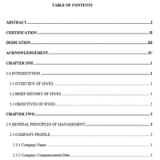
Sample table of contents
1Cover Page
2Certification
3Report Overview
4Table of Contents
5List of Figures and Tables
6Acknowledgement
7
8CHAPTER ONE: INTRODUCTION
9  1.1  Introduction
10  1.2  Background of SIWES
11  1.3  Aims and Objectives of SIWES
12  1.4  Scope of the Report
13
14CHAPTER TWO: PROFILE OF THE ORGANISATION
15  2.1  History of the Organisation
16  2.2  Vision and Mission
17  2.3  Organisational Structure
18  2.4  Departments and Functions
19
20CHAPTER THREE: WORK DONE DURING THE TRAINING
21  3.1  Introduction
22  3.2  Tasks and Activities Carried Out
23  3.3  (Your tasks, one subsection each)
24
25CHAPTER FOUR: EXPERIENCE GAINED, PROBLEMS AND SOLUTIONS
26  4.1  Introduction
27  4.2  Skills and Experience Gained
28  4.3  Relevance to My Course
29  4.4  Problems Encountered and How They Were Solved
30
31CHAPTER FIVE: SUMMARY, CONCLUSION AND RECOMMENDATIONS
32  5.1  Summary
33  5.2  Conclusion
34  5.3  Recommendations
35
36References
Rename the sections to fit your department if your supervisor asks for different headings. Keep the five-chapter order.
Common mistakes to avoid
- Using a four-chapter sample. If you follow an online sample with four chapters, you will end up with one big "experience" chapter and a report that doesn't match the guideline.
- Forgetting the list of figures and tables. If your outline asks for it, add it. Number every figure and table as you write, so the list is easy to build.
- Listing problems without solutions. Chapter Four wants both.
- Adding a dedication page. It isn't part of the outline.
- Copying logbook entries word for word. Use the logbook as notes, then rewrite as a proper report.
- Writing about the company instead of yourself. Chapter Two is about the company. Chapters Three and Four are about you.
Write your Al-Hikmah report in the right format
If you would rather not format all of this by hand, our SIWES report generator already knows this layout. Type "Al-Hikmah University" on the create page and it switches to five chapters, leaves out the dedication page, uses "Report Overview" and adds a numbered list of figures for you. You can read Chapters One and Two free before you decide to unlock the rest, and you can still switch pages on or off before you download a print-ready Word or PDF file.
FAQs
How many chapters does an Al-Hikmah University SIWES report have?
Five. They are Introduction, Profile of the Organisation, Work Done During the Training, Experience Gained with Problems and Solutions, and Summary, Conclusion and Recommendations.
Does the Al-Hikmah SIWES report need a dedication page?
No. The outline does not ask for one. It does ask for a certification page and a Report Overview.
Is the abstract called a Report Overview at Al-Hikmah?
Yes. The Report Overview is the one-page summary of your training that many other schools call the abstract.
Do I need a list of figures and tables?
The Al-Hikmah outline includes one. List every figure and table in your report, including the organogram, with its page number. Number them as you write, such as Figure 2.1 and Table 3.1.
What is the difference between Chapter Three and Chapter Four?
Chapter Three records the work you did, task by task. Chapter Four covers the experience and skills you gained, the problems you faced and how you solved them.
Where do I write the problems I faced during SIWES?
In Chapter Four, with the solution beside each problem.
Can I use a four-chapter SIWES report sample for Al-Hikmah?
You can use it as a guide for Chapters One and Two, but you will need to split the experience chapter in two and move the conclusion and recommendations into Chapter Five.
Can I generate an Al-Hikmah SIWES report automatically?
Yes. The MonoEd SIWES report generator switches to the five-chapter layout when you select Al-Hikmah University, numbers your figures and adds the list of figures. You can preview Chapters One and Two free before unlocking the rest.
About the Author
Mohammad-Jamiu B. Balogun, GMNSE
AI Security Researcher · Founder, MonoEd Africa
Mohammad-Jamiu is a First-Class Telecommunications Engineer and Best Graduating Student, BUK '24, and an AI security researcher. He founded MonoEd Africa to give Nigerian students AI-powered academic tools — from SIWES logbooks to final year projects. His work has reached over 10,000 students across Nigeria.