SIWES Presentation Slides: How to Make Yours (10-Slide Outline)
A simple 10-slide outline for your SIWES defence presentation, what to put on each slide, and how to present in ten minutes without reading.
Quick summary:
A good SIWES presentation has about 10 slides and lasts 8 to 12 minutes: title, introduction, the organisation, its structure, the work you did (two or three slides), skills learned, challenges, recommendations and conclusion. Use pictures from your training, keep each slide to a few short points, and practise until you can talk without reading.
At the end of SIWES, many departments ask you to present your experience in front of lecturers. This is often called the SIWES defence or seminar. Your slides do not need to be fancy. They need to be clear and show that you actually learned something.
The 10-slide outline
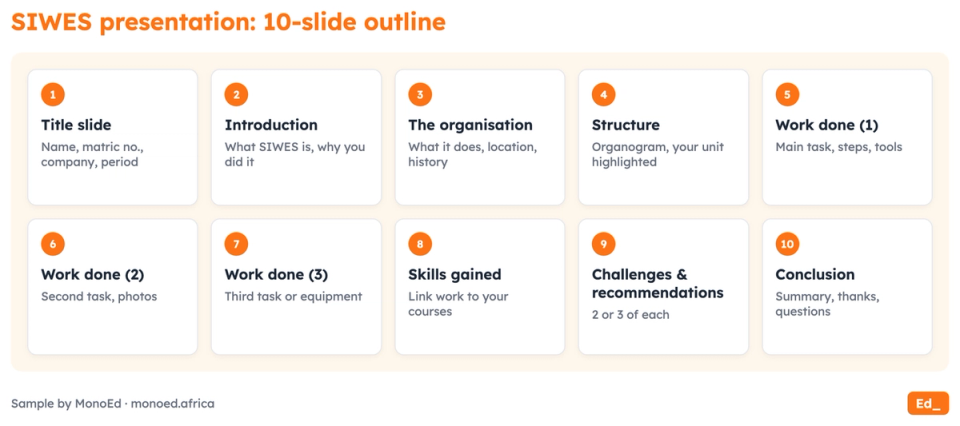
1. Title slide
Your name, matric number, department, the organisation, training period, and your supervisor's name.
2. Introduction
One or two lines on what SIWES is and why you did it. Keep it short, the panel already knows.
3. About the organisation
What the company does, where it is, and when it was established. One picture of the building or logo helps.
4. Organisational structure
A simple organogram. Highlight the unit you worked in. See how to draw a SIWES organogram.
5 to 7. Work done
This is the most important part. Use two or three slides for your main tasks. For each one, show what the task was, how you did it, and the tools or equipment used. Photos of you at work, equipment or screenshots are much better than text.
8. Skills and knowledge gained
Link what you did to your course. For example: "Applied the titration methods from CHM 201 in routine water testing."
9. Challenges and recommendations
Two or three honest challenges and practical recommendations for the company, your school or the ITF.
10. Conclusion and thank you
One line summing up the experience, then thank your supervisors. End with "Questions?"
How much text per slide
- Three to five short points per slide, not full paragraphs.
- Font size 24 or bigger for text, so the back row can read it.
- One idea per slide.
- If you need more words, put them in your speaker notes, not on the slide.
Use pictures from your training
Panels remember what they see. Good images include:
- you working with equipment (ask permission before taking photos at work)
- the inside of a lab, workshop, studio or office
- a screenshot of software you used
- a simple diagram of a process you followed
Do not use photos of confidential documents or anything the company asked you not to share.
Timing
Most panels give 8 to 15 minutes. Plan about one minute per slide and leave time for questions. Practise at least three times with a timer.
How to present without reading
- Read each slide once in your head, then talk about it in your own words.
- Look at the panel, not the screen.
- If you forget, look at the slide title. It should remind you of the point.
- Speak slowly. Nervous students speak fast.
Prepare for questions
The panel will ask about the work you did and how it relates to your course. Prepare short answers to the questions in our SIWES defence questions and answers.
Make the slides from your report
Your presentation should follow your SIWES report, so write the report first. If you have not, the MonoEd SIWES Report Generator turns your logbook notes into a first draft that you can then cut down into slides. See also how to write a SIWES report.
Common mistakes
- Copying whole paragraphs from the report onto slides
- Spending three slides on the history of SIWES and one on your own work
- Low-quality or stretched images
- Dark text on a dark background
- Going over time
Frequently Asked Questions (FAQs)
How many slides should a SIWES presentation have?
About 10 to 15. Fewer than 8 usually looks thin, and more than 15 is hard to finish in time.
Should I use PowerPoint or Google Slides?
Either is fine. Save a PDF copy on a flash drive and on your phone in case the computer at the venue has a different version.
Can I use a template?
Yes. Choose a simple, light template with readable fonts. Avoid busy backgrounds.
What should I wear for the SIWES defence?
Corporate or smart clothes, unless your department says otherwise.
What if I did not do much during SIWES?
Talk honestly about what you did, what you observed and what you learned. Even observation counts if you can explain it clearly.
About the Author
Mohammad-Jamiu B. Balogun, GMNSE
AI Security Researcher · Founder, MonoEd Africa
Mohammad-Jamiu is a First-Class Telecommunications Engineer and Best Graduating Student, BUK '24, and an AI security researcher. He founded MonoEd Africa to give Nigerian students AI-powered academic tools — from SIWES logbooks to final year projects. His work has reached over 10,000 students across Nigeria.